
As manufacturing businesses expand, managing operations through spreadsheets and separate tools often becomes inefficient and harder to control. Inventory mismatches, production delays, and financial errors can quickly create obstacles that hinder business growth.
Implementing an effective ERP system will help manufacturing companies achieve major objectives, such as operational transformation, process visibility, and business success. However, proper solution selection requires thorough planning. If you are wondering how to choose ERP software for manufacturing companies, this guide will help you make an informed decision. Let us dive in!
Understand Your Business Requirements
The first step to selecting vendors is to determine your operational requirements. Every manufacturing company operates with distinct manufacturing processes, which include discrete manufacturing, process manufacturing, and custom job production.
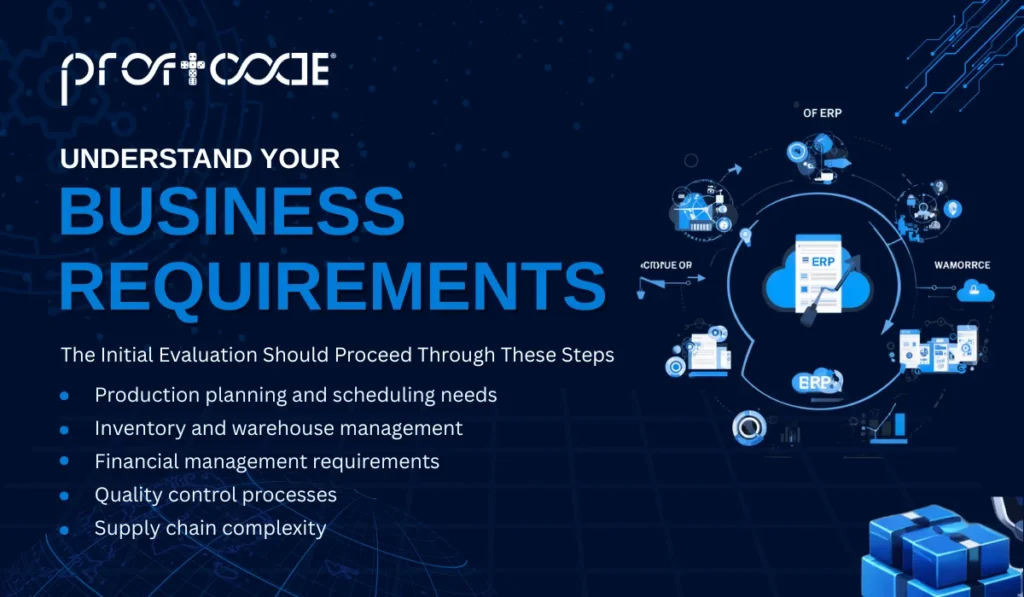
The initial evaluation should proceed through these steps:
- Production planning and scheduling needs
- Inventory and warehouse management
- Supply chain complexity
- Quality control processes
- Financial management requirements
The ERP solution for small businesses must provide multi-department integration capabilities to expand operations without placing excessive work on employees. You should choose the best ERP development system that aligns with existing business processes while supporting future business growth.
Focus on Industry-specific Manufacturing Features
Manufacturing companies need more than basic accounting and inventory systems. A strong ERP for small business manufacturing must include bill of materials management, material requirement planning (MRP), capacity planning, and production scheduling. Material Requirements Planning (MRP) is a structured production planning method widely used in manufacturing, as defined by the Association for Supply Chain Management (ASCM).
The system should provide features that enable companies to monitor inventory levels in real time, track machine usage, and maintain product traceability. Industry-specific manufacturing ERP systems often reduce the need for extensive customisation, which can simplify implementation compared to generic ERP platforms.
Evaluate Scalability and Future Growth
Businesses require technology solutions that should develop together with their business growth. The appropriate manufacturing software for small business manufacturing operations must support their need to handle increased production capacity, manage multiple storage facilities, and their new product offerings.
Cloud-based ERP platforms provide organisations with an optimal solution because they enable users to upgrade and add new users while integrating with emerging technologies such as IoT and automation tools. Companies should always establish their five-year business growth plan.
Consider The Budget and Total Cost of Ownership
Cost goes beyond initial licensing fees. The total investment includes implementation costs, customisation expenses, and system upgrades. An effective ERP system for a small business should provide both affordable pricing and strong operational capabilities.
Calculate the total cost of ownership over a 5- to 7-year period. The manufacturing system requires evaluating subscription-based models and on-premises solutions to determine which option delivers superior long-term value.
Evaluate Ease of Use and Implementation
Implementing ERP systems requires substantial resources to ensure successful execution in small enterprises. Users face difficulties with systems that have complex interfaces because these systems create challenges that make it hard for them to use the system.
The best manufacturing software for a small business should offer:
- Intuitive dashboard interface
- Access control, which depends on the user’s job functions
- Simple tools for generating reports
- Intuitive interface that reduces training time and accelerates user adoption.
The remote access capability of cloud-based solutions enables growing companies to expand their operations while the solutions help decrease their infrastructure expenses. Many ERP software for small businesses offer SaaS models, enabling faster, more affordable software deployment.
Compare Top Vendors and Market Leaders
Research and shortlisted systems are recognised as the best ERP for small manufacturing businesses. The comparison includes their features and pricing models, implementation timelines, and industry reputation.
Request demos and case studies from vendors who specialise in manufacturing. The system demonstrates its performance through real-world examples that show how it works in your specific operating environment. The two factors of vendor support and long-term partnership potential hold equal importance.
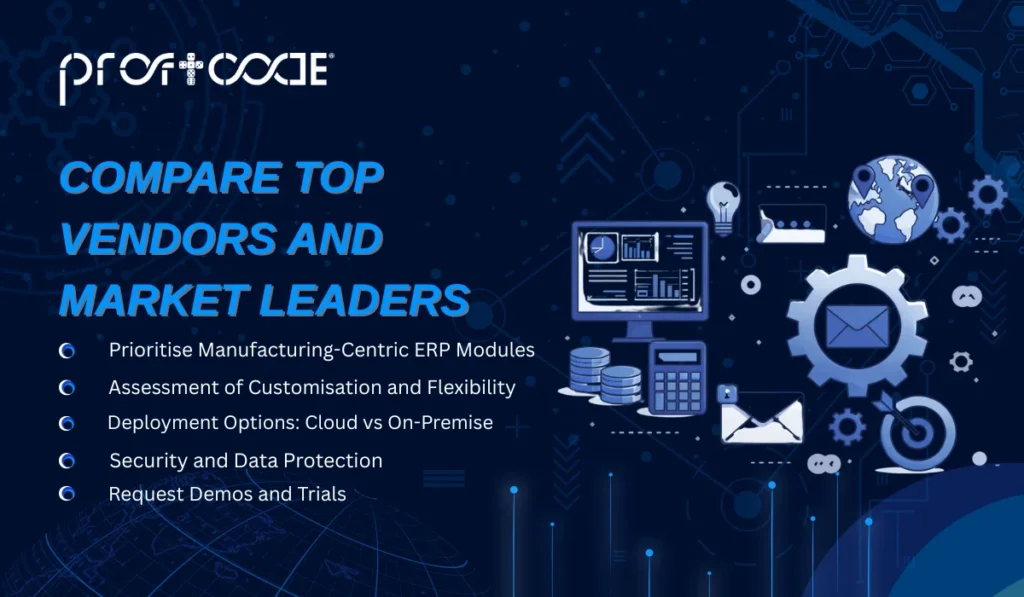
Prioritise Manufacturing-Centric ERP Modules
The ideal small business ERP manufacturing solution should combine inventory control with procurement processes, financial management, and production scheduling into a single system. The system’s integrated modules work to minimise redundant processes while improving decision-making precision.
The system requires advanced features, which include quality management systems, production analytics tools, and compliance tracking capabilities. Your manufacturing business needs these features to sustain efficient operations during periods of business expansion.
Assessment of Customisation and Flexibility
Every manufacturing business has its own operational procedures. When selecting appropriate small manufacturing ERP software, evaluate how well the system can adapt to specific operational requirements without requiring extensive programming or high expense for a customised solution.
ERP systems with flexible design enable users to change workflows, build custom dashboards, and create their own reporting systems. The system maintains its current value because your organisation continues to grow.
Deployment Options: Cloud vs On-Premise
Businesses today select cloud solutions because they offer greater flexibility and enable remote work. Some manufacturers continue to use on-premise deployment because they prefer to maintain control over their data. Selecting the right manufacturing ERP software for small business operations requires assessing both your IT infrastructure and security requirements.
Cloud ERP systems for business growth help to deploy their systems within shorter timeframes while needing to spend less money at the beginning and receiving automatic system updates. Organisations that use on-premise systems obtain advanced customisation features that require them to allocate internal IT personnel for system maintenance tasks.
Security and Data Protection
Data security has become essential for contemporary manufacturing operations. The perfect ERP system for small manufacturing businesses needs to deliver essential security features such as strong encryption and secure cloud hosting services.
The organisation needs to confirm its adherence to industry standards while establishing its backup and disaster recovery protocols. The company must maintain protection for its production data and financial records, as these assets require mandatory security measures.
Request Demos and Trials
You need to request live demonstrations and trial products before you make your final decision. The evaluation process requires testing from department leaders in the production, finance, procurement, and sales departments.
The testing process helps assess whether the system successfully fulfills your business requirements. The selection process requires this step because actual testing uncovers business software limitations that marketing materials fail to disclose.
To Sum Up
Choosing an appropriate ERP system is a strategic decision that enhances operational efficiency and business expansion capabilities while supporting continuous development in your manufacturing company. Your business needs to select a solution that matches its current operations and upcoming objectives.
If you’re looking for a scalable ERP solution tailored to manufacturing needs, Proftcode offers customizable systems designed to improve operational efficiency and productivity. Get in touch with Proftcode to get an ideal ERP solution for your business!