
In today’s fast-paced digital economy, businesses must manage multiple processes simultaneously—finance, human resources, sales, inventory, and customer relationships. Handling these operations with separate systems often leads to inefficiencies, errors, and poor data visibility.
This is where ERP Development Services come into play. ERP (Enterprise Resource Planning) systems integrate different business functions into a single centralized platform, enabling organizations to streamline operations, improve productivity, and make data-driven decisions.
Companies across the USA, UK, and UAE are increasingly investing in ERP Software Development Services to modernize their operations and remain competitive in the global market. Whether it is a startup seeking scalability or an enterprise aiming for automation, ERP solutions help organizations optimize their workflows and improve efficiency.
This guide explains everything businesses need to know about ERP development, including why companies need it, how ERP systems are developed, their key features, benefits, challenges, and why choosing the right development partner like Proftcode Private Limited is essential.
ERP Development Services: Explained
ERP Development Services involve designing, developing, customizing, implementing, and maintaining enterprise resource planning systems that integrate core business processes into one unified platform.
Instead of using separate tools for accounting, HR, CRM, inventory management, and operations, an ERP system connects all these functions into a single system with a shared database.
Businesses can choose from different ERP approaches, including:
- Custom ERP Development Services – Tailor-made ERP solutions built specifically for an organization’s processes.
- Odoo ERP Development Services – ERP systems built using the Odoo framework, known for flexibility and modular architecture.
- Cloud ERP Solutions – ERP systems hosted on the cloud for accessibility and scalability.
- Enterprise ERP Systems – Large-scale ERP platforms designed for multinational businesses.
The goal of ERP development is to create a system that improves efficiency, reduces operational costs, and enhances collaboration across departments.
Why Do Businesses Need ERP Development Services?
Organizations in developed economies, such as the USA, the UK, and the UAE, operate in highly competitive environments where efficiency and automation are crucial.
Here are the main reasons businesses invest in ERP Software Development Services:
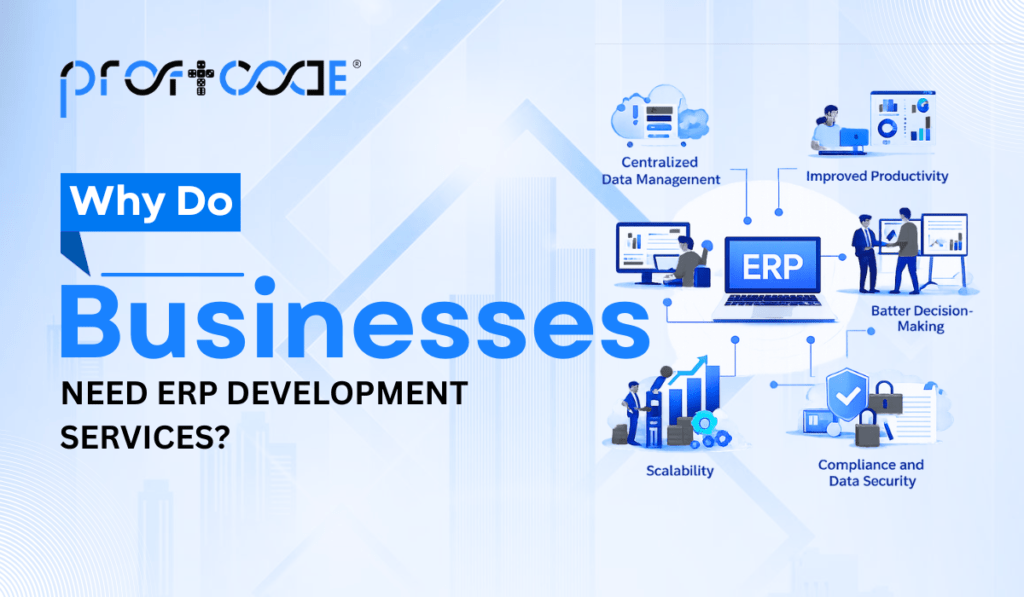
1. Centralized Data Management: ERP systems centralize business data in one location, allowing teams to access real-time information across departments.
2. Improved Productivity: By automating repetitive tasks, ERP systems reduce manual workload and allow employees to focus on strategic work.
3. Better Decision-Making: ERP platforms provide detailed analytics and reporting tools, enabling leaders to make informed decisions.
4. Business Process Integration: ERP integrates departments such as finance, HR, sales, and supply chain, ensuring smooth collaboration.
5. Scalability: Growing companies require systems that can expand with their operations. ERP systems provide the flexibility to scale.
6. Compliance and Data Security: Businesses in countries like the UK and UAE must comply with strict data regulations. ERP systems help maintain compliance and secure business data.
How ERP Software Development Works?
Developing an ERP system requires a structured process to ensure that the final product aligns with business requirements.
1. Business Requirement Analysis: The development team analyzes the company’s processes, workflows, and operational challenges to determine system requirements.
2. System Architecture Design: Developers create a system architecture that defines how modules, databases, and integrations will function.
3. ERP Development: The ERP system is built using modern technologies and frameworks. Companies may choose Custom ERP Development Services or platforms like Odoo ERP Development Services.
4. Integration: ERP systems often integrate with existing tools such as CRM platforms, payment systems, or e-commerce platforms.
5. Testing and Quality Assurance: Developers conduct rigorous testing to ensure the system performs reliably without errors.
6. Deployment and Training: After testing, the ERP system is deployed, and employees are trained to use it effectively.
7. Maintenance and Support: ERP systems require continuous monitoring, updates, and improvements.
Key Features of ERP Systems:
A modern ERP system provides powerful capabilities that help businesses streamline operations, improve collaboration, and gain real-time insights across departments. Below are the most important features offered by ERP Development Services.
1. Advanced Financial Management: ERP systems centralize financial operations, enabling accurate tracking of income, expenses, invoices, taxes, budgeting, forecasting, and real-time financial reporting.
2. Intelligent Inventory and Supply Chain Management: ERP systems monitor inventory levels, manage warehouses, track shipments, optimize procurement processes, and ensure efficient supply chain coordination across departments.
3. Comprehensive Human Resource Management: ERP HR modules manage employee records, payroll processing, attendance tracking, recruitment workflows, performance evaluations, and workforce planning efficiently.
4. Integrated Customer Relationship Management (CRM): ERP-integrated CRM systems track customer interactions, manage sales pipelines, automate communication, improve service quality, and strengthen long-term customer relationships.
5. Real-Time Analytics and Business Intelligence: ERP platforms provide dashboards, reporting tools, and analytics that deliver real-time insights for informed decision-making and strategic business planning.
6. Automated Workflow and Process Optimization: ERP systems automate repetitive tasks, streamline approvals, reduce manual errors, improve operational efficiency, and enhance productivity across departments.
7. Cloud Accessibility and Remote Collaboration: Cloud-based ERP systems allow secure access from anywhere, enabling teams to collaborate remotely while maintaining real-time data synchronization.
8. Seamless Integration with Business Applications: Custom ERP systems integrate easily with CRM platforms, accounting software, e-commerce tools, payment gateways, and other essential business applications.
9. Customization and Scalability: ERP solutions offer flexible customization options and scalable architecture, allowing businesses to add modules, features, and integrations as operations grow.
Importance of ERP Development for Global Businesses:
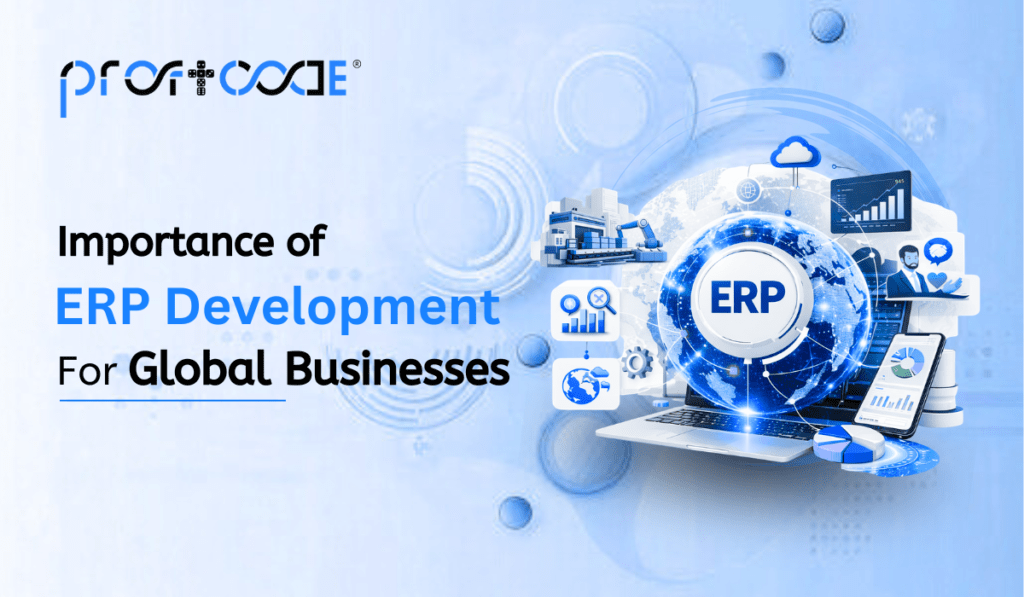
ERP systems have become a critical component for organizations that want to operate efficiently, scale globally, and maintain a competitive advantage in international markets.
1. Enhanced Operational Efficiency: ERP systems automate core business processes, integrate departments, eliminate redundant tasks, streamline workflows, and significantly improve organizational productivity and operational efficiency.
2. Greater Data Transparency and Accuracy: ERP systems centralize business data, providing real-time visibility across departments, improving accuracy, collaboration, reporting consistency, and strategic decision-making capabilities.
3. Improved Customer Experience and Relationship Management: Integrated CRM within ERP enables businesses to track customer interactions, manage sales pipelines, deliver faster support, and improve satisfaction.
4. Support for Global Business Expansion: ERP solutions help organizations manage multi-location operations, multi-currency transactions, international compliance, and regulatory requirements across global markets including USA, UK, UAE.
5. Long-Term Cost Optimization: ERP automation reduces manual work, operational errors, resource wastage, and administrative costs while improving overall efficiency, productivity, and long-term business profitability.
Ways to Implement ERP Development:
Businesses can implement ERP systems through different approaches depending on their operational requirements, budget, scalability needs, and technological infrastructure.
1. Custom ERP Development: Custom ERP Development Services create tailored ERP systems designed around unique business workflows, ensuring flexibility, scalability, seamless integration, and optimized operational efficiency.
2. Odoo ERP Development: Odoo ERP Development Services provide modular, flexible ERP solutions with applications for finance, HR, CRM, and inventory management for scalable business growth.
3. Cloud-Based ERP Solutions: Cloud-based ERP solutions allow businesses to access systems remotely, reduce infrastructure costs, improve scalability, and enhance collaboration across distributed teams.
4. Hybrid ERP Solutions: Hybrid ERP solutions combine on-premise control with cloud scalability, enabling businesses to maintain data security while benefiting from remote accessibility.
Challenges in ERP Development:
While ERP systems offer significant advantages, organizations may face several technical and operational challenges during development and implementation.
1. High Initial Investment: Implementing ERP solutions requires substantial upfront investment in development, infrastructure, software licensing, system integration, and long-term maintenance resources.
2. Complex Implementation: Integrating ERP systems with existing workflows, legacy systems, and databases can be technically complex and requires careful planning and expertise.
3. Employee Training and Adoption: Employees often require proper training and onboarding to effectively understand ERP functionalities, adapt to new workflows, and utilize the system efficiently.
4. Data Migration and Management Issues: Migrating large volumes of data from legacy systems to new ERP platforms requires careful validation, cleansing, and secure data transfer processes.
5. Customization and System Complexity: Excessive customization during ERP development may increase system complexity, development time, maintenance challenges, and overall implementation costs.
Why Choose Proftcode for ERP Development Services?
Selecting the right development partner is crucial for successful ERP implementation. Proftcode offers reliable and scalable ERP Software Development Services tailored for businesses worldwide.
1. Custom ERP Solutions: Proftcode specializes in Custom ERP Development Services designed to match unique business requirements.
2. Expertise in Odoo ERP: The company provides professional Odoo ERP Development Services, helping businesses implement flexible and scalable ERP systems.
3. Global Market Understanding: Proftcode develops ERP systems suitable for businesses operating in markets like the USA, UK, and UAE.
4. Scalable Technology: ERP solutions are built using modern technologies that allow businesses to scale operations easily.
5. Seamless Integration: Proftcode ensures ERP systems integrate smoothly with existing tools and business applications.
6. Dedicated Support: The company offers continuous support, maintenance, and system upgrades.
With a focus on innovation and efficiency, Proftcode helps businesses transform their operations through advanced ERP solutions.
End of line
ERP systems have become a fundamental component of modern business infrastructure. By integrating core business functions into a unified system, ERP Development Services help organizations streamline operations, improve productivity, and enhance decision-making.
Businesses in regions such as the USA, UK, and UAE are increasingly adopting ERP Software Development Services to remain competitive and achieve operational excellence.
Whether it is through Custom ERP Development Services tailored to specific business needs or flexible solutions like Odoo ERP Development Services, implementing the right ERP system can significantly improve business performance.
Choosing an experienced development partner like Proftcode ensures businesses receive reliable, scalable, and efficient ERP solutions that support long-term growth.
Frequently Asked Questions (FAQs)
1. What are ERP Development Services?
ERP Development Services involve designing, developing, customizing, and implementing ERP systems that integrate multiple business processes into a single platform.
2. What is the difference between ERP and CRM?
ERP manages internal business processes such as finance, HR, and inventory, while CRM focuses on managing customer relationships and sales activities.
3. What are Odoo ERP Development Services?
Odoo ERP Development Services involve building ERP systems using the Odoo framework, which provides modular applications for business management.
4. How long does ERP development take?
The development timeline depends on the complexity of the system. A basic ERP solution may take 3–6 months, while advanced enterprise systems may take longer.
5. What industries benefit from ERP systems?
ERP systems are widely used in manufacturing, healthcare, retail, logistics, finance, and IT services.