
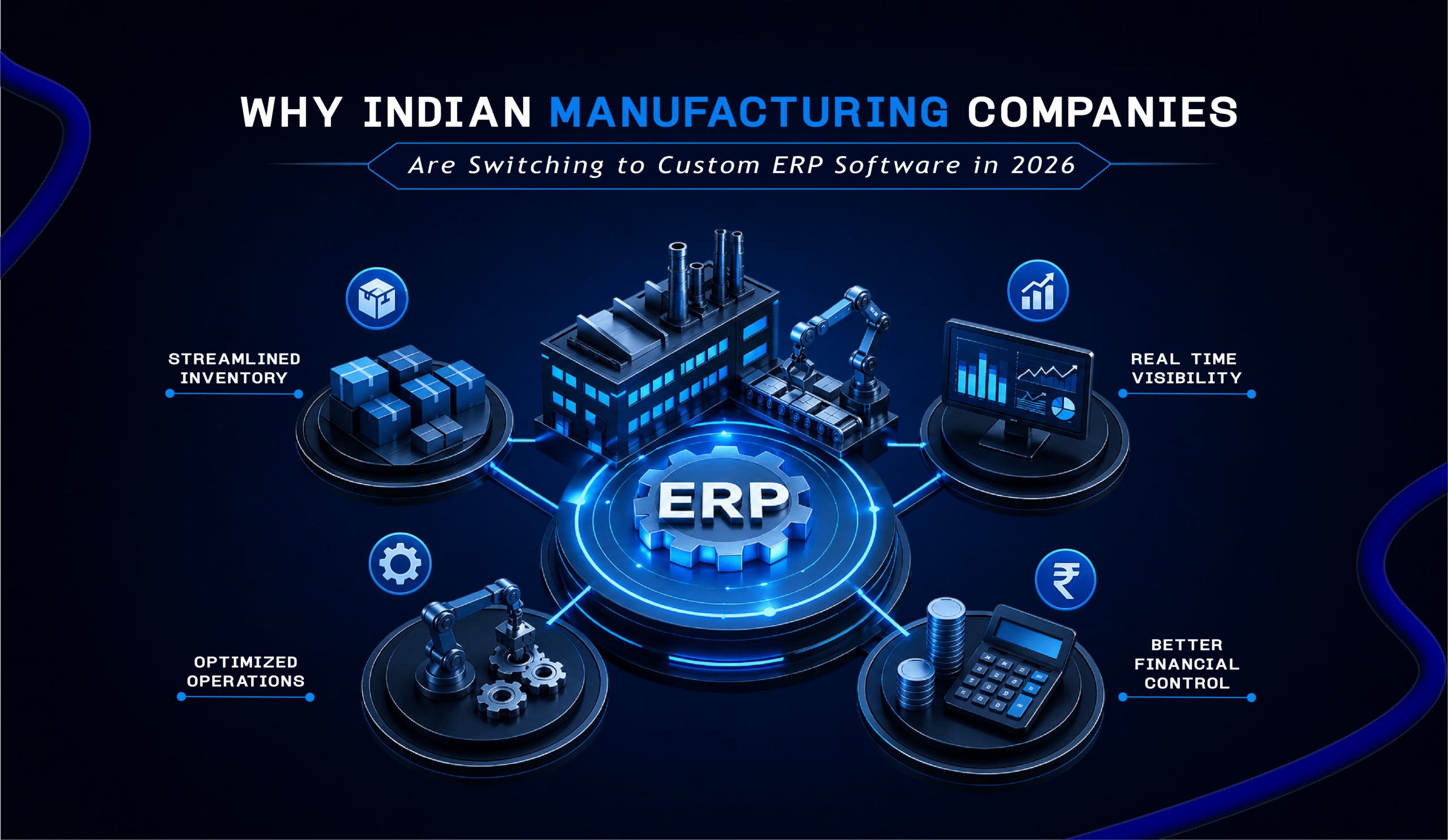
Picture a mid-sized textile manufacturer in Surat running SAP Business One and paying Rs. 8 lakh every year in subscription fees. You would expect their operations to be smooth and fully digital by now. But their shop floor data still goes into Excel. GST filing takes three days every month. Their production planner still calls suppliers on WhatsApp because the system simply does not support how their business actually works. This is not one company’s problem. This is the everyday reality of thousands of Indian manufacturers who invested in custom ERP software for Indian manufacturing companies, only to find that the tool was never really built for them.
In 2026, a growing number of Indian manufacturers are walking away from off-the-shelf ERP subscriptions and investing in custom-built ERP software that actually mirrors their factory, their workflows, and India’s ERP compliance requirements. India’s ERP market for manufacturing is growing fast, but custom development is now outpacing SaaS adoption in the MSME segment. This blog explains exactly why this shift is happening and whether your manufacturing business should make the same move.
Why Generic ERP Software Is Failing Indian Manufacturing Companies
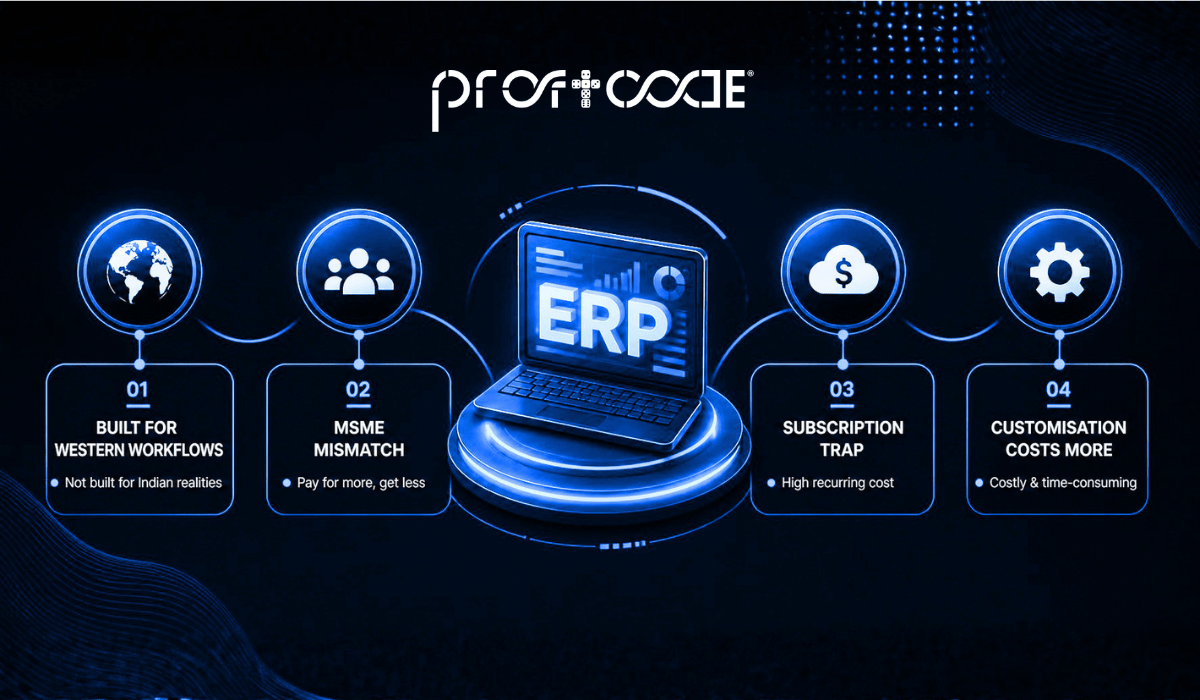
Most of the popular ERP software for manufacturing available today was designed for Western manufacturing environments. Tools like SAP, Oracle, and Microsoft Dynamics were built around Western tax systems, Western supply chains, and Western regulatory frameworks. When Indian manufacturers try to run their business on these systems, the result is always the same: expensive workarounds, frustrated teams, and a system that nobody fully trusts.
Built for Western Workflows, Not Indian Realities
Global ERP tools were never designed with India in mind. Every India-specific feature requires separate and expensive customisation, making “ready-made” anything but ready.
- They do not natively support GST multi-slab compliance
- They do not support e-invoicing mandates under GSTN
- They do not support TDS and TCS deduction workflows
- They do not support multiple state GSTIN management for multi-plant manufacturers
The MSME Mismatch Problem
India has over 63 million MSMEs that form the backbone of its manufacturing sector, yet the most widely used ERP platforms are built for enterprises with 500-plus employees. The result is a painful mismatch.
- MSMEs end up paying for 80% of features they never use
- The 20% they actually need, such as regional language support, informal vendor management, and cash transaction tracking, is missing
- Enterprise complexity creates confusion on the shop floor instead of clarity
The Subscription Trap
SaaS ERP costs between Rs. 1,000 and Rs. 15,000 per user per month. For a 25-person factory team, that is Rs. 3 lakh to Rs. 45 lakh spent every single year with nothing to show in terms of ownership.
- No ownership and no control over the software
- Vendor can change pricing, discontinue modules, or shut down at any time
- All manufacturing data sits on the vendor’s server, not the manufacturer’s own infrastructure
Customisation Costs More Than Building From Scratch
Most Indian manufacturers eventually end up customising their off-the-shelf ERP anyway because the standard version does not work for them. Customisation on SAP or Oracle costs Rs. 5 lakh to Rs. 20 lakh per module. After paying for all of that customisation, the manufacturer still pays a monthly subscription fee. The logic becomes simple: if you are going to pay for customisation, why not build exactly what you need from the ground up?
What Is Custom ERP Software & How Is It Different from SAP or Zoho?
Custom ERP is neither a template nor a subscription. It is software built specifically for your factory’s workflows, processes, products, and team. Think of it as a bespoke suit versus a readymade shirt from a mall. Both cover you. Only one fits perfectly. Unlike generic ERP software for the manufacturing industry, a custom-built system does not ask you to change how your business works to fit the software. The software is built to fit your business.
What Custom ERP Includes for Indian Manufacturers
|
Module |
What It Does for Indian Manufacturers |
|
Production Planning |
MRP, BOM, work orders tailored to your product line |
|
Inventory Management |
Real-time stock across multiple warehouses and plants |
|
Purchase and Vendor Management |
Supports informal vendors, advance payments, and regional suppliers |
|
Sales and Dispatch |
Integrates with transporters, generates e-way bills |
|
Quality Control |
Custom QC checklists per product category |
|
GST and Finance |
Auto-calculates GST slabs, generates GSTR-1 and GSTR-3B |
|
HR and Payroll |
Factory worker payroll, PF, ESIC compliance |
|
Shop Floor Management |
Real-time production tracking per machine and operator |
|
Mobile Access |
Works on Android for floor supervisors |
|
Reporting Dashboard |
A business owner sees live factory performance from anywhere |
Who Custom ERP Is Built For
- Indian manufacturers with 20 to 500 employees
- Businesses that have outgrown Excel and Tally but find SAP too complex and expensive
- Companies in textiles, food processing, auto parts, pharmaceuticals, furniture, garments, and FMCG
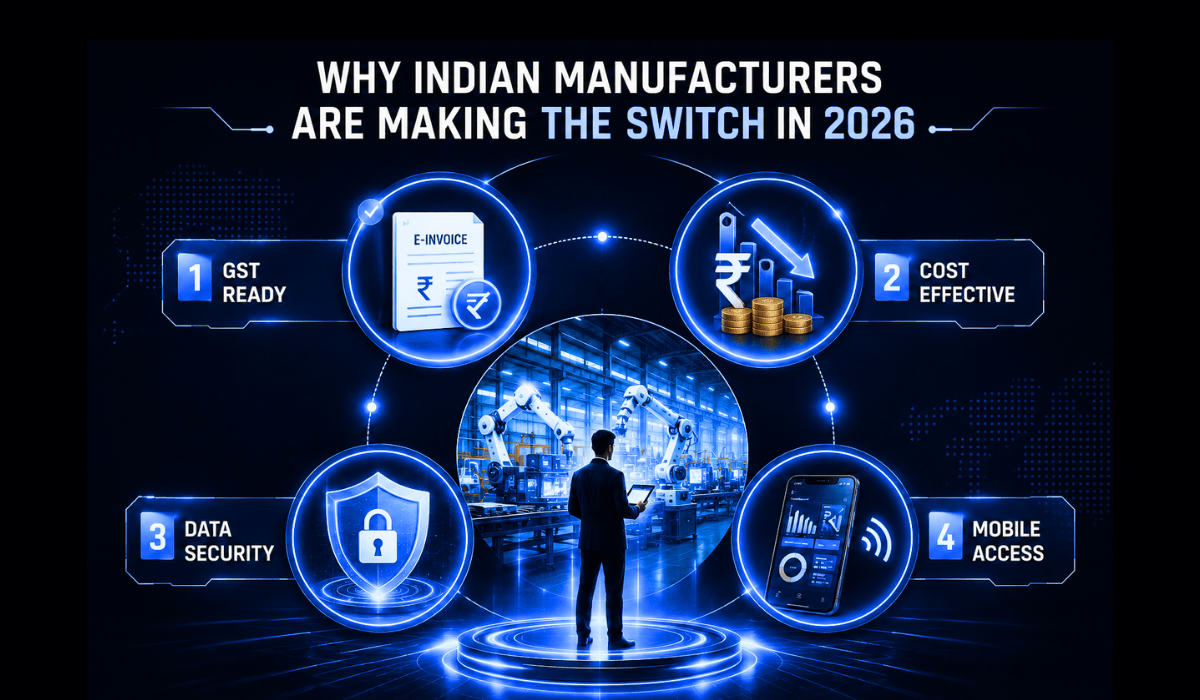
Why Indian Manufacturers Are Making the Switch in 2026
This shift is not happening by accident. There are clear, practical reasons why Indian manufacturers are choosing to invest in the best ERP software for the manufacturing industry, built specifically for their needs, rather than continuing to pay for systems that were never designed for them. As per the EY India Manufacturing Report, 68% of Indian SME manufacturers still rely on manual or semi-digital processes, and the reason is straightforward: the tools available were never built for them.
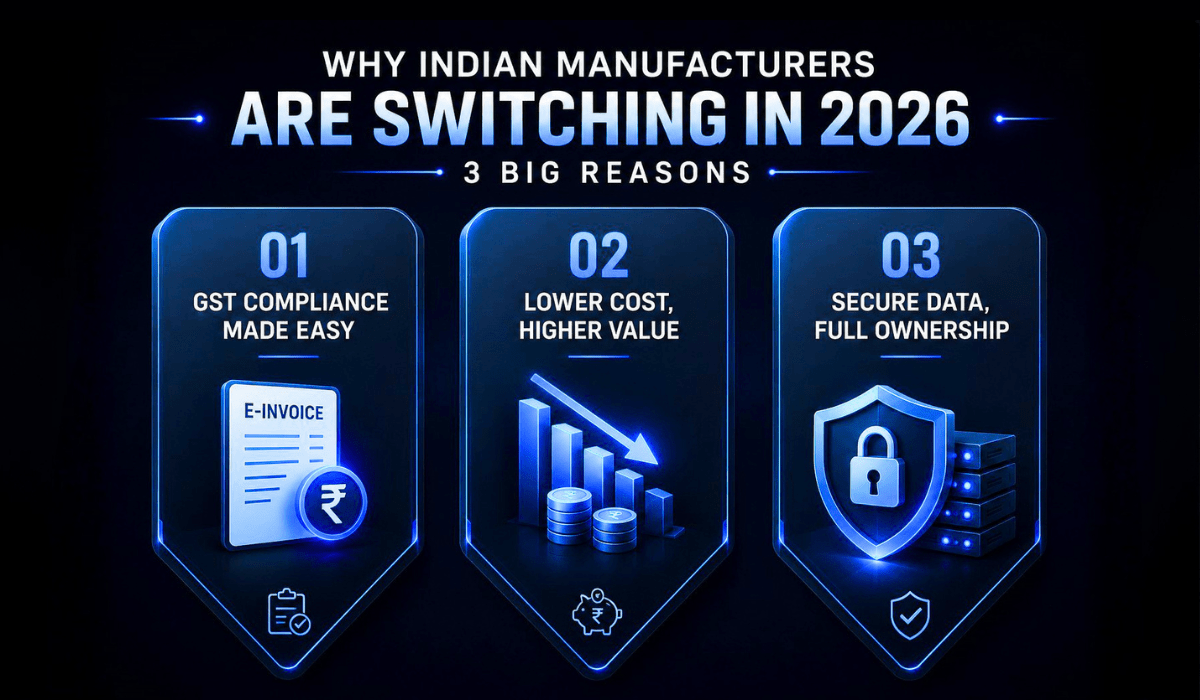
Reason 1: GST 2.0 and E-Invoicing Compliance Is Getting More Complex
India’s tax compliance requirements have grown every year since GST was introduced in 2017. Generic ERP platforms simply cannot keep pace with these India-specific updates.
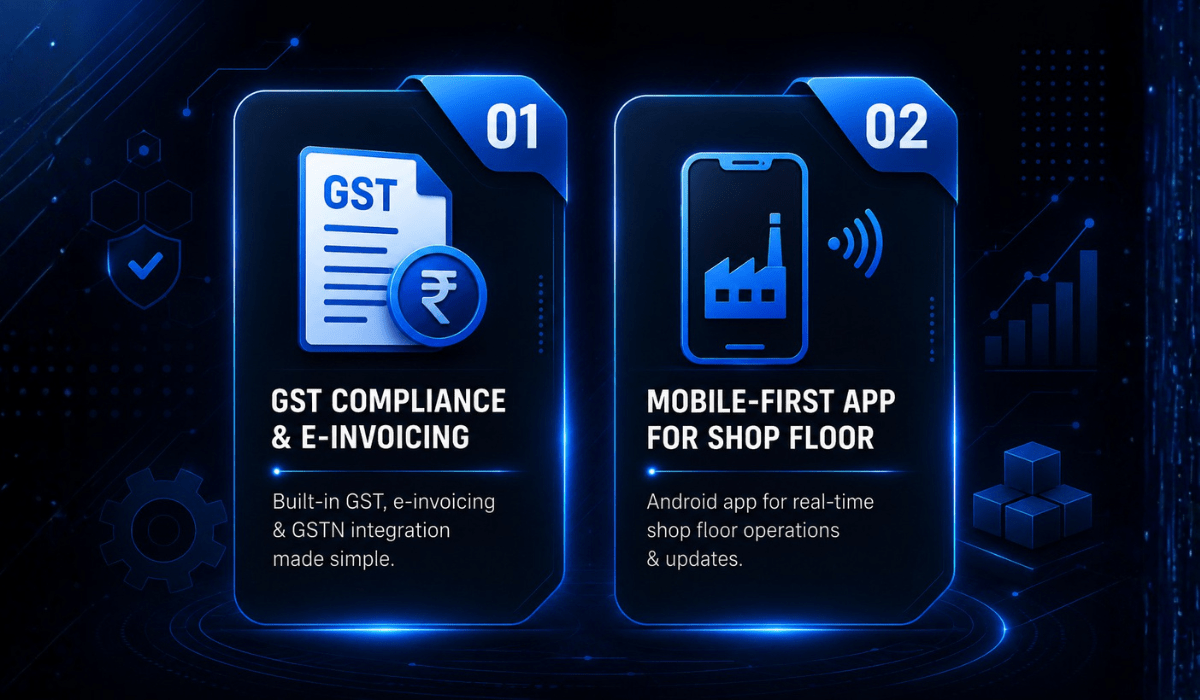
- In 2025-26, the e-invoicing threshold was lowered to Rs. 5 crore turnover, bringing thousands more manufacturers under its scope
- Generic ERP tools struggle to keep pace with India-specific GST updates every year
- A custom ERP is built with India’s tax structure as the foundation, not as an afterthought
- Auto-generation of IRN (Invoice Reference Number) directly from within the ERP, no manual steps required
Reason 2: Indian Manufacturing Workflows Are Unique
No global ERP was designed keeping Indian manufacturing practices in mind. The way Indian factories actually operate is genuinely different from what global software assumes.
- Multiple informal vendor relationships and cash advance payments to suppliers
- Job work arrangements where parts of production are outsourced to contract manufacturers under GST rules
- Multi-location inventory spread across rented godowns
- Seasonal production cycles, especially in the food, garments, and agriculture sectors
- Custom ERP handles all of these natively without any patching or workarounds
Reason 3: The 5-Year Cost Makes Custom ERP the Smarter Investment
When manufacturers look at the full picture over five years, the numbers tell a clear story.
|
Cost Factor |
SaaS ERP (Zoho/SAP) |
Custom ERP |
|
Year 1 |
Rs. 3 to 8 lakh |
Rs. 5 to 15 lakh (one-time) |
|
Year 2 |
Rs. 3 to 8 lakh |
Only AMC at ~15% |
|
Year 3 |
Rs. 3 to 8 lakh |
Only AMC |
|
Year 4 |
Rs. 3 to 8 lakh |
Only AMC |
|
Year 5 |
Rs. 3 to 8 lakh |
Only AMC |
|
5-Year Total |
Rs. 15 to 40 lakh |
Rs. 6 to 18 lakh |
|
Ownership |
Never yours |
100% yours |
Custom ERP becomes cheaper from Year 3 onwards, and the manufacturer owns it outright forever.
Reason 4: Data Security and Ownership Is Non-Negotiable
India’s Digital Personal Data Protection Act 2023 has created real obligations around how manufacturing data is stored and managed. Manufacturers can no longer treat this casually.
- Production formulas, supplier pricing, and customer order data are sensitive intellectual property
- SaaS ERP stores all of this on vendor servers, often located outside India
- A custom ERP is deployed on the manufacturer’s own server or their own private cloud instance
- Full data ownership and control remain with the manufacturer at all times
Reason 5: Mobile-First Factory Floor Management
India’s factory supervisors and workers use Android smartphones. This is the ground reality of Indian shop floors today.
- Most off-the-shelf ERP platforms have poor mobile apps or charge extra for mobile access
- Custom ERP is built mobile-first from day one
- Shop floor attendance, production updates, and quality checks all happen through an Android app
- Factory owners get live visibility into their operations from their phone, from anywhere in India
Reason 6: Integration with India-Specific Systems
Custom ERP software for manufacturing industries can be built to connect directly with the systems Indian manufacturers actually use every day.
- GSTN portal for auto-filing of returns
- Tally for companies already using it for accounts, eliminating double entry
- WhatsApp Business API for vendor and customer communication
- Aadhaar and biometric systems for worker attendance
- EPFO portal for PF compliance
- E-way Bill portal for logistics and dispatch compliance
Off-the-shelf ERP requires expensive third-party connectors for all of these when those connectors exist at all.
Reason 7: Competitive Advantage Through a Proprietary System
India’s manufacturing sector is becoming more competitive every year. The companies that will win are the ones that build operational systems their competitors cannot replicate.
- A Jaipur handicraft exporter with a custom ERP tracking design-to-dispatch has an edge that no Excel-running competitor can match
- Proprietary operational systems become a business moat that grows stronger over time
- Your ERP is a competitive asset. Someone else’s SaaS subscription is not.
Which Indian Manufacturing Industries Are Switching to Custom ERP?
The move toward custom ERP is not limited to one sector. Across India’s manufacturing landscape, businesses with very specific operational and compliance needs are leading this shift because they are the ones who feel the gap most painfully when using generic tools.
Textile and Apparel Manufacturing
India’s textile industry is worth Rs. 11 lakh crore and has some of the most specific ERP requirements of any sector. Apparel manufacturing ERP software built for this industry looks very different from a generic tool.
- Style-Colour-Size matrix management for product variants
- TNA calendars for tracking production milestones
- Fabric costing and consumption tracking
- Job work management under the Indian GST rules
- Manufacturers in Tirupur, Surat, and Jaipur need all of this built in by default
Food and FMCG Manufacturing
India’s food processing sector is the world’s fifth largest and is growing at 11% CAGR. Food manufacturing ERP software for this industry must go beyond basic inventory and production tracking.
- FSSAI compliance documentation as a core module
- Batch traceability from raw material to finished product
- Expiry date tracking across warehouses
- Recipe management and costing for food products
Auto Parts and Engineering
India is a global auto parts hub with major clusters in Pune, Chennai, and Gurgaon. Precision manufacturing here demands far more than standard ERP features.
- MES integration with ERP for machine-level production tracking
- OEM-specific quality documentation and audit trails
- Buyer-specific labelling requirements
- Tooling and fixture management
Pharmaceutical Manufacturing
Pharma manufacturing in India operates under strict regulatory oversight, and custom ERP is often the only way to meet those requirements efficiently.
- GMP compliance is built into every production step
- Batch records and CoA (Certificate of Analysis) management
- Stability testing logs and documentation
- CDSCO audit trail requirements built natively
Furniture and Handicrafts
Manufacturing hubs like Jaipur, Jodhpur, Moradabad, and Rajkot have unique ERP requirements because handcrafted production does not work the same way as industrial manufacturing.
- BOM management for handcrafted items with variable material consumption
- SKU-level costing for custom orders
- Export documentation for furniture manufacturers selling to EU and USA buyers
How to Choose the Right Custom ERP Development Company for Your Manufacturing Business
Not every software company that claims to build ERP has actually built one for a factory floor. Choosing the wrong development partner is one of the most expensive mistakes a manufacturer can make, because a failed ERP implementation does not just waste money, it disrupts production. Here is what to check before signing anything.
8 Things to Verify Before Hiring
|
# |
What to Check |
Why It Matters |
|
1 |
Manufacturing industry experience |
Generic IT companies build a generic ERP. You need someone who understands your production floor |
|
2 |
India-specific compliance built in |
GST, e-invoicing, EPFO, FSSAI. Ask which ones are native, not add-ons |
|
3 |
Mobile app included |
Floor supervisors need an Android app, not just desktop software |
|
4 |
Source code ownership |
You must own the source code outright. Never let a vendor retain it |
|
5 |
Post-launch support SLA |
ERP issues stop production. A 24-hour response SLA is the minimum |
|
6 |
Integration capability |
Ask what they have already integrated: Tally, WhatsApp, GSTN, biometric |
|
7 |
Live client references |
Ask for 2 to 3 manufacturing clients you can call directly |
|
8 |
Phased implementation plan |
Good vendors start with core modules, not everything at once |
Red Flags to Avoid
- Companies that start development before fully documenting their requirements
- Vendors who do not offer source code ownership to the client
- Agencies quoting suspiciously low prices, a full manufacturing ERP for Rs. 50,000, is a warning sign, not a deal
- No dedicated project manager assigned to your implementation
How Proftcode Builds Custom ERP Software for Indian Manufacturing Companies
Proftcode offers end-to-end custom ERP development for Indian manufacturers, from requirement gathering all the way to go-live and ongoing support. Every module is built from the ground up for Indian manufacturing workflows, not adapted from a Western template.
- Manufacturing-specific modules designed around how Indian factories actually operate
- GST compliance, e-invoicing, and GSTN integration built natively, not as add-ons
- Mobile-first Android app for shop floor supervisors included as standard
- On-premise or private cloud deployment, so the manufacturer’s data stays on their own infrastructure
- Phased implementation starting with 2 to 3 core modules, expanding over time
- Post-launch dedicated account manager with SLA-backed response

Proftcode's Manufacturing ERP Implementation Process
|
Step |
Phase |
What Happens |
|
1 |
Discovery |
Process audit, workflow mapping, and requirement documentation |
|
2 |
Design |
UI/UX wireframes, database architecture, module planning |
|
3 |
Development |
Agile sprints, weekly demos, client feedback cycles |
|
4 |
Testing |
QA on all modules, user acceptance testing with your team |
|
5 |
Go-Live |
Phased rollout starting with the highest-priority modules |
|
6 |
Training |
On-site training for all user roles: admin, accounts, store, production, sales |
|
7 |
Support |
Ongoing AMC with priority support and a dedicated account manager |
Is Custom ERP the Right Move for Your Manufacturing Business?
The shift from generic SaaS ERP to custom-built manufacturing ERP is not a trend. It is a logical, economic, and operational decision for Indian manufacturers in 2026. The numbers make sense, the compliance requirements demand it, and the competitive landscape rewards it.
If you are a manufacturer with 20 or more employees, an annual turnover of Rs. 5 crore or more, and specific Indian compliance requirements, a custom ERP will serve you significantly better than any off-the-shelf product.
If you are a very early-stage manufacturer with simple operations, starting with ERPNext or Zoho is perfectly sensible. Migrate to a custom ERP when you outgrow it.
Ready to switch to a custom ERP for your manufacturing business?
Proftcode Private Limited builds custom ERP software specifically for Indian manufacturers. From textile units in Jaipur to food processors in Gujarat, we build an ERP that fits your factory, your workflow, and India’s compliance requirements.
Get a Free ERP Consultation: proftcode.com/contact-us
Got Questions? We’ve Got Answers
Custom ERP development for Indian manufacturers typically costs between Rs. 300,000 and Rs. 1,500,000, depending on the number of modules, users, and complexity. Unlike SaaS subscriptions, this is a one-time investment with full ownership. Most manufacturers recover the cost within 18 to 24 months.
A basic custom manufacturing ERP with 4 to 5 core modules takes 3 to 6 months from requirement gathering to go-live. A full-featured ERP covering production, inventory, GST, HR, and analytics typically takes 6 to 12 months with a phased rollout.
Yes. Most Indian manufacturers use Tally for accounting. Custom ERP can be integrated with Tally to sync financial data, eliminating double entry between the two systems.
For manufacturers with 20 to 200 employees and revenues of Rs. 5 to 100 crore, custom ERP is almost always a better fit than SAP. SAP is designed for large enterprises and becomes prohibitively expensive and complex for Indian MSMEs. Custom ERP is built to your exact scale and workflow.
Yes, and this is one of the biggest advantages of custom ERP for Indian manufacturers. GST multi-slab calculation, GSTR-1 and GSTR-3B auto-generation, e-invoice IRN generation, and e-way bill creation can all be built as native modules.
Yes, cloud ERP reduces upfront infrastructure costs and offers scalable pricing, making it accessible for small and mid-sized manufacturers.
The best apparel manufacturing ERP software manages style matrices, fabric consumption, production schedules, and buyer-specific export documentation seamlessly.