
Proftcode

Home » Cloud ERP vs Traditional ERP: Which is Better for Your Business?

Table of Contents

cloud erp vs traditional erp
Category :
ERP Solution

Key Takeaways

Cloud ERP vs Traditional ERP — the key difference is deployment and cost structure. Cloud ERP is hosted on remote servers, accessed via internet, and follows a subscription model with low upfront cost, fast deployment, and automatic updates. Traditional (On-Premise) ERP is installed on company-owned servers, requires high upfront investment, and gives full data control and deep customization. Cloud ERP suits startups, SMEs, and fast-growing businesses. Traditional ERP suits large enterprises in regulated industries like manufacturing, healthcare, and finance. The right choice depends on your budget, IT resources, compliance needs, and growth plans.

In today’s competitive landscape, ERP systems have become essential for businesses to streamline operations, unify departments, and drive growth. Investing in professional ERP Development Services gives your business the edge it needs to operate smarter and scale faster.

The biggest decision you’ll face is choosing between Cloud ERP and Traditional ERP. Cloud offers flexibility and low upfront costs, while Traditional delivers deep customization and full data control the right fit depends on your size, budget, and goals.

This guide compares both models across features, costs, and challenges, helping you choose the right ERP Software Development Services or Custom ERP Development Services for your business, with ProftCode by your side.

Why ERP Matters for Modern Businesses?

ERP systems are no longer a luxury; they are a business necessity. In a world driven by data, speed, and customer expectations, organizations that operate on fragmented, siloed systems fall behind fast. A well-implemented ERP unifies your entire business finance, HR, supply chain, inventory, sales, and more into a single source of truth. Here’s why investing in ERP Software Development Services is one of the smartest business decisions you can make:

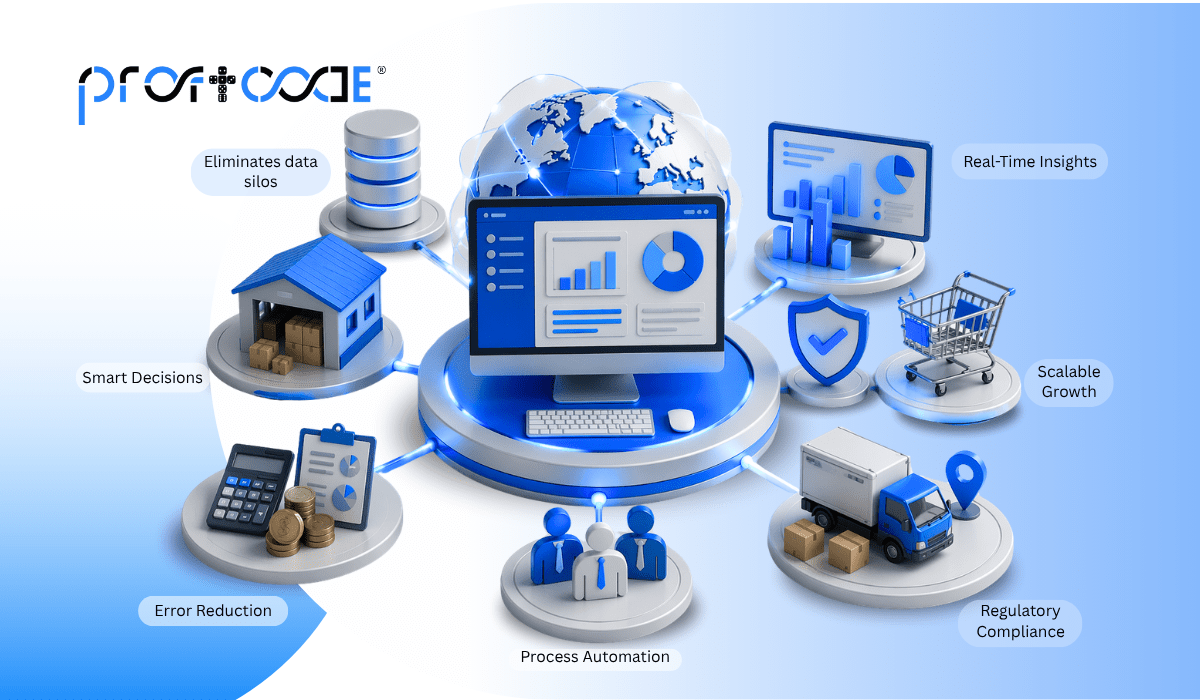
  • Eliminates data silos and ensures seamless, real-time information flow across all departments
  • Improves decision-making with live analytics, dashboards, and accurate business reporting
  • Reduces manual errors, redundant data entry, and time-wasting administrative processes
  • Enhances regulatory compliance and keeps your business aligned with industry standards
  • Scales with your business growth, supporting new markets, users, and operations effortlessly


Without a robust ERP, businesses struggle with slow processes, miscommunication, and poor visibility. The right ERP eliminates these pain points, but the deployment model you choose makes all the difference.
What is Cloud ERP? / What is Traditional ERP? (split into 2)

Before choosing between Cloud and Traditional ERP, it’s essential to understand how each system works. The right ERP Software Development Services model depends on your infrastructure, budget, and operational goals, making this comparison a critical first step for any business.

Cloud ERP

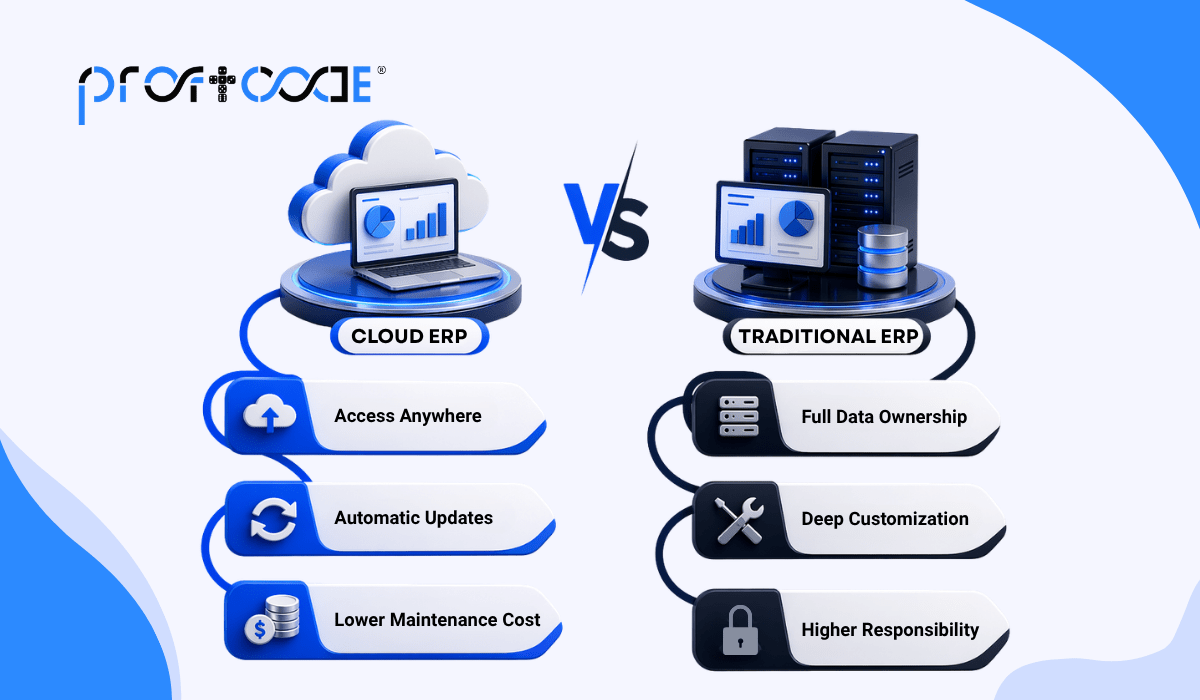
Cloud ERP is a SaaS-based solution hosted on remote servers, accessible anytime via the internet. With expert ERP Software Development Services, businesses enjoy automatic updates, vendor-managed security, flexible subscription pricing, and zero infrastructure maintenance costs, making it the perfect choice for agile, fast-growing companies that prioritize speed, mobility, and cost efficiency.

Traditional (On-Premise) ERP

Traditional ERP is installed directly on a company’s own servers, offering full data ownership and deep operational control. Businesses leveraging Custom ERP Development Services for on-premise deployment gain powerful customization tailored to complex workflows, complete data sovereignty, and independence from third-party vendors, making it the preferred choice for large enterprises in regulated industries where security and control are non-negotiable.
Cloud ERP Vs Traditional ERP Comparison

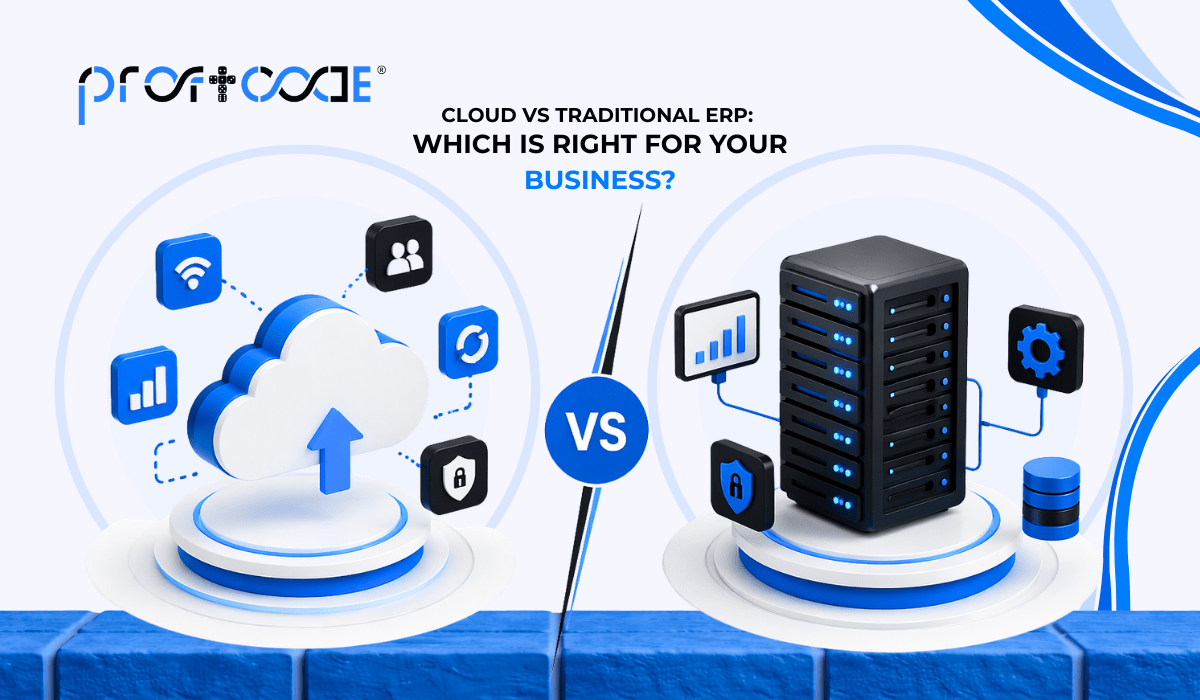
Understanding the core features of each system helps businesses align their choice with strategic goals. Custom ERP Development Services can further tailor these features to match your exact operational needs and industry requirements.

Feature Cloud ERP Traditional ERP
Deployment Online / SaaS On-Premise Servers
Cost Model Subscription-based High upfront license fee
Scalability Highly scalable Limited, costly to scale
Customization Moderate High (full control)
Maintenance Vendor-managed In-house IT team
Accessibility Anywhere, any device On-site or VPN
Security Vendor-managed Full business control
Implementation Weeks to months Months to years

Cloud vs Traditional ERP: Which is Right for Your Business?

Selecting the wrong ERP system doesn’t just slow you down — it costs you money, resources, and competitive advantage. The right ERP, built and deployed through professional ERP Development Services, transforms your business operations from the ground up. Here’s why your ERP decision carries long-term significance:

  • Operational Efficiency: A well-matched ERP automates repetitive tasks and connects departments, cutting processing times by up to 40% and reducing human errors.
  • Cost Optimization: Cloud ERP lowers upfront investment significantly, while Traditional ERP offers better long-term economics for enterprises with stable, complex needs.
  • Data Security & Compliance: Regulated industries like healthcare and finance benefit from the full control of on-premise systems, while cloud ERP offers certified security standards.
  • Remote Work Enablement: Cloud ERP empowers distributed teams to access data and processes from anywhere — a critical advantage in today’s hybrid work environment.
  • Customer Experience: Integrated systems mean faster order fulfillment, accurate inventory tracking, and more responsive customer support across all touchpoints.
Cloud ERP vs Traditional ERP for Manufacturing

Manufacturing is a complex, process-driven industry involving supply chains, production tracking, compliance, and quality control. Choosing the wrong ERP system can disrupt operations and reduce efficiency. That’s why selecting the right ERP Development Services partner is critical.

Key Comparison for Manufacturing


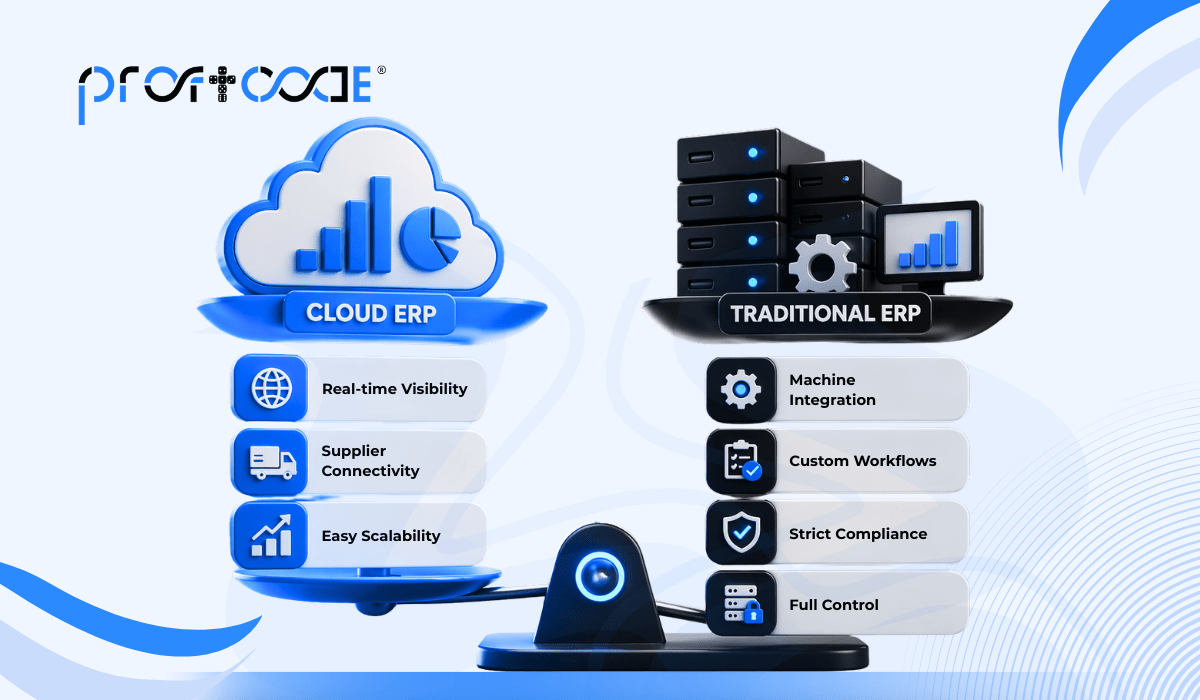
  • Production Monitoring: Cloud ERP provides real-time visibility from anywhere; Traditional ERP offers deeper integration with machines and systems.
  • Supply Chain Management: Cloud ERP enables real-time supplier connectivity; Traditional ERP supports customised procurement workflows.
  • Compliance & Traceability: Traditional ERP is better suited for industries with strict regulatory requirements.
  • Cost of Downtime: Cloud ERP reduces IT downtime with vendor support; Traditional ERP offers full control over system performance.
  • Scalability: Cloud ERP scales easily with growth; Traditional ERP requires additional infrastructure investment.


Read More here Ideal ERP Solution for a Growing Manufacturing Company
Cloud ERP vs Traditional ERP: Real Cost Breakdown

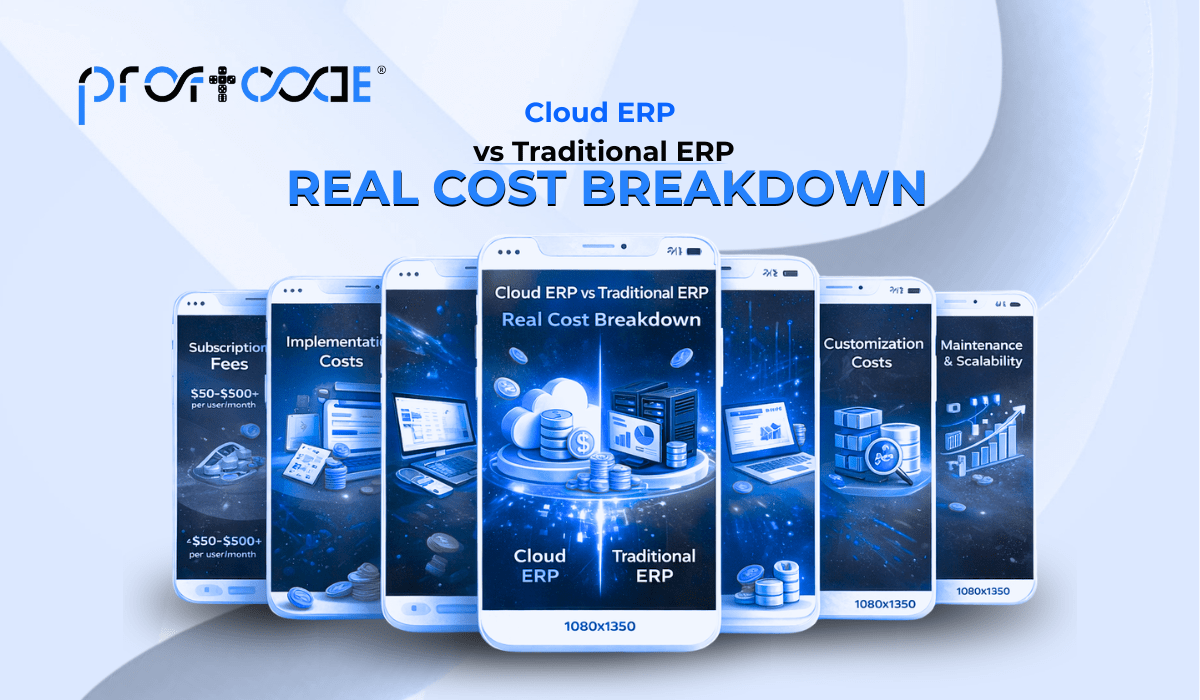
Real Cost Breakdown Cost is one of the most important factors when choosing an ERP system. However, the real cost goes beyond the initial price and includes implementation, maintenance, and scalability. Understanding the full cost structure helps businesses make better decisions.

Let’s break down the cost structure of both models:

Cloud ERP Cost Structure

  • Subscription Fees: Usually range from $50 to $500+ per user/month depending on features and customisation.
  • Implementation Costs: Faster and more affordable, typically based on business complexity and integrations.
  • Customisation Costs: Additional modules or integrations increase total cost but remain flexible.
  • Training & Onboarding: Lower due to user-friendly systems and vendor support.
  • Ongoing Costs: Recurring subscriptions and scaling costs may increase over time, especially in long-term usage.


Traditional ERP Cost Structure

  • License Fees: One-time costs ranging from $50,000 to millions depending on scale.
  • Hardware & Infrastructure: Additional investment in servers and data centers is required.
  • Custom Development Costs: Tailored modules and integrations add value but increase initial investment.
  • Maintenance & Support: Ongoing IT costs typically 15–25% of license cost annually.
  • Implementation Timeline Costs: Longer deployment leads to delayed ROI and higher initial effort.
Which Is Best Between Cloud AI Construction ERPS And Traditional Software

Choosing the ideal ERP solution is not a one-size-fits-all decision. Every business has unique needs, and the right approach depends on careful evaluation of your current state and future goals. Here are practical ways to guide your decision before engaging an ERP Software Development Services provider:

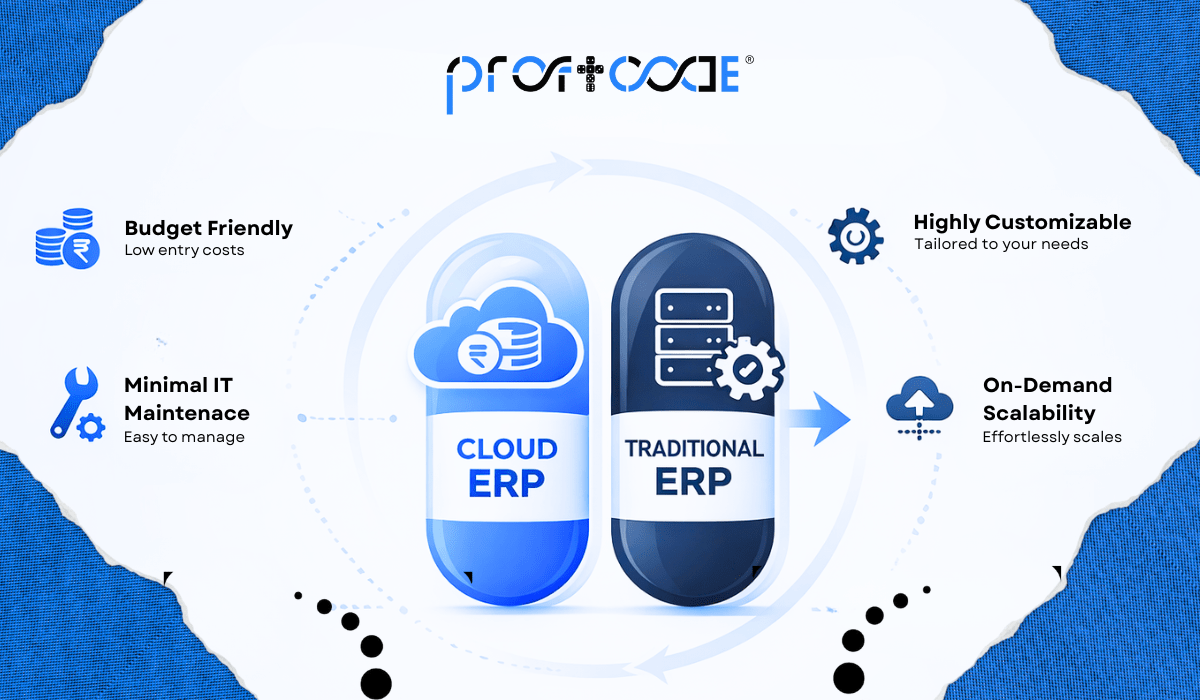
  • Assess Your Budget: If capital is limited, Cloud ERP’s subscription model offers low entry costs. Large enterprises with strong IT budgets may find on-premise more economical long-term.
  • Evaluate IT Infrastructure: Do you have a dedicated IT team? Traditional ERP demands continuous technical expertise for maintenance, updates, and troubleshooting.
  • Identify Customization Needs: Businesses with highly specialized processes benefit most from Custom ERP Development Services that are built precisely around their workflows.
  • Consider Growth Plans: Fast-scaling companies benefit from cloud ERP’s on-demand scalability — no infrastructure upgrades, no delays.
  • Review Compliance Requirements: Industries with strict data residency or regulatory requirements may need the control that on-premise deployment provides.
  • Analyze Integration Needs: Ensure your chosen ERP connects seamlessly with your CRM, e-commerce platform, accounting tools, and third-party APIs.
What is Hybrid ERP?

As businesses grow more complex, many organisations struggle between Cloud ERP flexibility and Traditional ERP control. Hybrid ERP solves this by combining both models into one system. It integrates cloud-based and on-premises components to deliver flexibility, control, and scalability. Leading ERP development services providers like Proftcode design hybrid solutions tailored to business needs.

Key Benefits of Hybrid ERP

  • Flexibility & Control: Businesses can choose which processes run on cloud or on-premises, ensuring better operational control and adaptability.
  • Cost Optimisation: Stable, high-volume processes stay on premises, while scalable operations move to the cloud, reducing overall costs.
  • Business Continuity: Even if cloud connectivity fails, on-premises operations continue without disruption.
  • Gradual Cloud Migration: Businesses can shift from legacy systems to the cloud step-by-step with minimal risk.
  • Regulatory Compliance: Sensitive data stays on premises to meet compliance requirements, while other operations leverage cloud efficiency.
  • Scalability on Demand: Cloud modules scale instantly during peak demand, while on-premises systems ensure consistent performance.

Challenges of Each ERP Type

No ERP system is without its limitations, and understanding these challenges upfront is key to making the right investment decision. Whether you opt for a cloud-based solution or a traditional on-premise setup, each comes with its own set of trade-offs. Businesses that partner with expert ERP Development Services providers can navigate these challenges more effectively, ensuring a smoother implementation and stronger ROI.


Challenges of Cloud ERP

  • Recurring subscription costs can add up significantly over time businesses must factor this into the total cost of their ERP Software Development Services investment
  • Limited customization compared to on-premise solutions, unique workflows often need more than standard cloud modules without Custom ERP Development Services
  • Dependency on internet connectivity any downtime or poor connection can disrupt critical operations across all departments
  • Data privacy concerns for sensitive industries, such as healthcare, finance, and legal sectors, may face compliance risks with third-party server storage
  • Vendor lock-in risks migrating away from a cloud provider can be costly and complex without proper planning and ERP Development Services support.


Challenges of Traditional ERP

  • High upfront investment in licensing, hardware, and implementation a significant financial commitment, especially for SMEs exploring ERP Development Services for the first time
  • Lengthy implementation timelines stretching 12–24 months, delaying ROI and requiring extensive coordination between internal teams and ERP developers
  • Requires a skilled in-house IT team for ongoing support, increasing operational costs, and creating dependency on technical staff for every update
  • Slower to adopt new features, without proactive Custom ERP Development Services, on-premise systems can quickly become outdated in fast-moving markets
  • Difficult and expensive to scale, adding new users, modules, or locations demands additional infrastructure investment and extended development timelines

Why Choose ProftCode for Your ERP Development Needs?

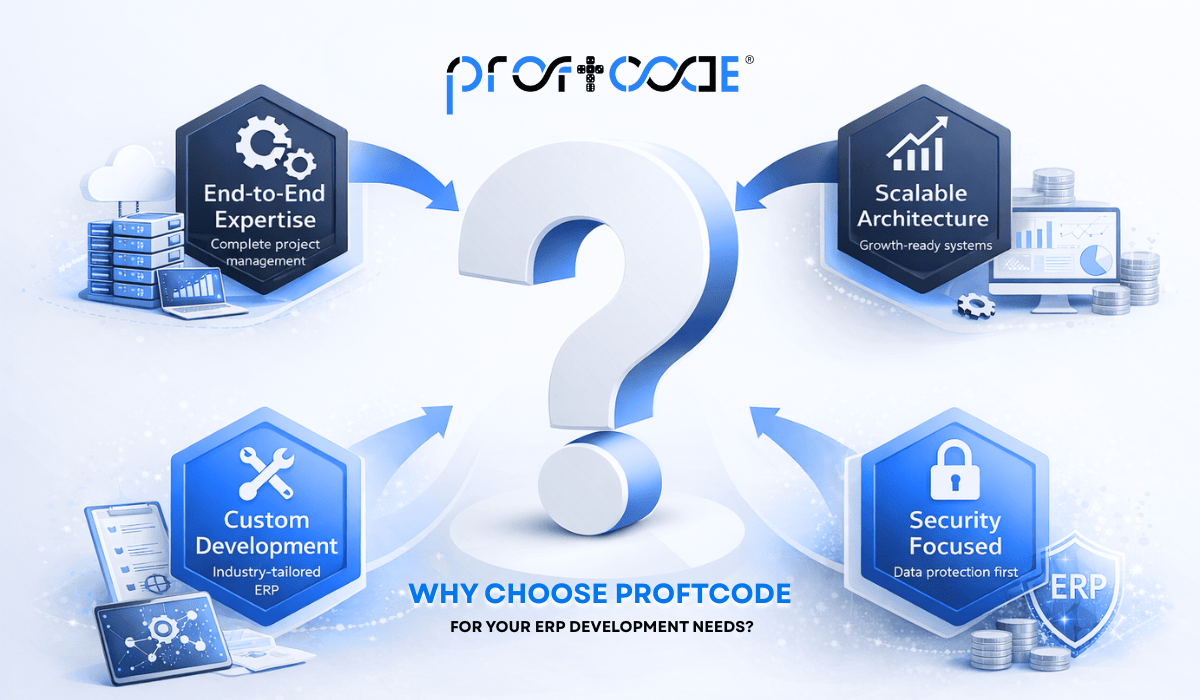
At ProftCode, we don’t believe in one-size-fits-all solutions. Whether you need the agility of a cloud-based system or the robust control of an on-premise platform, our team of expert developers delivers ERP Development Services that are precisely aligned with your business goals, industry requirements, and growth ambitions.

What Sets ProftCode Apart

  • End-to-End Expertise: From initial consultation and architecture planning to deployment and post-launch support, ProftCode manages every phase with precision and accountability.
  • Custom ERP Development Services: We build ERP systems from the ground up, tailored to your industry, workflows, team structure, and long-term operational strategy.
  • Scalable Architecture: Every solution we deliver is designed to grow with your business, ensuring your ERP investment remains relevant, powerful, and cost-effective for years.
  • Seamless Integration: We connect your ERP with CRM platforms, e-commerce systems, accounting software, payment gateways, and third-party APIs without disruption.
  • Security-First Development: Data protection and compliance are embedded into every layer of our development process, meeting international security standards.
  • Agile Delivery Model: Our iterative approach ensures faster time-to-market, better responsiveness to change, and significantly reduced project risk.


Whether you’re migrating from a legacy system, building a new ERP from scratch, or enhancing an existing platform, ProftCode’s ERP Software Development Services give you the tools, talent, and technology to succeed in a competitive market.


In Summary

The debate between Cloud ERP and Traditional ERP ultimately comes down to your business’s specific needs, size, budget, and long-term strategy. Cloud ERP offers flexibility, lower upfront costs, and remote accessibility, making it ideal for SMEs and growing businesses. Traditional ERP provides deeper customization and full data control, best suited for large enterprises with complex, regulated requirements.

No matter which path you choose, partnering with experienced professionals offering Custom ERP Development Services is the key to maximizing your investment. A well-built ERP transforms your operations, drives sustainable growth, and delivers a lasting competitive advantage. Connect with us today, and let’s build something that truly works for your business.

Got Questions? We’ve Got Answers

Cloud ERP is more budget-friendly for SMEs with no high upfront cost. Traditional ERP can be economical long-term for large enterprises with stable, long-term needs.

Yes, but with some limitations. Professional ERP Software Development Services can add custom modules and integrations to tailor the system to your specific business needs.

Cloud ERP: a few weeks to months. Traditional ERP: 12–24+ months. Expert ERP Development Services providers like Proftcode help speed up the process considerably.

Yes. Modern Cloud ERP uses encryption, MFA, and certifications (ISO, SOC 2, GDPR). For industries with strict data residency laws, on-premises may still be preferred.

Manufacturing, healthcare, logistics, retail, and finance gain the most from Custom ERP Development Services, as tailored systems remove clutter and match exact operational needs.

Manufacturing companies prefer traditional ERP systems for deep customisation, process control, and compliance, while cloud ERP systems suit scalable, fast-growing production environments.

Yes, cloud ERP uses encryption, certifications, and vendor-managed security, making it reliable for enterprises, though regulated industries may prefer on-premises.

Cloud ERP implementation takes weeks to months, while traditional on-premises ERP requires longer timelines, typically ranging from several months to years.

Yes, traditional ERP can be migrated to cloud ERP with proper planning, ensuring data security, minimal downtime, and smooth system integration.

Request a Callback

We respond promptly — typically within 30 minutes

Mahesh Jangid

As the CEO of Proftcode, I lead a dynamic IT agency dedicated to transforming ideas into impactful digital solutions. With over 7 years of experience in web and mobile app development, I am passionate about helping businesse from startups to established enterprise build their online presence.

Our Experts Are Ready To Give You Free

Have A Question? Let's Talk!

Address

S-25, Govind Vihar, Gajsinghpura, Gopalpura Bypass Road, Jaipur, Rajasthan 302021

⭐ 4.9/5.0

by 100+ customers for 200+ Web and mobile app projects

certified software company

Turning Your Ideas Into Reality Starts With Collaboration.

By completing this form you are signing up to receive our emails and can subscribe at any time.

Proftcode Private Limited india

Let's Build Something Amazing Together Free

Let our expert team guide you! Free consultation for your next App, Website, or Software project.

Turning Your Ideas Into Reality Starts With Collaboration.

🔒 Your number is safe with us. We never share personal data.


By completing this form you are signing up to receive our emails and can subscribe at any time.

Apply Now