WordPress + WooCommerce
WordPress is an open-source CMS that, when paired with the WooCommerce plugin, becomes a full-fledged e-commerce engine. You self-host it, manage your own server, and have near-unlimited freedom over design and functionality. This is the go-to for businesses that want custom experiences.
Webflow
Webflow is a visual website builder with a built-in CMS and, more recently, an e-commerce module. It lets designers build pixel-perfect sites without extensive coding. Webflow is cloud-hosted, meaning Webflow manages the infrastructure. It’s ideal for design-centric brands.
Shopify
Shopify is a dedicated SaaS e-commerce platform. It’s cloud-hosted, requires zero technical setup, and is purpose-built for selling products online. From inventory to payments to shipping, everything is centralised. It’s the choice of scale-first businesses.
Feature-by-Feature Comparison
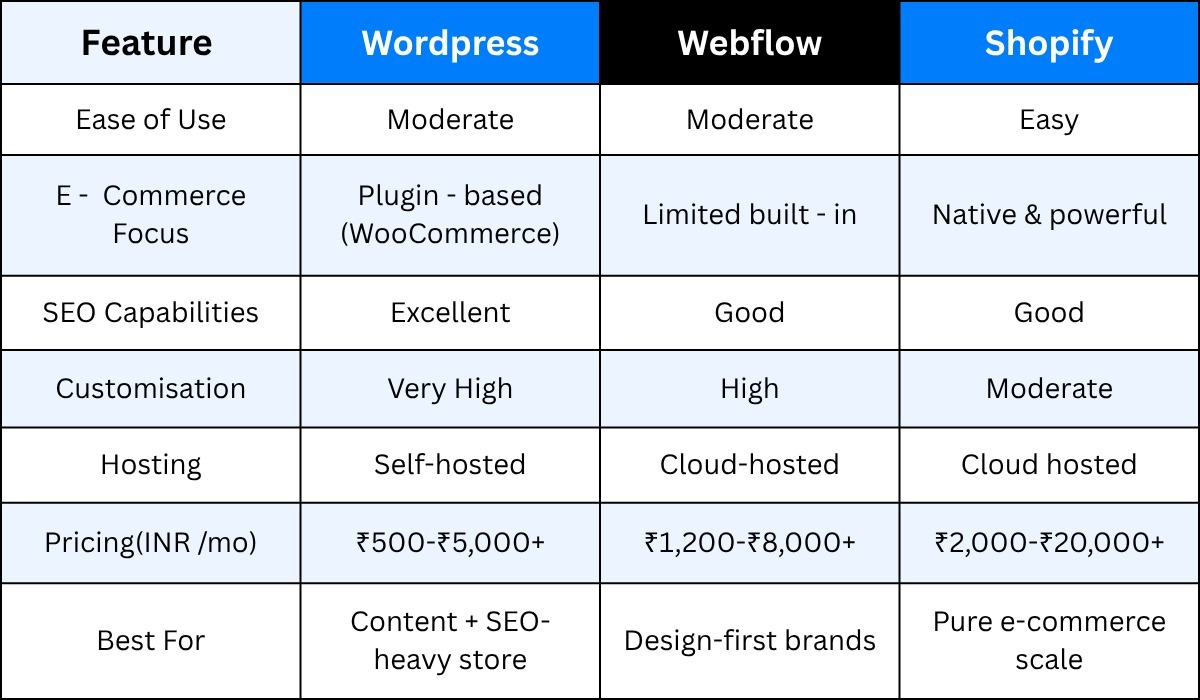
Key Features of Each Platform
WordPress – Power Through Flexibility
- 50,000+ plugins, including WooCommerce, Yoast SEO, and payment gateways.
- Complete control over code, database, and hosting environment.
- Superior blogging and content marketing infrastructure.
- WooCommerce supports physical, digital, and subscription products.
- Multilingual support is essential for India’s diverse linguistic landscape.
Webflow – Design-First Excellence
- No-code visual canvas with CMS-driven product management.
- Clean, semantic HTML output that supports strong on-page SEO.
- Built-in animation tools for premium brand experiences.
- Native e-commerce with basic inventory and checkout management.
- Responsive design with detailed control over breakpoints.
Shopify – Merchant-First Infrastructure
- 100+ professionally designed, mobile-optimised themes.
- Native multi-currency and multi-language support for global reach.
- Shopify Payments and 100+ third-party payment gateway integrations.
- Built-in abandoned cart recovery, upselling, and discount engine.
- Shopify App Store with 8,000+ apps for every business need.
Importance of Selecting the Right Platform in India
The Indian market has unique dynamics that make platform selection even more nuanced:
• Mobile Commerce Dominance: Over 78% of Indian e-commerce transactions happen on mobile. All three platforms offer mobile optimisation, but Shopify and Webflow have an edge in out-of-the-box mobile performance.
• Payment Gateway Integration: Indian customers expect UPI, Paytm, Razorpay, and net banking. WordPress and Shopify offer more mature payment integrations for Indian payments than Webflow.
• Regional Language Support: Reaching tier-2 and tier-3 cities requires multi-language content. WordPress and Shopify handle this better with available plugins and native features.
• Digital India Compliance: GST invoicing, e-way bills, and local compliance are easier to manage with platforms like WordPress (via plugins) or Shopify (via apps).
• Affordable Scalability: Indian startups often need to scale quickly and cost-efficiently. Shopify’s subscription model becomes expensive at scale, while WordPress offers more cost-effective long-term growth if managed by an expert e-commerce app developer in India.
Ways to Implement Each Platform for Your Indian Business:
For WordPress
• Partner with an experienced e-commerce website developer in India to set up managed hosting on services like Cloudways or SiteGround India.
• Install WooCommerce along with essential Indian-market plugins—Razorpay, GSTIN invoicing, and ShipRocket integration.
• Customise a premium theme or build one from scratch for your brand identity.
• Implement an aggressive SEO strategy using Yoast or Rank Math to dominate Google India search results.
For Webflow
• Use Webflow’s visual builder to create a branded storefront with high production value.
• Connect third-party tools via Zapier or Webflow integrations for inventory and CRM management.
• Use Webflow’s CMS for product catalogs and sync with Shopify’s buy button for advanced commerce.
• Best suited for D2C (Direct-to-Consumer) brands in fashion, lifestyle, and luxury segments in India.
For Shopify
• Sign up and choose a plan—Basic (₹1,994/mo) to Advanced (₹14,994/mo), with annual discounts.
• Install Indian-market apps: Razorpay, GoKwik, Shiprocket, and EasyEcom for inventory.
• Leverage Shopify Markets to expand to international buyers with localised pricing.
• Work with an e-commerce app developer in India to build custom Shopify apps for unique business workflows.
Challenges with Each Platform
WordPress Challenges
• Requires technical expertise for setup, security patches, and server management.
• Plugin conflicts can cause site crashes; a dedicated developer is essential.
• Site speed requires optimisation, especially on shared Indian hosting.
• Ongoing maintenance costs for updates and security can add up.
Webflow Challenges
• Limited native e-commerce functionality, not suitable for large catalogs (500+ products).
• No direct Indian payment gateway integrations as of now.
• The learning curve for non-designers can be steep.
• Higher cost than WordPress for comparable functionality.
Shopify Challenges
• Transaction fees apply if you don’t use Shopify Payments—a pain point in India.
• Customisation is limited compared to WordPress without custom app development.
• Monthly costs can escalate quickly as you add apps and upgrade plans.
• Migration away from Shopify is complex once you’re deeply embedded in their ecosystem.
Why Choose Proftcode for Your E-Commerce Website?
Proftcode is a trusted name among the best e-commerce website development companies in India. With a proven track record of delivering high-performance online stores across WordPress, Webflow, and Shopify, Proftcode brings together technical excellence, design sensibility, and deep market knowledge specific to India.
What Makes Proftcode Stand Out?
• Platform-Agnostic Expertise: Proftcode’s team of certified developers are specialists across all three platforms, ensuring you get unbiased advice tailored to your business goals—not the platform that’s easiest for the agency.
• India-First Development Approach: All solutions are built with Indian payment gateways, GST compliance, regional language support, and mobile-first performance in mind — factors most global agencies overlook.
• End-to-End E-Commerce Software Development Services: From ideation and UX design to development, QA, launch, and post-launch support, Proftcode handles the entire lifecycle of your digital store.
• Custom App Development: Need a feature that no plugin offers? Proftcode’s e-commerce app developer team in India builds bespoke Shopify apps and WordPress plugins tailored exactly to your requirements.
• SEO & Performance Optimisation: Every project at Proftcode is built with Core Web Vitals and Google India ranking factors in mind, giving you an organic growth advantage from day one.
• Transparent Pricing: No hidden costs. Proftcode provides detailed, milestone-based proposals that fit Indian business budgets, from growing D2C brands to enterprise retailers.
• Dedicated Account Management: You get a single point of contact who understands your business, not a rotating team of unfamiliar developers.
Whether you need the best e-commerce development service for a new launch or want to migrate from a broken platform to a scalable one, Proftcode delivers results that move the needle.