
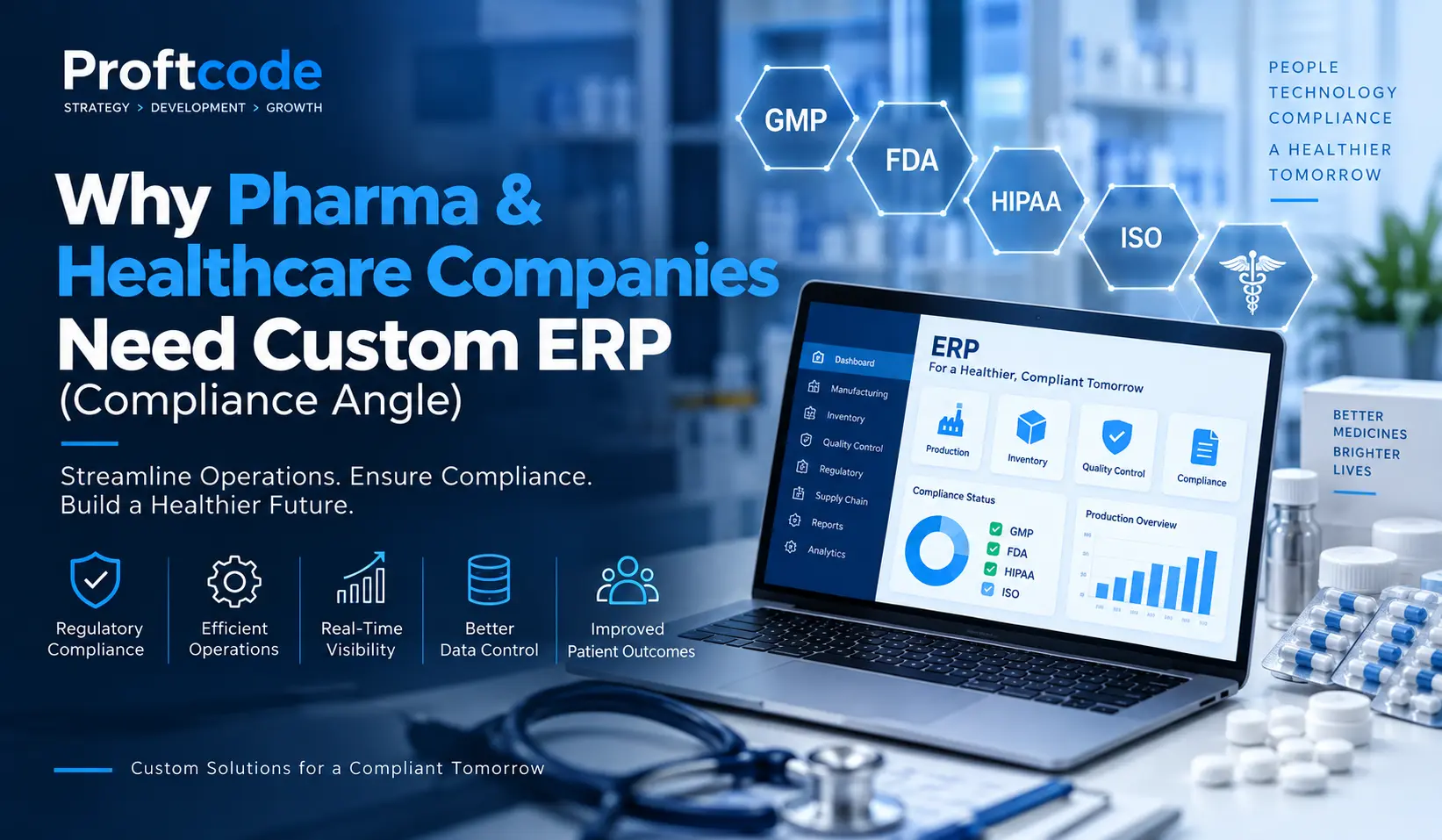
Pharma and healthcare businesses operate under a level of scrutiny most other industries simply don’t face. Every batch of medicine needs traceability. Every patient record needs protection. Every process, from procurement to distribution, needs to hold up under audit. Generic ERP systems, built to serve everyone from retail shops to trading firms, often struggle to handle this level of specificity, and that gap becomes a real liability once regulators come knocking.
This is exactly why custom ERP has become less of a luxury and more of an operational necessity for pharma and healthcare companies. Let’s look at why, specifically through the lens of compliance, and what a properly built system actually needs to include.
Why Generic ERP Falls Short for Pharma and Healthcare
Most off-the-shelf ERP platforms were designed with general business operations in mind: sales, inventory, and basic accounting. Pharma and healthcare need a lot more precision than that.
- Batch and lot traceability isn’t optional. Generic inventory modules often can’t track individual batches through the entire supply chain with the level of detail regulators expect
- Expiry management needs to be built in, not bolted on. Medicines and healthcare products require automatic tracking of shelf life, something generic systems handle inconsistently at best
- Patient and clinical data need specialized protection. Standard CRM or data modules aren’t built with healthcare-specific privacy requirements in mind
- Regulatory reporting formats vary by requirement. Generic reporting tools rarely produce the specific documentation formats regulators and auditors actually expect
- Recall processes need speed and precision. If a batch needs recalling, a generic system often can’t isolate affected units quickly enough to limit exposure
These aren’t minor inconveniences. In pharma and healthcare, a gap in any of these areas can mean regulatory penalties, reputational damage, or in the worst cases, genuine harm to patients.
The Compliance Landscape Pharma and Healthcare Businesses Navigate
Without getting into a full legal breakdown, it’s worth understanding broadly what kind of regulatory pressure these businesses operate under.
- Manufacturing standards require detailed documentation of production processes, quality checks, and batch records
- Data protection requirements govern how patient and clinical information must be stored, accessed, and shared
- Supply chain traceability is increasingly mandated, requiring end-to-end visibility from raw material to final distribution
- Periodic audits and inspections require businesses to produce accurate, organized records quickly, often with little notice
- Import and export regulations for pharma products often require specific documentation that generic systems aren’t built to generate
Staying compliant across all of this manually, or through a system that wasn’t designed for it, becomes an enormous operational burden as a business scales.
How Custom ERP Directly Supports Compliance
This is where custom ERP genuinely earns its place for pharma and healthcare businesses, not as a nice-to-have feature set, but as infrastructure built specifically to handle regulatory demands.
1. Batch and Lot Traceability Built Into the Core System
- Tracks every batch from raw material sourcing through manufacturing, storage, and distribution
- Makes it possible to instantly identify which customers or locations received a specific batch, critical during recalls
- Reduces the manual record-keeping burden that generic systems often push back onto staff
2. Automated Expiry and Shelf Life Management
- Flags products approaching expiry automatically, reducing the risk of expired stock reaching customers
- Supports first-expiry-first-out inventory practices without relying on manual tracking
- Reduces waste and regulatory risk simultaneously
3. Role-Based Access Control for Sensitive Data
- Ensures only authorized personnel can access sensitive patient or clinical data
- Creates a clear audit trail of who accessed what information and when
- Supports compliance with data protection requirements specific to healthcare information
4. Custom Reporting for Regulatory Submissions
- Generates reports in the specific formats regulators and auditors actually require
- Reduces the time spent manually compiling data from disconnected systems before an audit
- Minimises the risk of reporting errors that could trigger regulatory scrutiny
5. Quality Control Integration
- Embeds quality checkpoints directly into production and distribution workflows
- Flags deviations from standard processes immediately, rather than discovering issues after the fact
- Maintains a clear, documented history of quality checks for audit purposes
6. Faster, More Precise Recall Management
- Isolates affected batches quickly using built-in traceability data
- Identifies exactly which distributors, pharmacies, or customers received affected products
- Reduces the time between identifying an issue and initiating a recall, which matters enormously for patient safety
Beyond Compliance: Operational Benefits That Come Along With It
While compliance is the core driver, custom ERP for pharma and healthcare businesses also delivers practical day-to-day advantages.
- Reduced manual paperwork, freeing up staff time for more valuable work
- Better inventory accuracy, reducing both stockouts of critical medicines and unnecessary overstocking
- Improved supply chain visibility, helping identify bottlenecks before they cause delays
- Stronger vendor management, particularly important given how many pharma companies rely on multiple raw material suppliers
Compliance and operational efficiency aren’t separate goals here. A well-built system delivers both simultaneously, since the same traceability and structure that satisfies regulators also makes daily operations smoother.
ERP for the Manufacturing Industry: Where Pharma Manufacturing Fits In
Pharma manufacturing shares certain needs with ERP software for the manufacturing industry more broadly, including production scheduling, raw material tracking, and quality control checkpoints, but it layers additional regulatory requirements on top.
- Production scheduling needs to account for strict quality hold periods that general manufacturing doesn’t always require
- Raw material tracking needs pharmaceutical-grade documentation, not just basic inventory counts
- Quality control workflows require formal sign-offs and documented deviations, more rigorous than typical manufacturing quality checks
A custom ERP system built with pharma-specific compliance in mind handles these additional layers without forcing the business to bolt on separate compliance tools alongside a generic manufacturing ERP.
Managing Compliance Across Multiple Facilities
Many pharma and healthcare companies operate across multiple manufacturing units, warehouses, or distribution centers, sometimes spread across different cities. This adds another layer of complexity that generic ERP systems often struggle to handle well.
- Consistent compliance standards across locations. A custom ERP system can enforce the same quality checkpoints and documentation standards at every facility, rather than each location developing its own inconsistent process
- Centralized visibility for audits. Regulators may inspect any facility at any time, and having centralized, consistent records across all locations makes that process significantly smoother
- Coordinated recall management. If an issue is identified at one facility, a connected system allows for faster coordination across all locations to contain the impact
- Standardized vendor and raw material tracking. Ensures the same quality standards apply to suppliers regardless of which facility is placing the order
For businesses considering expansion, whether that means evaluating an ERP software development company in India for a new facility or comparing regional partners across erp software development companies in Jaipur, Delhi, or Hyderabad, building this multi-facility consistency into the system from the start avoids a lot of compliance headaches down the line.
Why Working With an Experienced ERP Development Partner Matters
Given how much precision this requires, choosing the right partner for erp software development services becomes especially important for pharma and healthcare businesses specifically.
- Regulatory understanding matters as much as technical skill. A development team unfamiliar with pharma or healthcare compliance requirements may miss critical functionality during the build
- Requirement gathering needs to go deep. Generic questions won’t surface the specific traceability and reporting needs unique to this industry
- Post-launch support needs to account for evolving regulations. Compliance requirements shift over time, and the system needs to be maintainable as those changes happen
Whether you’re evaluating an ERP software development company in India broadly or comparing specific regional options like ERP software development companies in Jaipur, ERP software development companies in Delhi, or teams offering ERP software development in Jaipur and ERP software development companies in Hyderabad, the same core question applies. Does this partner genuinely understand pharma and healthcare compliance, or are they applying generic manufacturing ERP concepts to a business that needs far more precision?
What to Ask a Potential ERP Development Partner
Before committing, pharma and healthcare businesses should be asking specific, pointed questions.
- Have you built ERP systems specifically for pharma or healthcare businesses before?
- How does your system handle batch traceability and recall management?
- What data protection measures are built in for sensitive patient or clinical information?
- Can the reporting module generate documentation in the formats our regulators require?
- How do you handle system updates as compliance requirements change over time?
Vague or generic answers to these questions are usually a sign the partner hasn’t built for this specific level of regulatory complexity before.
A Quick Self-Check for Pharma and Healthcare Businesses
Before assuming your current system is sufficient, consider these honestly.
- Can you trace a specific batch through your entire supply chain within minutes, not hours?
- Is expiry management automated or dependent on manual staff tracking?
- Do you have clear, role-based access control over sensitive patient or clinical data?
- Could you generate a complete audit report quickly if regulators requested one with short notice?
- Has your current system ever caused delays or errors during a compliance audit?
If several of these raise concerns, it’s a strong signal that a generic ERP setup is creating genuine compliance risk, not just operational inconvenience.
Final Thought
For pharma and healthcare companies, ERP software isn’t just a tool for running operations more smoothly. It’s a core part of staying compliant, protecting patients, and avoiding the serious consequences that come with regulatory failures. Generic systems simply weren’t built to carry that weight. Custom ERP, built with compliance as a foundational requirement rather than an afterthought, gives these businesses the precision and traceability that this industry genuinely demands.
Frequently Asked Questions
Standard ERP systems typically lack the batch traceability, expiry management, and regulatory reporting depth that pharma and healthcare compliance requirements demand, creating gaps that generic systems weren’t built to handle.
Look for batch and lot traceability, automated expiry tracking, role-based access control for sensitive data, custom regulatory reporting, and integrated quality control checkpoints.
Yes, especially given how costly compliance failures can be. A properly built system reduces regulatory risk while also improving day-to-day operational efficiency, which benefits businesses of any size.
Pharma ERP layers additional regulatory requirements, like quality hold periods and pharmaceutical-grade documentation, on top of standard manufacturing functions like production scheduling and inventory tracking.
Prioritise genuine experience with pharma or healthcare compliance requirements, thorough requirement gathering, and a clear plan for maintaining the system as regulations evolve.