
Key Takeaways
- Use a six-factor framework- process uniqueness, growth trajectory, true cost, timeline, integration needs, and long-term ownership- to decide.
- Look at total cost over years, not the sticker price: subscription fees, integration costs, and workflow-misalignment losses all add up.
- Off-the-shelf works for standard processes, fast deployment, and tight budgets; custom fits unique workflows and real growth plans.
- A simple scoring system helps low scores favour off-the-shelf; high scores make custom “very likely the stronger long-term investment.”
- Custom ERP means real ownership and control instead of depending on a vendor’s roadmap and pricing changes.
- The right development partner matters as much as the build-vs-buy decision itself.
This question comes up in almost every growing business at some point. You’ve outgrown spreadsheets, your team is juggling five disconnected tools, and someone finally says the words, “Maybe we need an ERP system.” Fair enough. But then the real question shows up right behind it. Should you buy something off the shelf or invest in custom ERP development built specifically for how your business actually works?
There isn’t a one-size-fits-all answer here, and honestly, anyone who gives you one without asking about your business first probably isn’t being fully honest with you. This blog walks through a practical decision framework to help you figure out, with real clarity, whether custom ERP software is actually worth it for where your business stands right now.
What Does "Custom ERP" Actually Mean?
Before jumping into the framework, let’s get the terminology straight.
Custom ERP development means working with an ERP software development company to build a system shaped around your specific processes, industry needs, and growth plans. It’s not a modified version of an existing template. It’s built from the ground up (or heavily tailored) to match your business logic exactly.
Off-the-shelf ERP, on the other hand, is a pre-built platform. You sign up, configure a few settings, and start using it. Quick, but rigid.
Neither option is inherently better. The right choice depends entirely on your specific situation, which is exactly what this framework is designed to help you figure out.
Step 1: Assess How Standard (or Unusual) Your Processes Are
This is the single biggest factor in the custom vs off-the-shelf ERP decision.
Signs your processes are fairly standard:
- You follow common industry practices with minimal deviation
- Your reporting needs are fairly generic (basic sales, inventory, and financial reports)
- You don’t have complex multi-stage workflows unique to your business
Signs your processes are genuinely unique:
- You have industry-specific compliance or documentation requirements
- Your workflow involves multiple departments coordinating in ways that generic software doesn’t anticipate
- You’ve already tried adapting standard software and found yourself constantly working around its limitations
If your business falls into the second category, custom ERP software tends to deliver far better long-term value, simply because you’re not paying for features you don’t need while missing the ones you do.
Step 2: Consider Your Growth Trajectory
ERP decisions shouldn’t just reflect where your business is today. They need to account for where it’s heading.
- Slow, steady growth: An off-the-shelf ERP with room for basic customization might serve you well for a few more years.
- Rapid scaling plans: Custom ERP development, built with scalability in mind from day one, avoids the painful process of outgrowing your system every eighteen months.
- Expansion into new markets or locations: Custom systems can be designed to handle multi-location complexity properly, rather than bolting on workarounds later.
- Planned mergers or acquisitions: If consolidation is on your roadmap, a custom system built for flexibility saves significant integration headaches down the line.
Step 3: Calculate the Real ERP Implementation Cost, Not Just the Sticker Price
This step trips up a lot of businesses. They compare the upfront cost of off-the-shelf subscriptions against custom development quotes and assume the cheaper number wins. It’s rarely that simple.
Factors that affect true ERP implementation cost:
- Licensing or subscription fees over multiple years, not just the first one.
- Customization and integration costs for off-the-shelf platforms that don’t fit out of the box.
- Staff training time and productivity loss during transition.
- Ongoing maintenance and support costs.
- The cost of workarounds and inefficiencies if the system doesn’t properly fit your workflow.
Off-the-shelf ERP often looks cheaper upfront but can accumulate hidden costs over time through add-ons, integrations, and workflow inefficiencies. Custom ERP software requires a bigger initial investment but tends to have more predictable long-term costs since it’s built to fit from the start.
Step 4: Weigh Implementation Time Against Urgency
How quickly do you actually need this system running?
- Need it running within weeks? Off-the-shelf ERP software for small businesses is usually faster to deploy.
- Have a few months of runway? Custom ERP development allows for a system that fits properly, even if it takes longer to build and test.
- Facing a critical operational gap right now? Sometimes a phased approach works best; start with a basic off-the-shelf tool to stop the bleeding, then transition to a custom ERP once you have breathing room to plan properly.
There’s no shame in starting simple if urgency demands it. Just go in with a clear plan for when and how you’ll reassess.
Step 5: Evaluate Integration Needs
Most businesses aren’t starting from scratch. You likely already use some combination of accounting software, CRM tools, or industry-specific platforms.
- Custom ERP development allows integrations to be built specifically for your existing tech stack, reducing friction and manual data transfers.
- Off-the-shelf ERP may offer pre-built integrations for popular tools but can struggle with niche or older systems your business relies on.
If your current tools are fairly mainstream, off-the-shelf integrations might cover you fine. If you’re running specialized or legacy systems, custom development usually handles this more reliably.
Step 6: Factor In Long-Term Ownership and Flexibility
This part often gets overlooked until it becomes a problem.
With off-the-shelf ERP:
- You’re dependent on the vendor’s roadmap, pricing changes, and feature decisions.
- Sudden platform changes or price increases can disrupt your operations without much warning.
- You don’t own the system outright. You’re renting access to it.
With custom ERP software:
- You own the system and have full control over future changes.
- No dependency on a third-party vendor’s business decisions affecting your operations.
- Greater flexibility to adapt the system as your business evolves, without waiting on someone else’s update schedule.
For businesses planning to operate and scale over many years, ownership and flexibility often become deciding factors on their own.
Custom vs Off-the-Shelf ERP: A Quick Recap
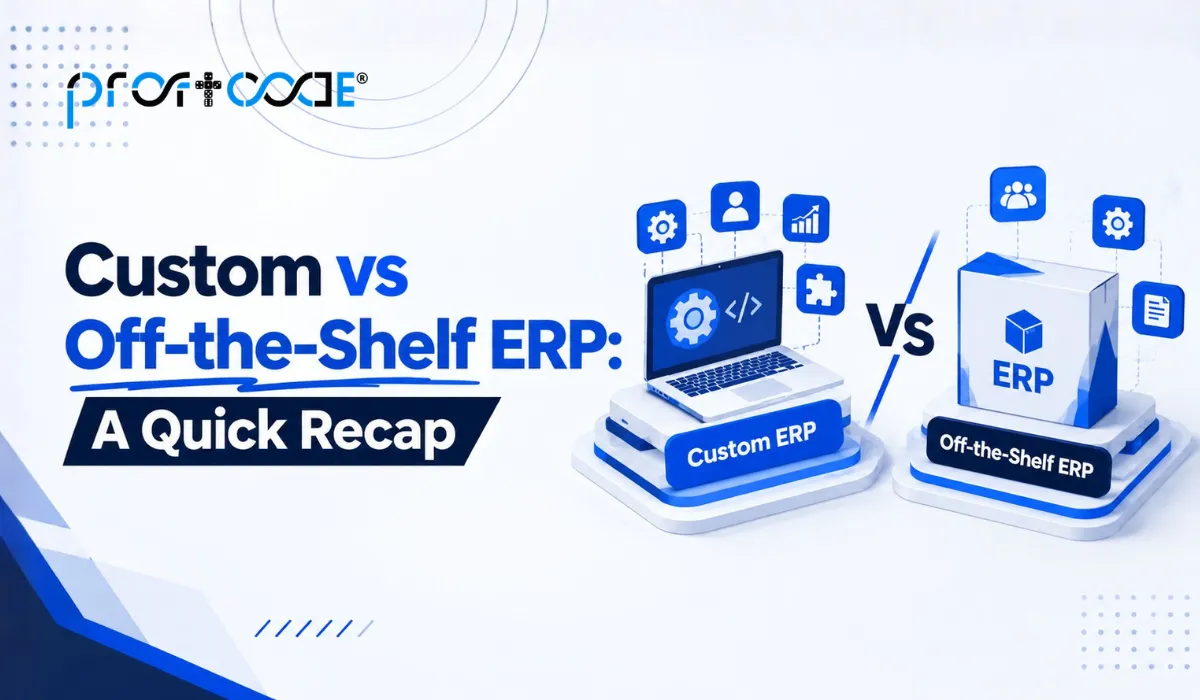
Since this comparison runs through several factors, here’s a condensed side-by-side view before we move to the scoring framework.
Off-the-shelf ERP works better when:
- Your processes are fairly standard for your industry.
- You need something running quickly, within weeks rather than months.
- Budget constraints make a large upfront investment difficult right now.
- Your existing tools are mainstream and easy to integrate.
Custom ERP software works better when:
- Your workflows have genuine quirks specific to your business or sector.
- You’re planning significant growth or expansion soon.
- You rely on specialized or legacy systems needing reliable integration.
- Long-term ownership and control matter more than a fast initial rollout.
Keeping this recap in mind makes the more detailed framework below easier to apply to your specific situation.
A Practical Scoring Framework
To make this decision less abstract, here’s a simple way to score your situation. Give yourself one point for each statement that’s true for your business.
- Our processes have unique steps that generic software struggles to handle.
- We’re planning significant growth or expansion in the next two to three years.
- We rely on specialized or legacy tools that need reliable integration.
- We’ve already outgrown at least one off-the-shelf tool due to its limitations.
- Long-term ownership and control over our system matter to us.
- We have a reasonable timeline (a few months, not days) to implement a new system.
Scoring guide:
- 0 to 2 points: Off-the-shelf ERP is likely a practical, cost-effective choice for now.
- 3 to 4 points: Worth seriously evaluating custom ERP development, especially if the budget allows.
- 5 to 6 points: Custom ERP software is very likely the stronger long-term investment for your business.
This isn’t a perfect science, but it gives you a starting point that’s more structured than a gut feeling alone.
When ERP Software for Small Business Makes More Sense
Not every growing business needs a fully custom build right away, and that’s genuinely fine.
- If you’re still refining your core processes, a flexible off-the-shelf tool gives you room to experiment before committing to a rigid custom build.
- If the budget is tight, starting lean and scaling gradually often makes more financial sense than overinvesting too early.
- If your team is small, simpler software with a shorter learning curve helps with faster adoption.
The key is being honest about where your business genuinely stands, not where you hope to be in a year, when making this call.
Choosing the Right ERP Software Development Company
If your framework results point toward custom ERP development, choosing the right partner becomes the next critical decision.
What to look for:
- Proven experience with businesses similar in size and complexity to yours.
- A clear requirement-gathering process before any development begins.
- Transparent pricing and realistic timelines, not vague estimates that shift later.
- Strong post-launch support, since ERP systems need ongoing updates and fixes.
- Genuine willingness to customize around your workflow, not push a rigid template.
If you’re evaluating an ERP software development company in India specifically, local teams often bring a better understanding of regional compliance requirements and business practices, which can smooth out the entire development process considerably.
At Proftcode Private Limited, this framework is essentially what we walk clients through before recommending anything. We’d rather map your actual processes first and tell you honestly if off-the-shelf will serve you fine than push a custom build you don’t really need yet. If custom ERP development does turn out to be the right fit, our team builds it around your workflow from day one, not the other way round.
Final Thought
Is custom ERP worth it? For some businesses, genuinely yes. For others, not yet, and that’s a perfectly reasonable place to be, too. The real value of a decision framework like this isn’t handing you a universal answer. It’s helping you ask the right questions about your own business honestly, so whichever path you choose, it’s based on where you actually stand, not on which option sounded more impressive in a sales pitch.
Frequently Asked Questions
Not necessarily in the long run. While custom ERP development costs more upfront, off-the-shelf ERP can accumulate hidden costs through subscriptions, add-ons, and workflow inefficiencies over time.
It varies by scope and complexity, but most custom builds through an experienced ERP software development company take a few months from requirement gathering to full deployment.
Yes, if the business has unique processes or clear growth plans. However, many small businesses genuinely do better starting with ERP software for small-business needs and scaling up later.
The biggest risk is outgrowing the platform’s limitations as the business scales, which can force a costly and disruptive migration to a new system later.
Use the scoring framework above. If your processes are unique, your growth plans are significant, and you rely on specialized tools, custom ERP development is likely the stronger long-term fit.