
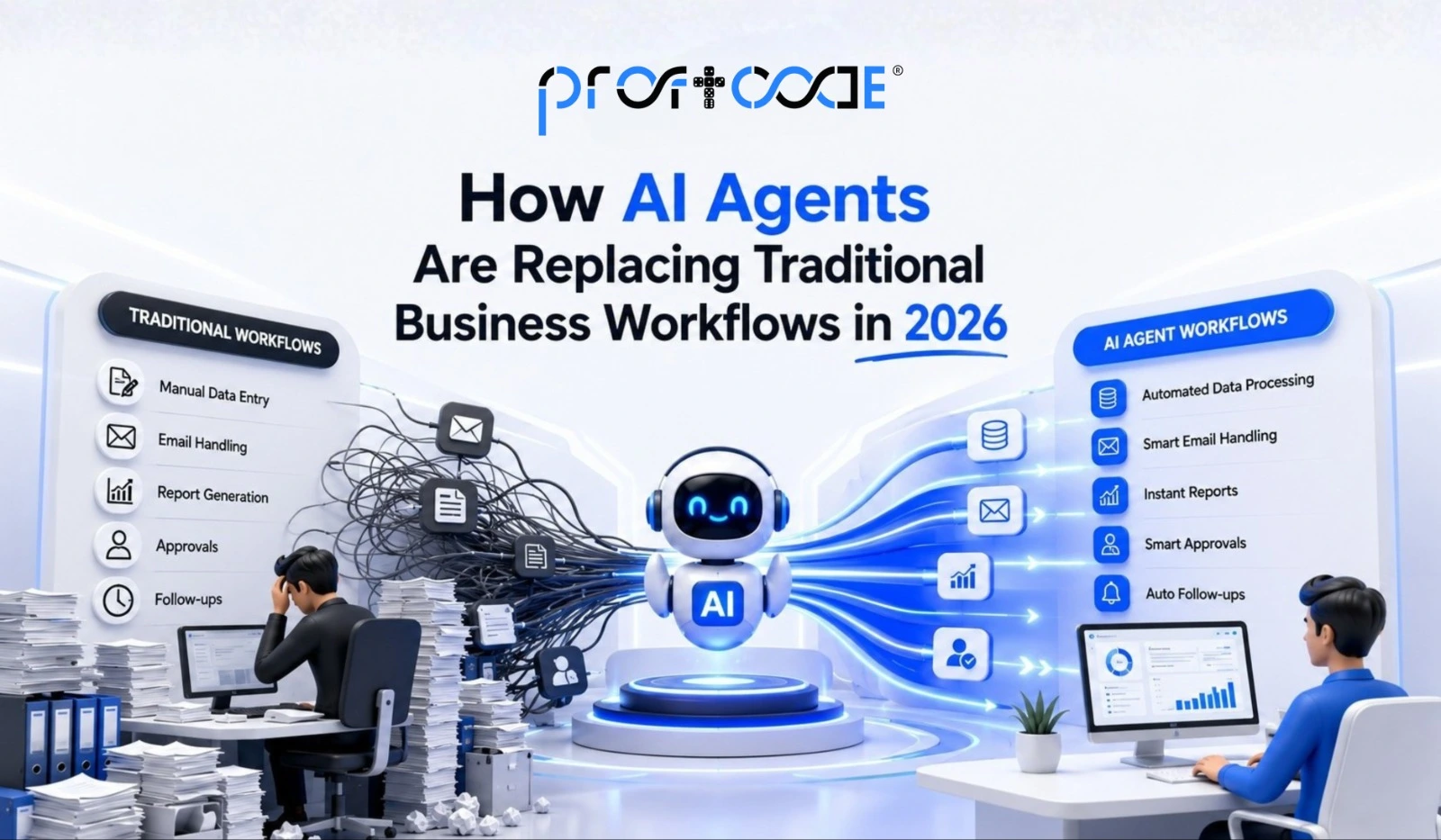
The way businesses operate has undergone significant changes, and 2026 marks a pivotal turning point that cannot be ignored. AI agents are no longer experimental tools used only by tech giants. They are practical systems driving business process automation with AI across sales, marketing, finance, HR, customer support, and operations. Companies that once relied on long approval chains, manual data entry, and rigid software workflows are now watching AI agents take over with speed and accuracy that human teams cannot match at scale.
This shift is not about replacing employees. It is about replacing outdated, repetitive workflows that drain productivity. From startups in Jaipur to enterprises across India, our custom software development services help businesses transition from manual workflows to intelligent automation , AI agents in business in 2026 are becoming the new standard. In this blog, we explore how AI agents are transforming business workflows in 2026, where they create the biggest impact, and what your business should do to keep pace.
What Are AI Agents and How Do They Work in Business?
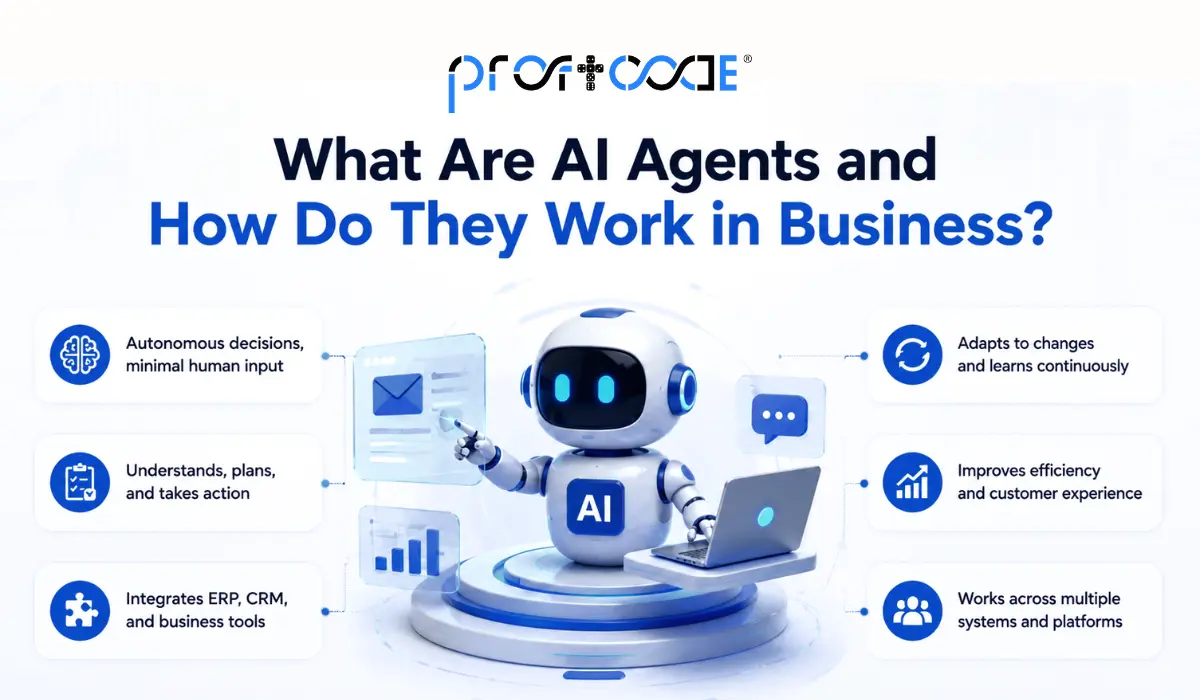
An AI agent is an autonomous software system that can perceive its environment, make decisions, and take action toward a goal without constant human input. Unlike basic AI chatbot and agent development of the past, modern AI agents use large language models, machine learning models, retrieval augmented generation (RAG), and natural language processing to plan multiple steps and adapt when conditions change.
In practical terms, an AI agent can read an incoming customer email, check inventory in your ERP, generate a personalized response using generative AI tools, and schedule a follow-up in the CRM. All of this happens in seconds. That is the leap separating traditional workflows from agentic AI for enterprises. AI copilots, LLM-powered business agents, and multi-agent AI systems built on frameworks like LangChain, AutoGPT, and CrewAI form the foundation of this new digital workforce.
How AI Agents Are Replacing Traditional Business Workflows
Traditional workflows were built for a world where every action needed human approval, and every decision needed a meeting. That model is breaking down. AI workflow automation and modern workflow automation solutions now handle those actions in the background while employees focus on strategy and customer relationships.
Here is what is changing in 2026:
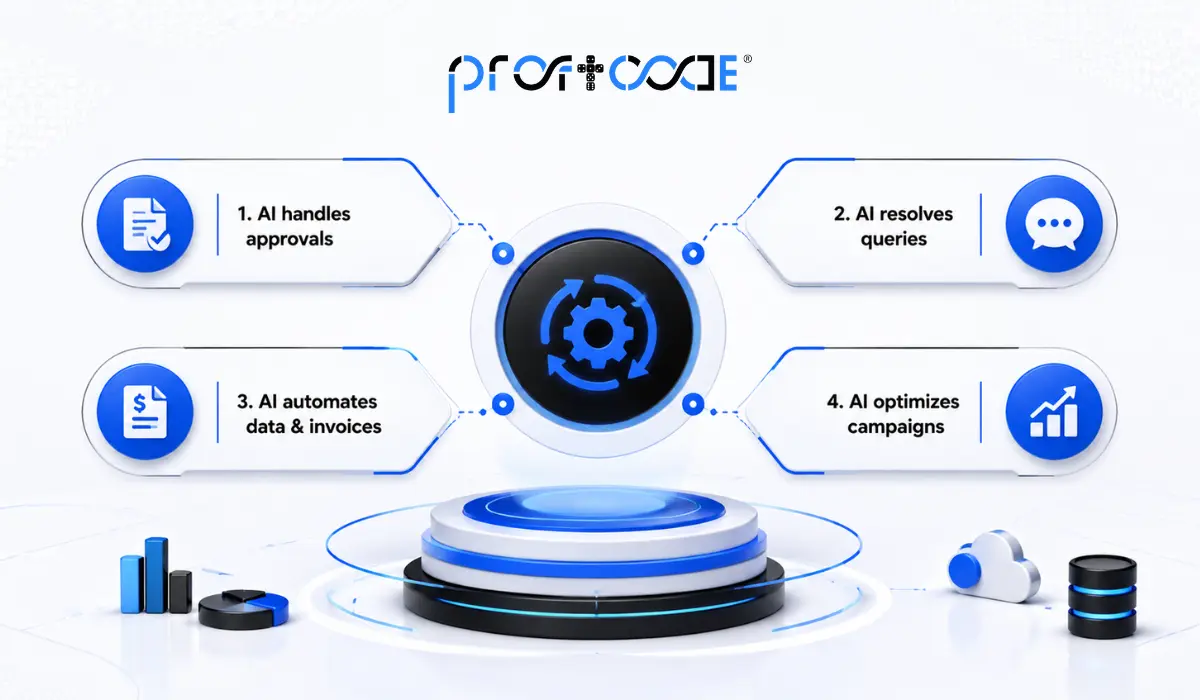
- Routine approvals, such as expense claims and purchase orders, are processed by autonomous AI agents for businesses that check policies and approve or escalate in real time.
- Customer queries that once traveled through ticket queues are answered instantly by AI agents trained on company knowledge.
- Data entry, invoice processing, and reconciliation tasks are completed by AI agents integrated with accounting and ERP systems.
- Marketing campaigns are drafted, tested, and optimized by AI agents that learn from performance data, enabling true business process automation with AI.
The shift goes beyond individual tasks. It is hyperautomation in action, where companies design outcomes and let AI agents figure out the path.
Key Areas Where AI Agents Are Transforming Operations
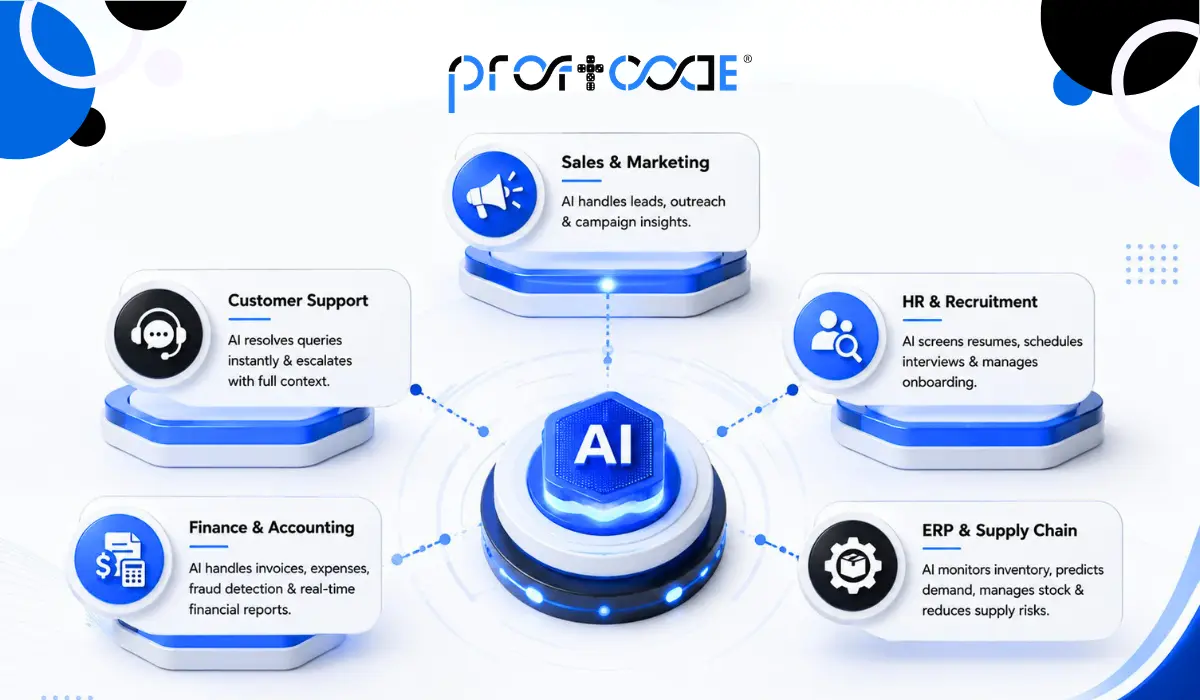
AI agents for business automation are reshaping every function. Here are the top AI agent use cases for Indian businesses and global enterprises alike.
Sales and Marketing
AI agents for sales and marketing handle lead qualification and work seamlessly with our CRM development solutions to trigger the right action at the right moment, personalized outreach, follow-up scheduling, and campaign analysis. They sit inside your CRM and trigger the right action at the right moment, shortening sales cycles and freeing your team to close deals.
Customer Support
AI agents for customer support resolve a large share of tier one queries on their own. They pull answers from product manuals and past tickets, then escalate complex issues to humans with full context already attached.
HR and Recruitment
AI agents for HR automation screen resumes, schedule interviews, send onboarding documents, and track employee engagement. What used to take recruiters days now takes minutes.
Finance and Accounting
AI agents for finance automation handle invoice matching, expense categorization, fraud detection, and reporting. They integrate with accounting and bank systems, giving leaders a real-time view of cash flow.
ERP and Supply Chain
AI integration with ERP software is one of the most powerful use cases in 2026. AI agents monitor inventory, predict demand, reorder stock, and flag supply chain risks before they affect operations. This level of intelligent process automation was not possible with traditional ERP setups.
AI Agents vs Traditional Workflows
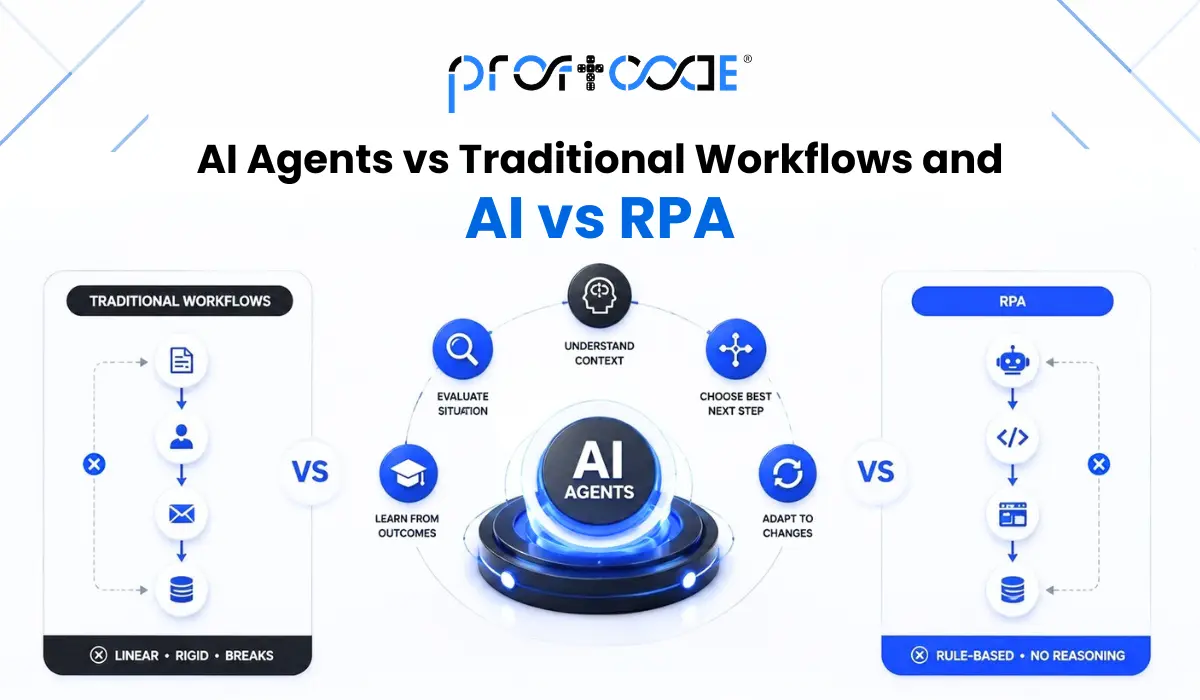
Traditional workflows are linear. If something unexpected happens, the workflow breaks, and someone has to fix it manually. The older AI vs RPA conversation showed a similar limit. RPA tools follow scripts. They cannot reason. AI agents understand context.
AI agents are dynamic. They evaluate the situation, choose the best next step, and adjust when conditions change. They learn from outcomes and coordinate with other agents through workflow orchestration, creating multi-agent AI systems that handle complex, cross-functional processes end to end. In a business environment where conditions change daily, that flexibility is no longer a luxury. It is a necessity.
Benefits of Replacing Traditional Workflows with AI Agents
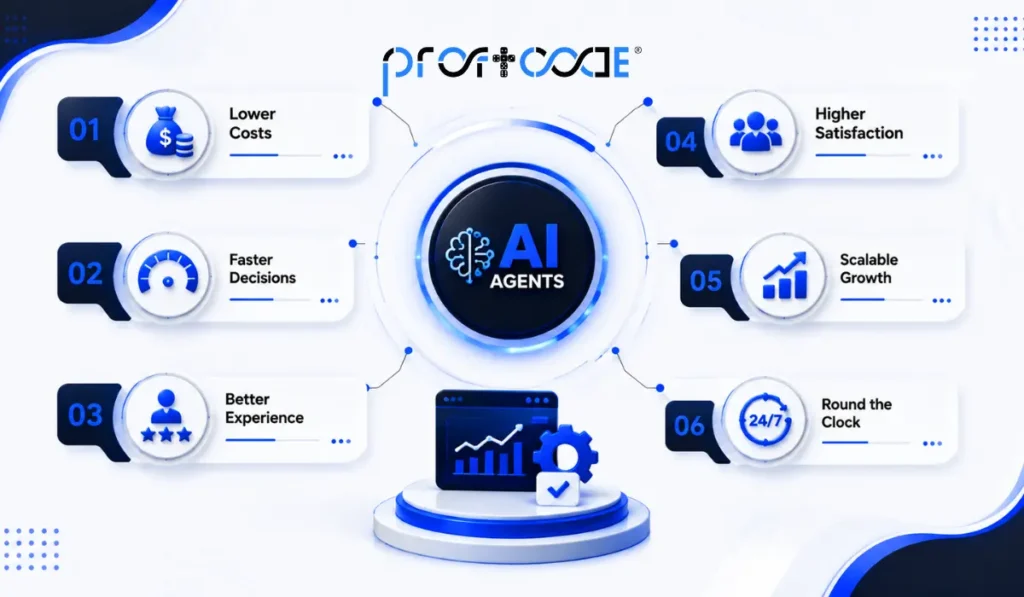
The benefits of replacing traditional workflows with AI agents go far beyond saving time. Businesses adopting AI-driven business transformation in 2026 are seeing measurable gains.
- Lower costs: Many businesses report how AI agents reduce operational costs by 30 to 50% in the functions they automate first.
- Faster decision-making: AI agents surface insights instantly using decision intelligence.
- Better customer experience: Instant responses and personalized communication build loyalty.
- Higher employee satisfaction: Teams focus on meaningful work instead of routine tasks.
- Scalable growth: Enterprise AI solutions handle 100 customers or 100,000 with the same system.
- Round-the-clock operations: AI agents work continuously, ideal for global businesses.
How to Implement AI Agents in Your Business
You do not need to overhaul everything at once. The smartest approach to implementing AI agents in your business is to start small, prove value, and expand.
- Identify high-volume, repetitive tasks where your team spends the most time on routine work.
- Map the workflow clearly so the AI agent is designed around real business logic.
- Choose the right technology stack, including custom AI agent development, no-code AI tools where suitable, and integration with your CRM and ERP.
- Pilot, measure, and refine with one workflow before scaling to the next.
- Train your team so that employees can collaborate effectively with AI agents.
Working with an experienced AI agent development company ensures your AI investment delivers measurable returns from day one.
Overall View
The shift to AI agents is not a future trend. It is already happening, and 2026 is the year it becomes mainstream. Businesses that continue to rely on rigid, manual workflows will fall behind those embracing AI agents for business automation. The opportunity is to redesign how work gets done, not just to add another tool to existing processes.
Whether you run a startup exploring AI agents for small businesses or a larger organization adopting agentic AI for enterprises, the path forward is clear. Start small, choose the right partner, and let AI handle the work that should never have been manual. At Proftcode, an AI automation company in India and a trusted AI development company in Jaipur, we help businesses build, deploy, and scale AI agents that solve real problems. From AI automation services for businesses to AI integration with ERP software, AI-powered CRM automation, and complete business digital transformation with AI, our team designs solutions that fit your goals and your budget. Talk to our team and start your transition today.
If your business is still relying on manual processes, repetitive tasks, and outdated workflows, you are losing time and money every single day. Proftcode helps businesses in India implement AI agents that work around the clock, handle complex workflows, and deliver real results. Get in touch with our team and take the first step toward smarter business automation.
Frequently Asked Questions
A chatbot follows scripted rules and answers predefined questions. An AI agent is autonomous, learns from data, plans multi-step actions, and integrates with other business systems to complete entire workflows on its own. It is the next stage of AI chatbot and agent development.
Yes. AI integration with ERP software is one of the most powerful use cases in 2026. They can automate sales, marketing, customer support, and admin tasks, giving small teams enterprise-level capability without enterprise-level cost.
The cost of AI agent development for small businesses depends on complexity, integrations, and use cases. Simple workflow agents start at modest budgets, while custom solutions with ERP and CRM integration need a larger investment. A free consultation with a development partner gives you a clear estimate.
Absolutely. Modern AI agents integrate with platforms like Salesforce, HubSpot, Zoho, SAP, and custom ERP systems. AI integration with ERP software and AI-powered CRM automation are among the top AI agent use cases for Indian businesses today.
No. The AI agents vs human workforce debate misses the point. AI agents replace repetitive workflows, not people. Employees move to higher value work like strategy, creativity, customer relationships, and problem solving, supported by a digital workforce that never sleeps.