
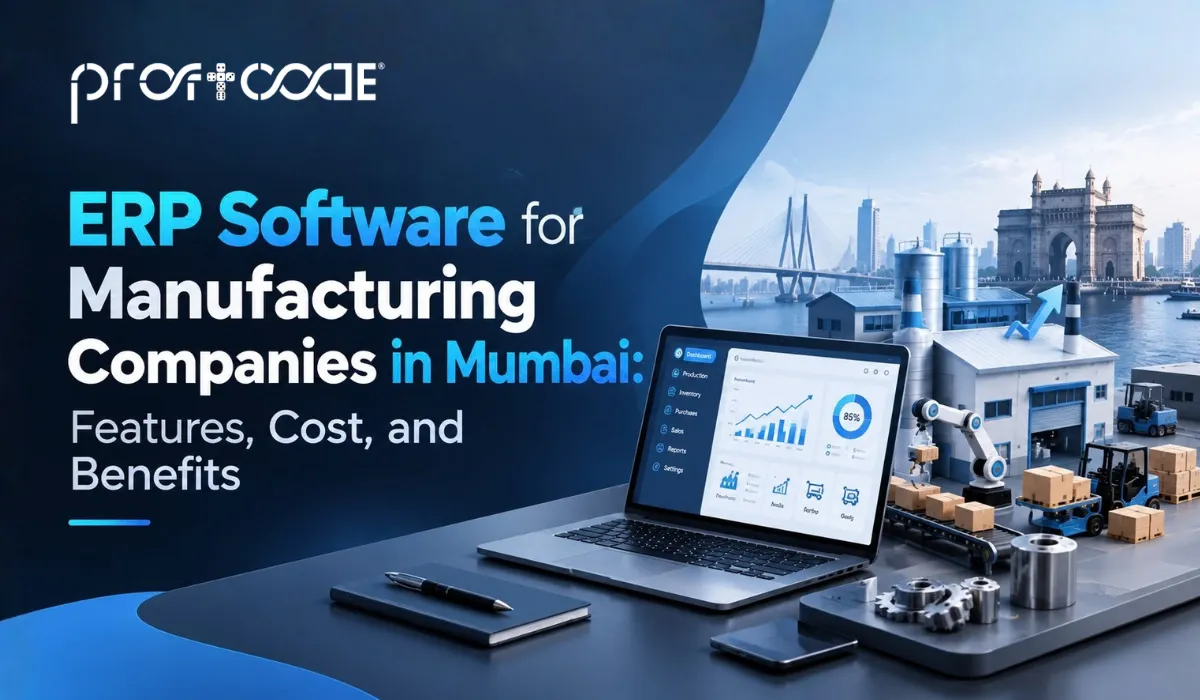
Manufacturing in Mumbai comes with a specific kind of pressure. Real estate costs eat into margins before production even starts. GST filings, e-invoicing, and e-way bills all need to be accurate every single month. And a lot of businesses are still running inventory on Excel, production updates on WhatsApp, and accounts separately on Tally, hoping the three somehow line up at month-end. ERP software for manufacturing companies in Mumbai exists to close exactly this gap. This post walks through the actual features, real cost ranges, and genuine benefits, so you’re not left guessing which numbers to trust.
What Is ERP Software for Manufacturing Companies?
ERP software for manufacturing companies is a connected system that brings production, inventory, purchasing, sales, and finance into one platform, instead of scattered spreadsheets and disconnected tools. It works by capturing data at every stage of the manufacturing process, from raw material purchase to finished goods dispatch, and making that data available to every department in real time, so decisions aren’t based on outdated or conflicting numbers.
Why Manufacturing Companies in Mumbai Need ERP Software in 2026
High Real Estate and Operating Costs in Mumbai
Space in Mumbai, whether it’s a shop floor in Bhiwandi or a warehouse in Taloja, comes at a premium most manufacturers elsewhere don’t deal with. Every square foot wasted on excess inventory or inefficient storage layout is money that could’ve gone toward actual growth. ERP helps optimize inventory levels so businesses aren’t paying rent to store stock they don’t immediately need.
GST, E-Invoicing, and E-Way Bill Compliance Pressure
Compliance requirements have only gotten stricter. Manual GST filing, disconnected from actual sales and purchase records, increases the risk of mismatches and penalties. A manufacturing ERP software Mumbai businesses use for GST-ready billing automatically generates accurate invoices, e-way bills, and tax reports, cutting down the manual reconciliation that used to eat up an accountant’s entire week.
Multi-Location Units (Mumbai Office, Bhiwandi Warehouse, MIDC Plant)
It’s genuinely common for a Mumbai-based manufacturer to have a sales office in the city, a warehouse in Bhiwandi, and a production unit somewhere in a MIDC zone. Coordinating inventory, production schedules, and dispatch across these locations manually is a recipe for mismatched numbers and missed deadlines. ERP centralizes this, giving every location visibility into the same live data.
Lorem ipsum dolor sit amet, consectetur adipiscing elit. Ut elit tellus, luctus nec ullamcorper mattis, pulvinar dapibus leo.
Tally and Excel Limits When Business Grows
Tally handles accounting well, but it was never built to manage production planning, raw material tracking, or multi-location inventory. Excel, similarly, works fine for a handful of SKUs and a small team but falls apart once order volume and complexity increase. Businesses relying on both often end up duplicating data entry, which is exactly where errors creep in.
Key Features of ERP Software for Manufacturing Companies in Mumbai
Production Planning and Scheduling
- Plans production runs based on demand forecasts and current capacity.
- Reduces machine idle time by scheduling jobs more efficiently.
- Flags potential bottlenecks before they cause delays down the line.
Inventory and Raw Material Management
- Tracks stock levels in real time across multiple warehouses or units.
- Sends automated alerts when raw materials run low.
- Reduces both overstocking and the production delays caused by material shortages.
Bill of Materials (BOM) Management
- Maintains accurate BOM records for every product variant.
- Automatically calculates raw material requirements based on production orders.
- Reduces wastage from inaccurate material estimation.
Quality Control and Batch Tracking
- Embeds quality checkpoints directly into the production workflow.
- Tracks batches and lots for traceability, especially important for pharma, chemical, and food processing units.
- Flags deviations from quality standards immediately, not after the batch has shipped.
Purchase and Vendor Management
- Tracks purchase orders, vendor performance, and pricing history.
- Helps negotiate better terms using actual historical purchase data.
- Reduces duplicate or unnecessary purchases across departments.
Sales, Dispatch, and Order Management
- Tracks orders from confirmation through to dispatch.
- Gives sales teams real-time visibility into stock availability before promising delivery dates.
- Reduces the awkward situation of committing to stock that isn’t actually there.
Finance, GST, and Accounting Integration
- Automates invoicing, GST calculations, and e-way bill generation.
- Keeps a clean, audit-ready trail of every transaction.
- Reduces the manual reconciliation between production data and financial records.
HR, Payroll, and Attendance
- Manages payroll processing and attendance tracking for shop floor and office staff.
- Simplifies leave approvals and shift scheduling.
- Reduces the HR overhead that comes with manually managing a growing workforce.
Reports, Dashboards, and Mobile Access
- Generates real-time dashboards for production, inventory, and financial performance.
- Allows managers to check numbers remotely instead of waiting for someone at a desk to compile a report.
- Supports custom reporting for metrics specific to your business.
AI and Automation Features (2026 Trend)
- Demand forecasting based on historical sales patterns and seasonal trends.
- Predictive maintenance for machinery, flagging wear before it causes a breakdown.
- Automated anomaly detection across financial and inventory data, catching issues early rather than during a monthly audit.
ERP Software Cost for Manufacturing Companies in Mumbai
This is usually the section everyone actually wants to read, so let’s be direct about it.
Average ERP Cost Range in 2026
These are approximate, illustrative ranges based on typical project scope. Actual costs vary depending on your specific requirements, so treat this as a starting reference rather than a fixed quote.
Business Size | Users | Approximate Cost Range (INR) |
|---|---|---|
Small manufacturer | 5 to 15 users | 1.5 lakh to 6 lakh |
Mid-size manufacturer | 15 to 50 users | 6 lakh to 20 lakh |
Large manufacturer | 50+ users, multi-location | 20 lakh and above |
Pricing Models Explained
One-time license (on-premises):
- A single upfront payment for the software license.
- Additional costs for server hardware and IT maintenance.
- No recurring per-user fees, but higher initial investment.
Per-user SaaS (cloud subscription):
- Monthly or annual fee based on number of users.
- Lower upfront cost, but recurring fees add up over several years.
- The provider typically handles updates and maintenance.
Custom development:
- Built specifically around your business processes.
- Higher upfront cost, but no recurring per-user fee structure.
- Full ownership of the system, with flexibility to modify it as your business evolves.
What Affects ERP Cost
- Number of users: More users generally means higher licensing or subscription costs.
- Modules required: Basic finance and inventory cost less than a full suite, including production planning, quality control, and HR.
- Customization level: Deeper customization around your specific workflows increases development time and cost.
- Integrations needed: Connecting with existing tools like Tally, e-commerce platforms, or industry-specific software adds to the scope.
- Deployment type: Cloud deployment generally has lower upfront costs, while on-premises requires hardware investment.
Hidden Costs to Watch Out For
- Data migration: Moving historical records from Excel or Tally into the new system often costs more than expected if the data isn’t clean.
- Training: Staff need proper onboarding, which takes time and sometimes additional vendor support fees.
- Annual maintenance contracts (AMC): Ongoing support and updates usually come with an annual fee, separate from the initial cost.
- Upgrades: As your business grows, adding modules or users later can involve additional development or licensing costs.
Cloud ERP vs On-Premise ERP: Cost Comparison
Factor | Cloud ERP | On-Premise ERP |
Upfront cost | Lower | Higher |
Recurring cost | Ongoing subscription | Minimal, mainly AMC |
Hardware investment | Not required | Required |
Maintenance | Handled by provider | Requires internal IT |
Long-term cost (5 years) | Can exceed on-premises for larger teams | Often more predictable |
Custom ERP vs Ready-Made ERP: Which Is Better for Mumbai Manufacturers?
Factor | Custom ERP | Ready-Made ERP |
Upfront cost | Higher | Lower |
Flexibility | Built around your exact workflow | Limited to the platform’s features |
Time to launch | Longer, typically a few months | Faster, often within weeks |
Scalability | Scales with your specific growth plans | May hit tier limits as you grow |
Ownership | Full ownership, no vendor lock-in | Dependent on vendor’s pricing and roadmap |
For manufacturers with fairly standard processes, ready-made ERP can genuinely work well. But businesses with unique production workflows, multiple units across Mumbai’s industrial belt, or specific compliance needs tend to outgrow generic platforms fairly quickly. This is where working with an experienced ERP development company in Mumbai, like Proftcode, makes a real difference, since a custom-built system reflects exactly how your production, inventory, and finance actually operate, rather than forcing your business into someone else’s template.
Benefits of ERP Software for Manufacturing Companies in Mumbai
Lower Inventory Holding Costs
Real-time stock visibility helps avoid overstocking, which directly reduces the cost of storing excess raw material or finished goods, something that matters even more given Mumbai’s real estate costs.
Faster Production and Fewer Delays
Better scheduling and material planning mean fewer production stoppages caused by missing raw materials or scheduling conflicts, helping keep delivery timelines on track.
Real-Time Visibility Across All Units
Whether your production happens in a MIDC plant and your warehouse sits in Bhiwandi, ERP gives management a single, accurate view of operations across every location, without waiting for someone to compile separate reports.
Easy GST Compliance and Fewer Errors
Automated GST calculation and e-invoicing significantly reduce manual errors that often lead to compliance issues or penalties during filing season.
Better Decision-Making with Live Data
Managers get access to real-time dashboards instead of waiting for a month-end report, allowing quicker responses to emerging issues or opportunities.
Scalable Growth Without Extra Staff
As order volume grows, ERP automation handles a lot of the repetitive administrative work that would otherwise require hiring additional staff just to keep up with manual processes.
Industries in Mumbai That Benefit Most from Manufacturing ERP
Industry | Key ERP Need |
Pharma | Batch traceability and regulatory compliance |
Textile | Production scheduling and raw material tracking |
Chemical | Quality control and safety documentation |
Plastic and Packaging | Inventory management and BOM accuracy |
Food Processing | Expiry tracking and batch traceability |
Engineering and Fabrication | Project-based production planning |
Auto Components | Quality control and vendor management |
ERP for Manufacturers Across Mumbai Industrial Areas
Manufacturers operating out of MIDC Andheri, Bhiwandi, Thane, Navi Mumbai’s TTC industrial area, Vasai-Virar, or Taloja all face a common challenge: coordinating operations across locations that are often quite far apart geographically. A cloud-based, connected ERP system removes the need for constant physical visits or phone calls just to check stock or production status, giving businesses across these areas centralized visibility regardless of where each unit is located.
ERP Implementation Process and Timeline
- Requirement study: Understanding your existing workflows, pain points, and specific needs before proposing a solution.
- Design: Planning the system architecture and module structure based on the requirement study.
- Development or configuration: Building custom features or configuring existing modules to match your processes.
- Data migration: Transferring historical records from Excel, Tally, or previous systems into the new platform.
- Testing: Running the system through real scenarios to catch issues before go-live.
- Training: Walking staff through the new system with hands-on sessions, not just a quick demo.
- Go-live: Launching the system, usually with close support available during the first few weeks.
Typical timeline:
- Small manufacturers: 6 to 10 weeks.
- Mid-size to large manufacturers: 3 to 6 months, depending on customization and number of locations involved.
How to Choose the Right ERP Software Company in Mumbai
- Manufacturing experience: Look for a track record specifically with manufacturing businesses, not just general ERP projects.
- Customization capability: Confirm they can build around your specific production workflow, not just configure a generic template.
- Local support: A Mumbai-based team offers faster response times and better understanding of local compliance requirements.
- GST-ready systems: Ensure the platform handles GST, e-invoicing, and e-way bills accurately out of the box.
- Cloud option availability: Check whether they offer flexible deployment, cloud, on-premises, or hybrid, based on your needs.
- Scalability: The system should grow with your business without requiring a complete rebuild later.
- Post-launch support: Confirm what support looks like after go-live, not just during development.
- Transparent pricing: Ask for a detailed cost breakdown upfront, not a vague single figure.
Why Choose Proftcode for Manufacturing ERP Software
Proftcode builds custom ERP systems specifically around how manufacturing businesses in Mumbai actually operate, whether that’s a single unit in Bhiwandi or a multi-location setup spanning MIDC zones. The focus stays on understanding production workflows, inventory patterns, and compliance needs first, rather than pushing a generic template dressed up as customization. With ongoing local support and a track record across manufacturing sectors, the goal is to build a system your team genuinely uses, not one they quietly work around. If you’re evaluating options, a direct conversation about your specific setup is usually the fastest way to figure out what actually fits.
End of Line
Manufacturing companies in Mumbai are dealing with real estate costs, compliance pressure, and multi-location coordination that manual systems simply weren’t built to handle. ERP software addresses this directly, connecting production, inventory, and finance into one system that actually reflects how your business runs. Whether you choose a ready-made platform or a custom build, the right ERP system pays for itself through fewer errors, faster decisions, and genuine operational efficiency.
If you’re ready to see what this could look like for your specific business, book a free ERP consultation or demo with Proftcode and get a clear picture of the right fit before making any commitment.
Frequently Asked Questions
Costs typically range from 1.5 lakh for small manufacturers to 20 lakh or more for larger, multi-location operations, depending on users, modules, and customization level.
Small manufacturers typically see implementation completed within 6 to 10 weeks, while mid-size to large manufacturers with more customization needs may take 3 to 6 months.
Yes, reputable cloud ERP providers use encryption, regular security audits, and access controls that often exceed what smaller businesses can build in-house.
Yes, most modern ERP systems can integrate with Tally for accounting purposes, though the depth of integration depends on the specific ERP platform and development approach.
For businesses with standard processes, ready-made ERP works well. For manufacturers with unique workflows or multi-location operations, a custom ERP typically offers a better long-term fit and scalability.