
Key Takeaways
- ERP selection is organizational transformation, not just a software purchase; treat it with that weight.
- Document your functional, technical, compliance, and scalability requirements before talking to any vendor.
- Industry experience matters: ERP for a pharma distributor looks nothing like ERP for a garment manufacturer.
- Fully custom ERP offers maximum flexibility but takes longer; configurable platforms deploy faster with some process trade-offs.
- Systems must natively handle GST, e-invoicing, and TDS/TCS, not through manual workarounds.
- Red flags: no industry references, fixed pricing without a requirements analysis, unrealistic timelines, and resistance to written SLAs.
Every business owner in Delhi reaches a point where the old ways of working simply stop being enough. The spreadsheets become too complex, the manual processes too error-prone, and the lack of real-time visibility too costly. This is usually the moment when the conversation about ERP begins. But what follows that conversation, specifically the process of choosing the right ERP software development company in Delhi, is where businesses make their most consequential technology decision and, unfortunately, also their most common mistakes.
An ERP system is not just a software purchase. It is an organisational transformation that touches every department, every process, and every person in your company. The vendor you choose will have more access to your business operations than almost any other external partner you will ever work with. That is why this decision deserves far more rigour than comparing pricing brochures or reading a few online reviews.
What ERP Software Actually Involves for Delhi Businesses
Before you evaluate a single vendor, you need to be completely clear about what ERP implementation actually means for your business. Many business owners enter this process thinking they are buying software. What they are actually doing is redesigning the operational architecture of their entire company.
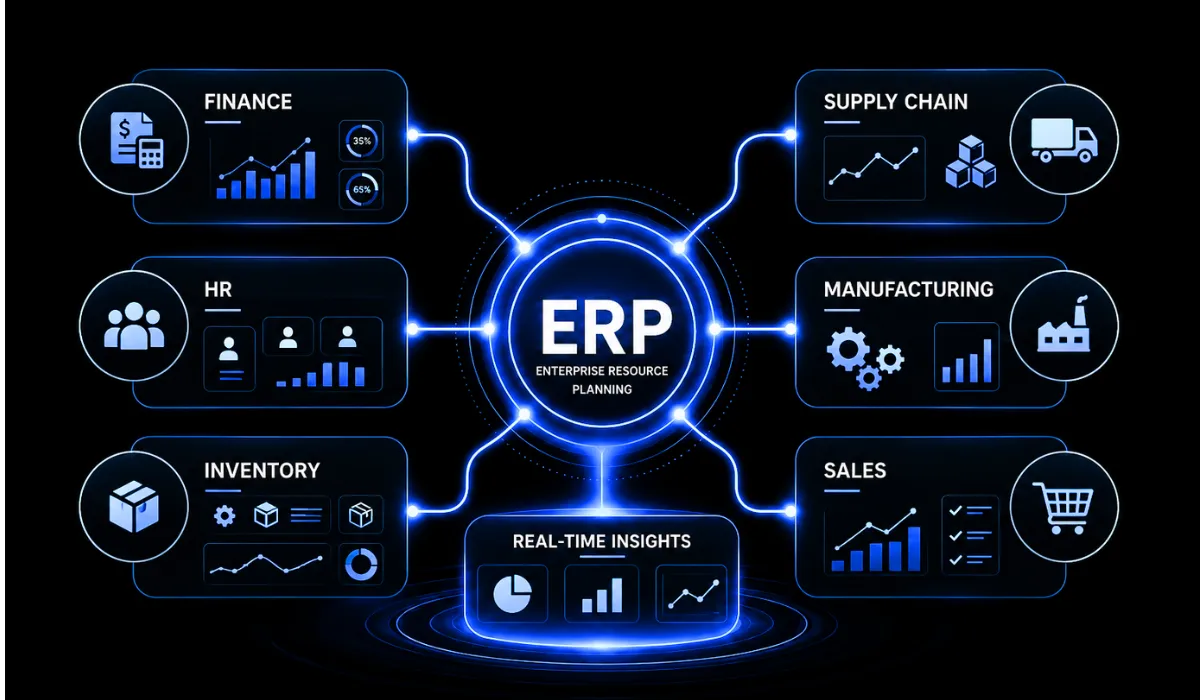
A well-implemented ERP system brings together:
- Finance and accounting, including GST compliance and statutory reporting
- Procurement and vendor management
- Inventory and warehouse management
- Manufacturing or production planning
- Human resources and payroll
- Sales and customer relationship management
- Real-time reporting and business intelligence dashboards
When it works well, data flows seamlessly across every department. When it is poorly implemented, you end up with a system more complicated than the problem it was supposed to solve. Understanding this scope helps you ask better questions when you speak to any ERP solutions company in India.
Define Your Requirements Before Approaching Any ERP Company in Delhi
One of the most common and costly mistakes businesses make is approaching ERP vendors before they have documented their own requirements. When you walk into a sales meeting without clarity, you become susceptible to being sold features you do not need and missing the ones you genuinely do.
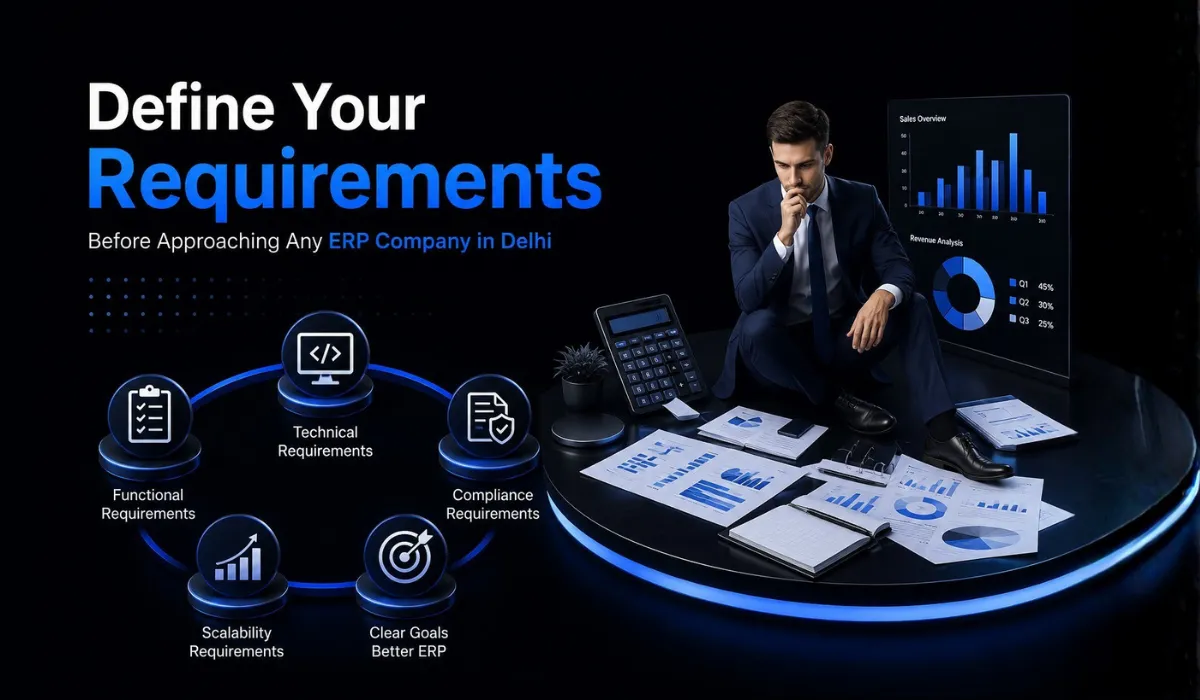
Before reaching out to any custom ERP software development company in Delhi, conduct a proper internal requirements analysis. Document the following clearly:
- Functional requirements: what the system must do across each department
- Technical requirements: what platforms, tools, and systems it must integrate with
- Compliance requirements: GST, TDS, e-invoicing, MCA, and industry-specific regulations
- Scalability requirements: where your business needs to be in the next three to five years
When you approach vendors with this document in hand, you immediately separate yourself from the majority of prospects they deal with. You also create an objective baseline against which every proposal you receive can be fairly evaluated.
Evaluate Industry Experience, Not Just Technical Capability
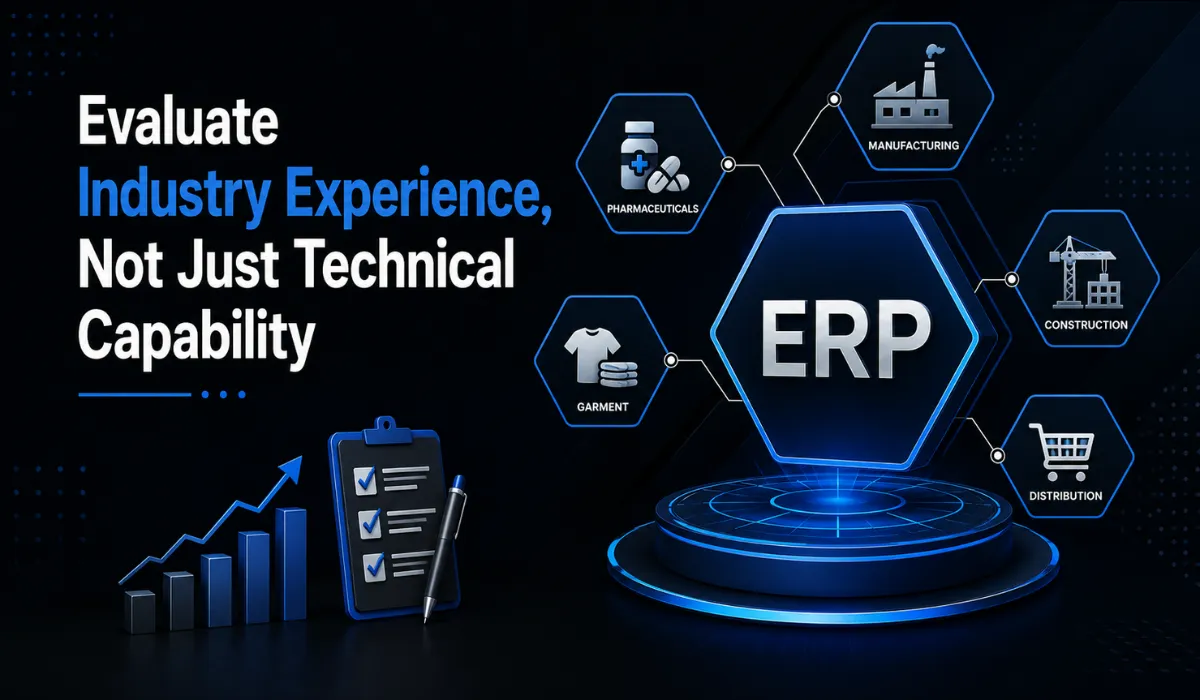
Technical skill is the bare minimum. What genuinely differentiates strong ERP software developers in Delhi is deep, demonstrable experience in your specific industry. An ERP built for a pharmaceutical distributor operates very differently from one built for a garment manufacturer or a construction company. The data models, compliance requirements, approval workflows, and reporting structures are fundamentally different across sectors.
When evaluating any company, go beyond its marketing material and ask:
- Have you implemented ERP systems for businesses in my industry specifically?
- Can you share a detailed case study including business size, modules implemented, and measurable outcomes?
- Can I speak directly with two or three of your existing clients who operate in a similar sector?
A confident and reputable company will facilitate these conversations without hesitation. Use these reference calls not just to validate claims but to understand what it was actually like to work with them through delays, scope changes, and post-launch challenges.
Read why Indian manufacturers are switching to custom ERP and what is driving that shift before choosing your development partner.
Custom ERP Development vs Configurable Platforms: Which is Right for You?
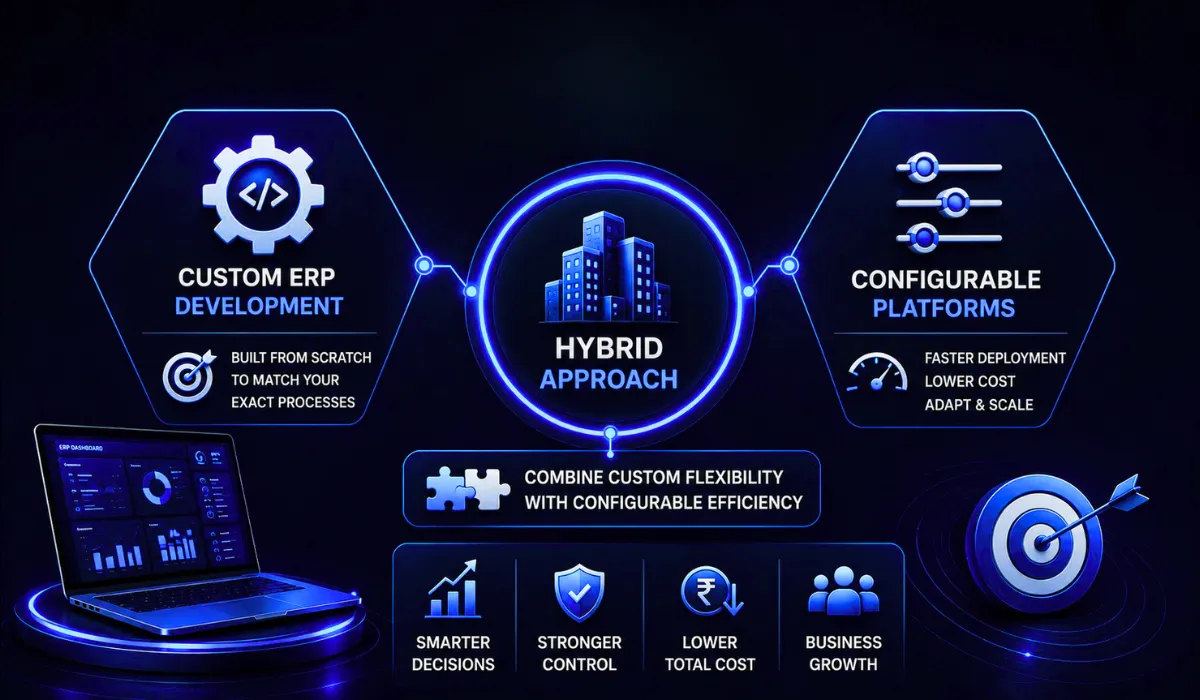
This is one of the most important strategic decisions in your ERP journey and one where many businesses get misled. There is a meaningful difference between a fully custom-built ERP and a configurable ERP platform, and the right choice depends entirely on your business profile.
Fully Custom ERP is built from scratch to match your exact processes. It offers maximum flexibility and is ideal for businesses with highly specialised or proprietary workflows. However, it requires a longer development timeline and a higher initial investment.
Configurable ERP Platforms are established frameworks adapted through configuration and selective customisation. They typically offer faster deployment and lower initial costs, but may require some process adjustments on your side.
The hybrid approach combines both, keeping core business data and critical processes on a custom layer while using configurable modules for standard functions like leave management or expense tracking.
As a trustworthy ERP development services company in Delhi NCR, I will give you an honest assessment of which approach suits your situation, even if one option is more profitable for them. Be cautious of any vendor who pushes the same solution to every client without examining your actual requirements first.
Assess Technical Depth Before You Sign Anything
ERP systems involve multi-tier architectures, real-time database transactions, API integrations, robust security frameworks, and performance optimisation across large datasets. During your evaluation, go well beyond the standard product demonstration.
Ask the right technical questions:
- How do you handle data integrity across concurrent transactions and multiple user sessions?
- What is your approach to role-based access control and data security?
- How have you handled integrations with Tally, GST portals, banking platforms, e-commerce marketplaces, and third-party logistics providers?
- What is your quality assurance process, including unit testing, integration testing, UAT, and performance testing under load?
- How do you manage version control and code documentation for long-term maintainability?
If the team in front of you cannot answer these questions clearly and confidently, that is a serious signal to look elsewhere. The best ERP software company in Delhi will welcome this level of technical scrutiny because it demonstrates that they build systems they are genuinely proud of.
Cloud ERP vs On-Premise ERP: What Delhi Businesses Need to Know
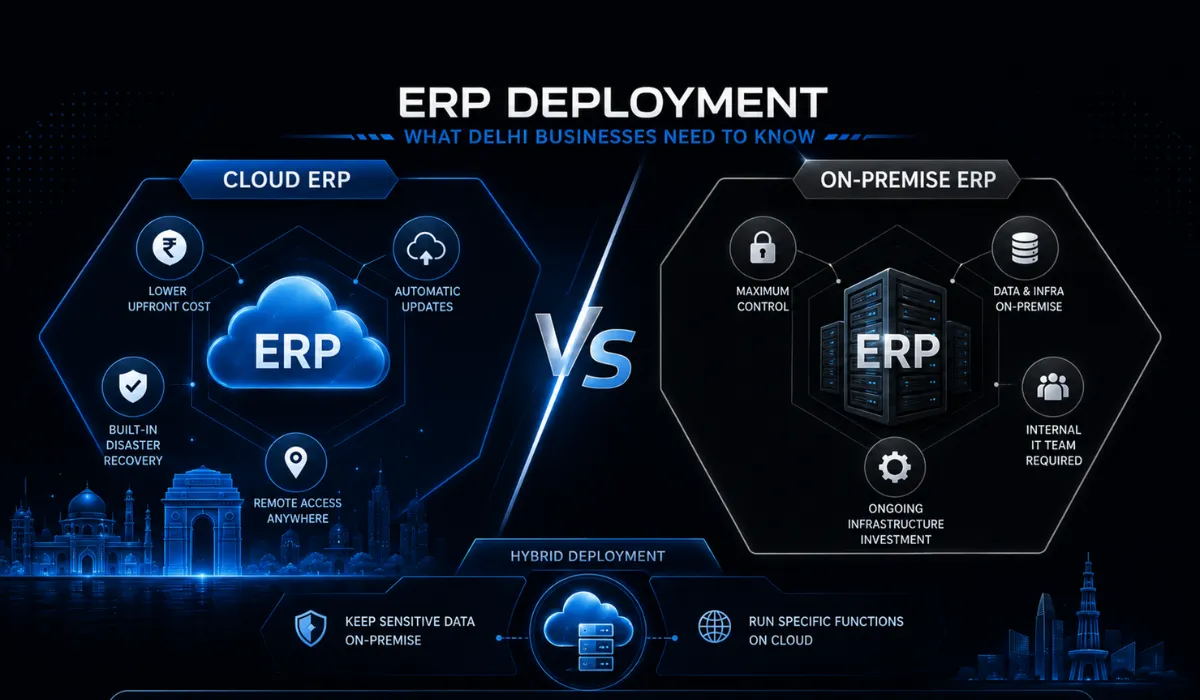
The choice between cloud and on-premise deployment is not a technical preference. It carries financial, operational, and strategic implications that will affect your business for years.
Here is a straightforward breakdown:
- Cloud ERP offers lower upfront infrastructure costs, automatic updates, built-in disaster recovery, and remote accessibility from any location—ideal for businesses with distributed teams, multiple branch offices across India, or limited internal IT capacity.
- On-Premise ERP keeps all data and infrastructure within your physical environment, giving you maximum control. Preferred by businesses in regulated sectors or those with specific data sovereignty policies. Requires a qualified internal IT team and ongoing infrastructure investment.
- Hybrid deployment allows you to keep sensitive operational data on-premises while running specific functions like field sales tools or employee self-service portals on cloud infrastructure.
A reliable cloud ERP software company in Delhi will model the total cost of ownership across all three scenarios over a five-year horizon and recommend based on your operational reality, not their preferred delivery model.
How to Evaluate ERP Implementation Methodology
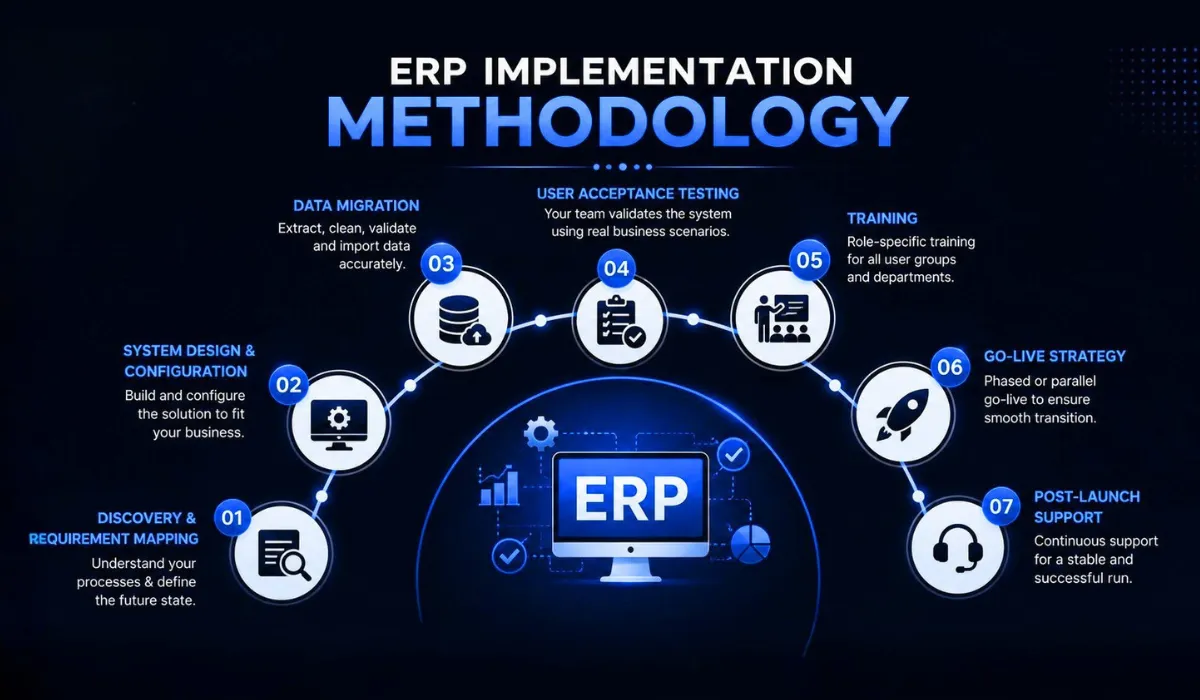
The quality of an ERP implementation is often determined less by the software itself and more by the methodology the implementing company follows. A structured, well-documented process is the mark of a mature organisation that has learned from real-world experience.
A credible implementation methodology should include these phases:
- Discovery and Requirement Mapping: Documenting your current processes and designing the future state
- System Design and Configuration: Building and configuring the solution to your specifications
- Data Migration: Extracting, cleaning, validating, and importing historical data from legacy systems
- User Acceptance Testing: Your team validates the system before go-live using real business scenarios
- Training: Role-specific training sessions for all user groups, from finance teams to warehouse staff
- Go-Live Strategy: A phased or parallel go-live approach to minimise operational disruption
- Post-Launch Support Period: A defined window of intensive support after you go live
Pay special attention to how they handle data migration. Moving years of transactional data from spreadsheets or older systems into a new ERP is one of the highest-risk phases of any project. Ask specifically for their data migration plan, how they handle data quality issues discovered mid-migration, and what their rollback strategy looks like if critical problems emerge close to go-live.
ERP Software Development Cost in Delhi: What You're Really Paying For
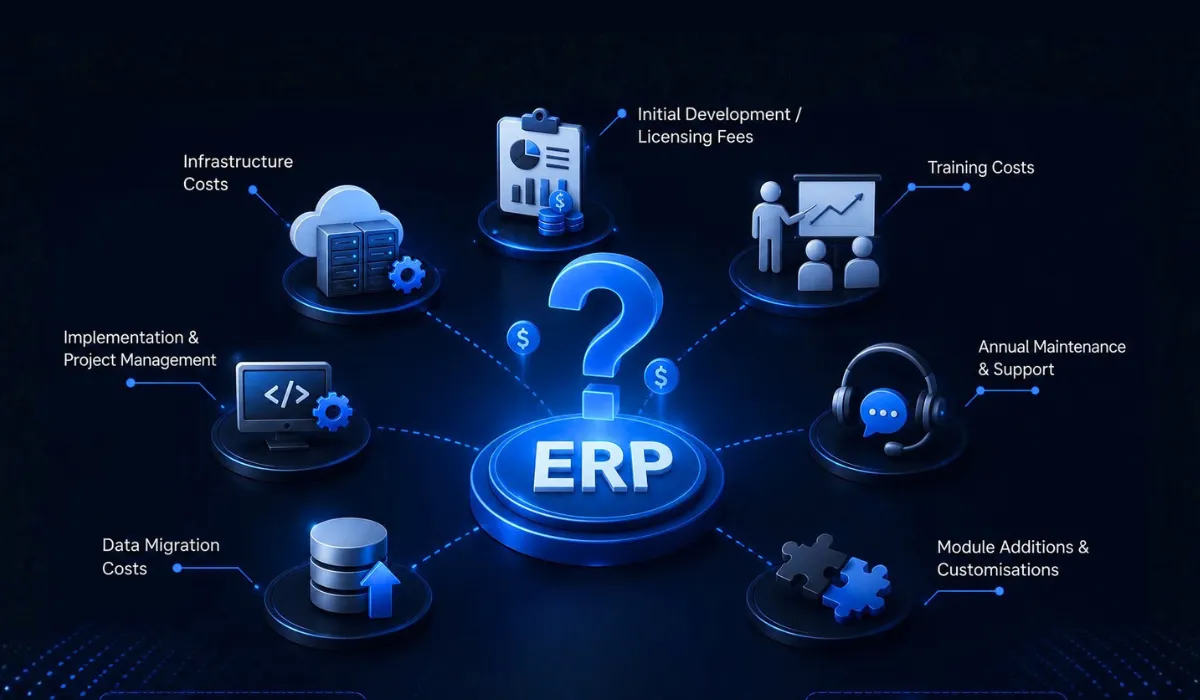
When businesses search for affordable ERP software development in Delhi, the most common mistake is treating the initial project quote as the total cost. In reality, ERP ownership costs extend significantly beyond development fees.
A complete five-year cost model should include:
- Initial development or licensing fees
- Implementation and project management charges
- Data migration costs
- Training costs across all user groups and locations
- Infrastructure costs for on-premise deployment
- Annual maintenance and support contracts
- Cost of future module additions and customisations
- Internal productivity cost of your team’s time during the implementation period
Request a detailed five-year total cost of ownership estimate from every vendor you seriously consider and compare them on this basis. A vendor who appears more expensive upfront but includes comprehensive training, dedicated support, and a clear upgrade path often represents far better long-term value than one offering a low initial price with costly ongoing support.
Post-Implementation Support Is Not Optional; It Is Critical
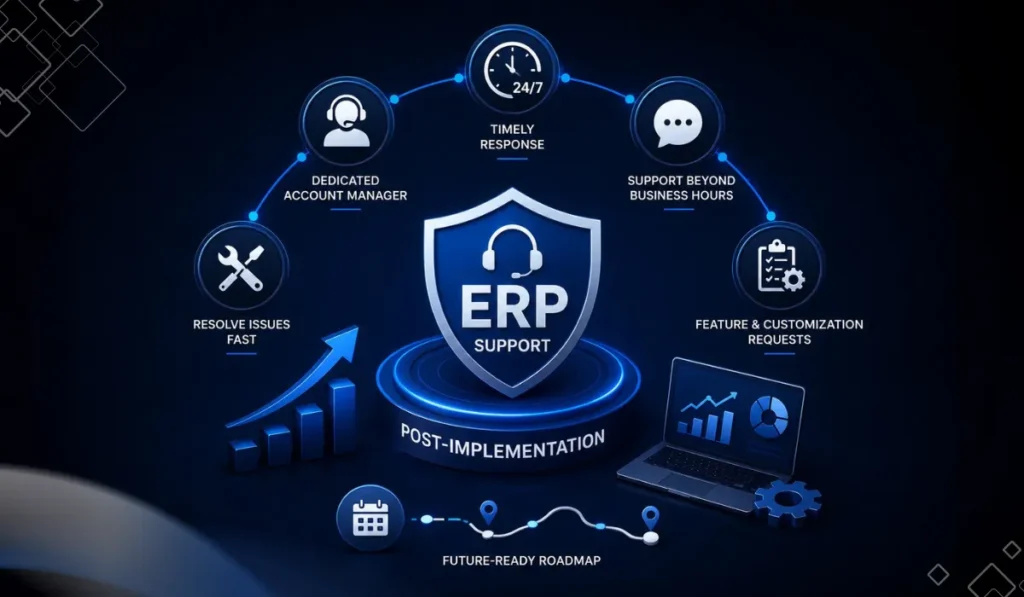
Your ERP system will need to grow with your business. Regulations will change, your team will expand, and new modules will become necessary over time. The support structure your vendor provides after go-live is therefore just as important as the quality of the initial build.
Before signing any agreement, get clear answers to these questions:
- What are the guaranteed response times for critical versus non-critical issues?
- Is support available beyond standard business hours for urgent situations?
- Is a dedicated account manager assigned to your account?
- How are requests for new features or customisations scoped and priced?
- What does the product roadmap look like for the next two to three years?
A strong ERP solutions company in Delhi will offer tiered support plans, documented service level agreements, and transparent processes for handling both urgent bugs and long-term feature evolution.
GST, TDS & Indian Compliance: What Your ERP Must Handle
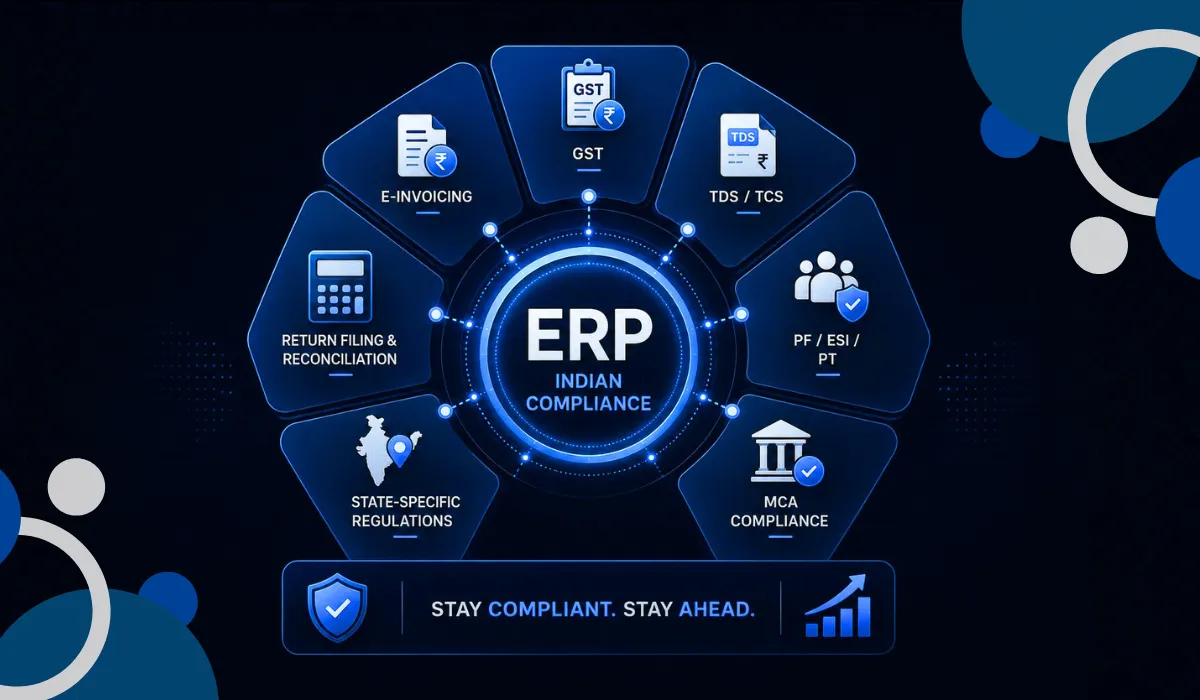
This point is often underweighted in ERP evaluations but carries enormous practical importance for businesses operating in India. Your ERP must handle Indian-specific compliance requirements natively and accurately, not through workarounds or manual adjustments.
A serious enterprise resource planning software company should demonstrate clear capability across:
- GST computation, return filing, and reconciliation across multiple tax slabs
- E-invoicing is mandated by the GST Council for applicable businesses
- TDS and TCS management with automated deduction and challan generation
- Provident Fund, ESI, and professional tax calculations within payroll
- MCA compliance for companies registered under the Companies Act
- State-specific regulations relevant to your sector and geography
Ask for a live demonstration using real scenarios from your business, not a pre-scripted walkthrough. Compliance failures in an ERP can result in penalties and regulatory exposure that far outweigh any cost savings made during vendor selection.
Red Flags You Should Never Ignore
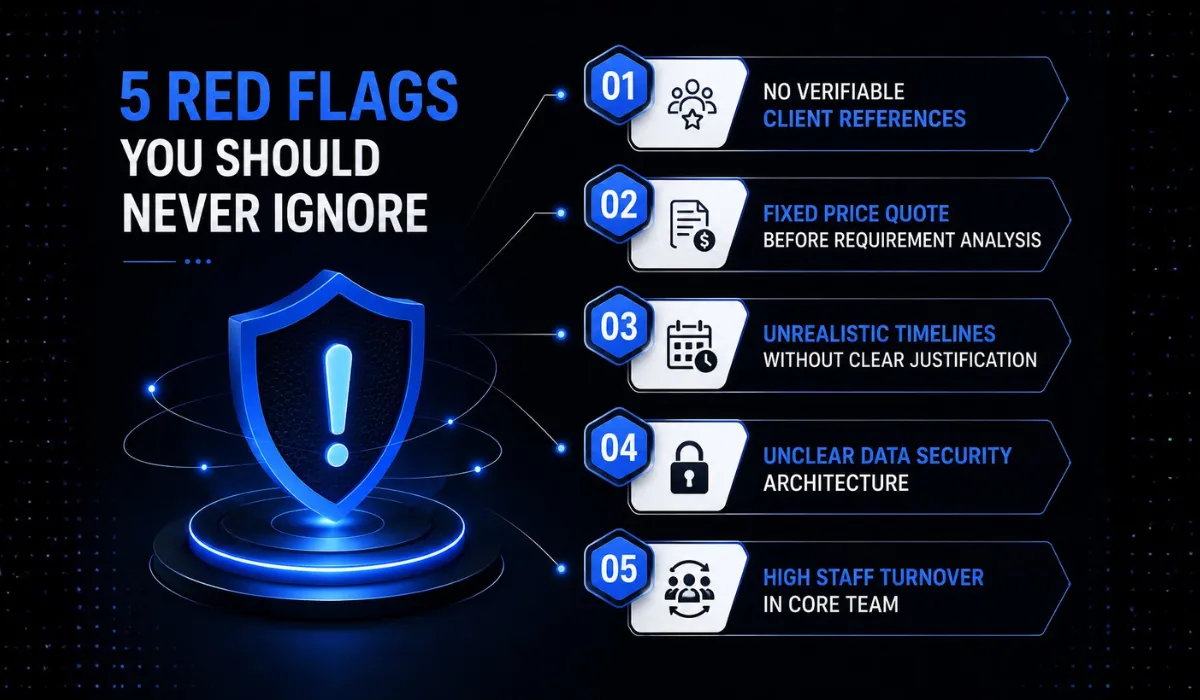
Experience in evaluating technology vendors teaches you to recognise patterns that signal serious risk. Walk away or ask very hard questions if you encounter any of the following:
- Vendors who cannot provide verifiable references from clients in your industry
- Fixed-price quotes are offered before any requirement analysis has been conducted
- Unrealistically short implementation timelines with no explanation of how they will be achieved
- Inability to clearly explain data security architecture and practices
- High staff turnover within the core development and delivery team
- Resistance to putting support commitments and SLAs in writing
- Evasiveness when asked about budget overruns, timeline slippage, or past project failures
None of these is a minor concern. Each one has the potential to derail an ERP project entirely and leave your business in a far worse operational position than before you started.
Making the Final Decision: Your Delhi ERP Partner
Choosing the right ERP software development company in Delhi comes down to preparation, the right questions, and finding a partner who is as invested in your success as you are. Do your internal homework first, evaluate vendors on substance, not just presentation, and think long-term. The right company will not just deliver software; they will help transform how your business operates every single day.
Start with our ERP development services guide for businesses to understand what a professional ERP development process looks like.
Got Questions? We’ve Got Answers
The cost of ERP development in Delhi varies widely depending on the scope, complexity, number of modules, and whether you choose a custom build or a configurable platform. A basic ERP for a small business can start from a few lakhs, while a full-scale custom enterprise solution for a mid-size company can range from fifteen lakhs to several crores. Always request a detailed five-year total cost of ownership estimate, not just the upfront development quote.
Implementation timelines depend on your business size, the number of modules, the complexity of data migration, and how prepared your internal team is. A straightforward ERP for a small business may take three to six months. A comprehensive multi-module system for a mid-size or large enterprise typically takes nine to eighteen months. Be cautious of any vendor promising unusually fast delivery without a detailed plan to back it up.
It depends on your business profile. Cloud ERP is generally better suited for businesses with distributed teams, limited IT infrastructure, or a need for remote accessibility. On-premise ERP suits businesses in regulated industries or those with specific data control requirements. A good cloud ERP software company in Delhi will walk you through both options and help you make an informed decision based on your actual needs.
Custom ERP is built specifically for your business workflows and offers maximum flexibility but requires more time and investment. Off-the-shelf or configurable ERP platforms are pre-built frameworks that can be adapted to your needs faster and at a lower initial cost. A reliable custom ERP software development company in Delhi will honestly assess which approach fits your situation rather than defaulting to one model for every client.
Ask directly for case studies and client references specific to your industry. A credible ERP solutions company in Delhi will be able to demonstrate past implementations in your sector with measurable outcomes. Speaking to their existing clients is the most reliable way to validate their claims and understand the real experience of working with them.