
Key Takeaways
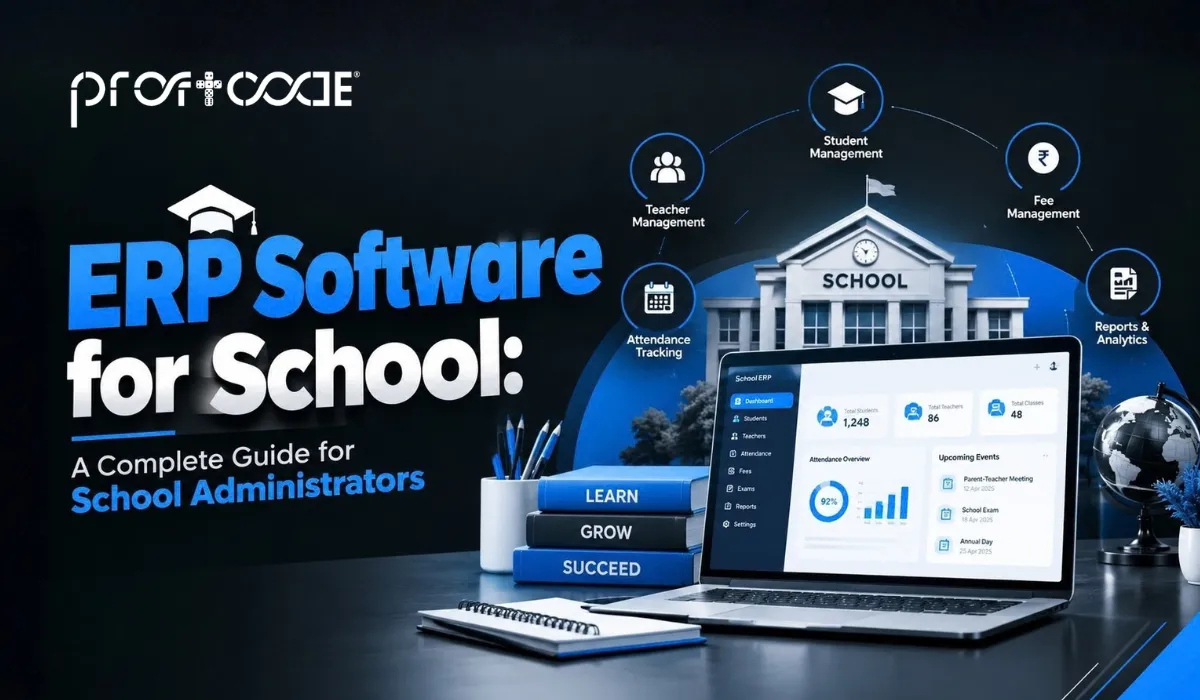
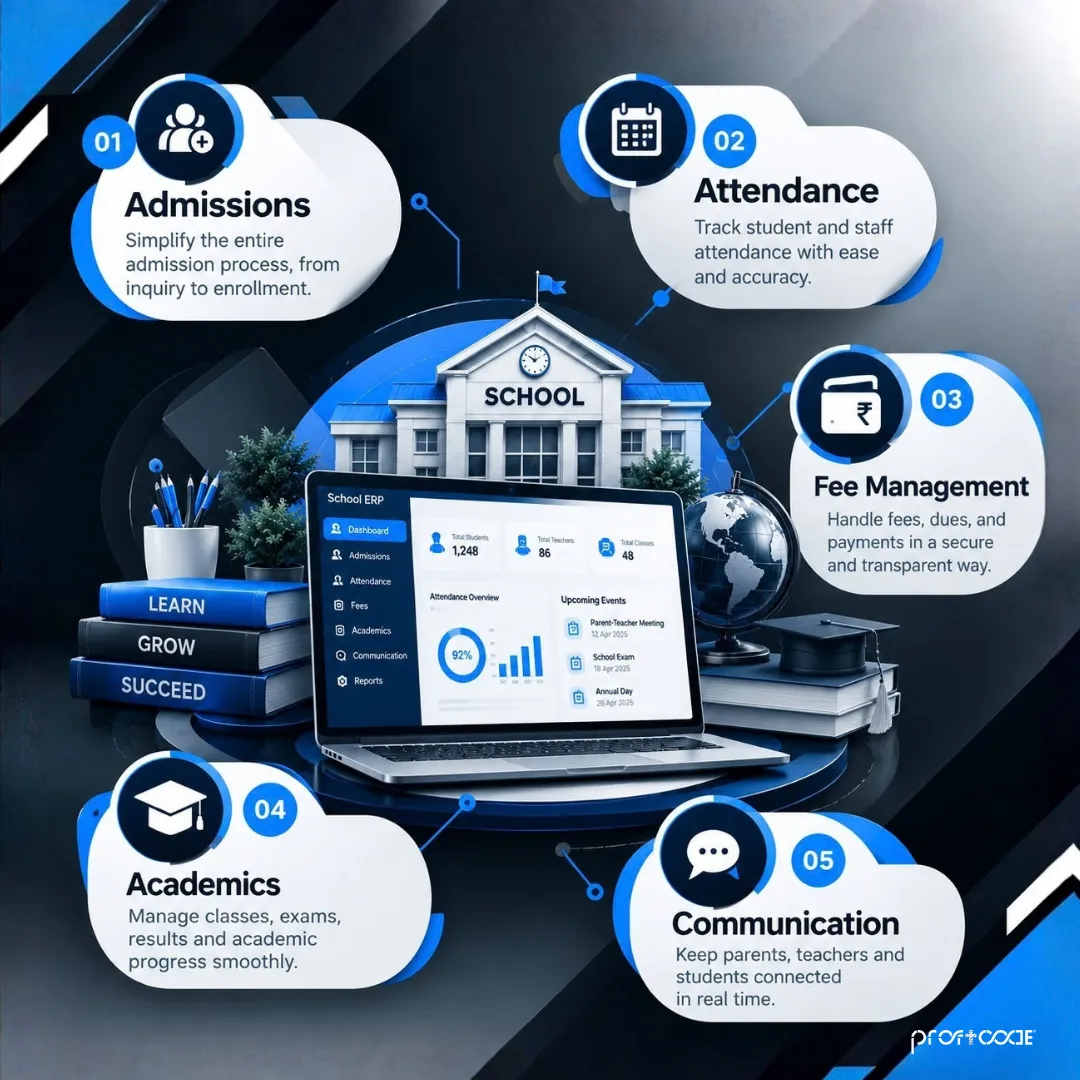
- School ERP connects admissions, fees, attendance, and communication in one system.
- Cost ranges from 50,000 for small schools to 6 lakh plus for large setups.
- Custom ERP fits unique needs. Ready-made fits standard single-campus schools.
- Cloud setups cost less upfront. On-premise offers tighter data control.
- Implementation takes 6 to 8 weeks, longer for multi-campus institutions.
- Common mistakes include choosing a generic ERP, skipping training, and making price-only decisions.
Run a school for even a year, and you’ll notice the same pattern every single term. Admission forms piling up in physical files. Handwritten fee receipts, then re-entered into Excel later. Attendance registers that don’t match what the accounts office has on record. None of this is because anyone’s careless. It’s just what happens when an institution grows past what paper and spreadsheets can reasonably handle.
This is exactly where ERP software for school comes in. This guide walks school administrators through what school ERP actually does, what it costs, how to choose the right provider, and what implementation genuinely looks like, so you’re not relying on a sales pitch to make this decision. If you’re still unsure whether your institution genuinely needs one, our broader piece on what ERP software is and why growing organizations need it is a useful starting point before diving into school-specific details.
Why Schools Need an ERP System for School Management in 2026
Admissions Season Turns Into Chaos Every Year
Without a proper ERP system for school management, admission season means stacks of physical forms, manual document verification, and staff cross-checking the same spreadsheet multiple times a day.
Fee Collection and Accounting Gets Messy Fast
Manual fee tracking across different classes, terms, and payment modes creates genuine reconciliation headaches. Proper accounting software for school components removes most of this friction by automating receipts, reminders, and ledger entries together.
Parent Communication Is Slow and Inconsistent
Circulars sent through physical notices or scattered WhatsApp messages often don’t reach every parent reliably, leading to confusion and repeated phone calls to the school office.
Attendance and Academic Records Don't Match Across Departments
When attendance is logged in one register and grades in another spreadsheet, discrepancies become almost inevitable, and sorting them out eats into staff time that should go toward actual teaching support.
Compliance and Board Reporting Keep Growing
Education boards increasingly expect organized, accurate records on short notice. A manual system makes this a scramble every single time an audit or inspection comes up.
How School ERP Works: Admission to Alumni Flow
Stage | What the ERP Does |
Inquiry | Logs prospective student details and follow-up status |
Admission | Manages application forms, document verification, and seat confirmation |
Fee Structure Setup | Assigns class- and term-wise fee structures automatically |
Attendance | Tracks daily student and staff attendance digitally |
Academics | Records grades, assignments, and exam results |
Fee Collection | Generates receipts and automates payment reminders |
Communication | Sends circulars and updates directly to parents |
Transport and Hostel | Tracks routes, allocations, and related billing |
Reporting | Compiles board-ready reports and academic transcripts |
Alumni Records | Maintains past student data for future reference |
Key Features of School ERP Software
Admissions Management
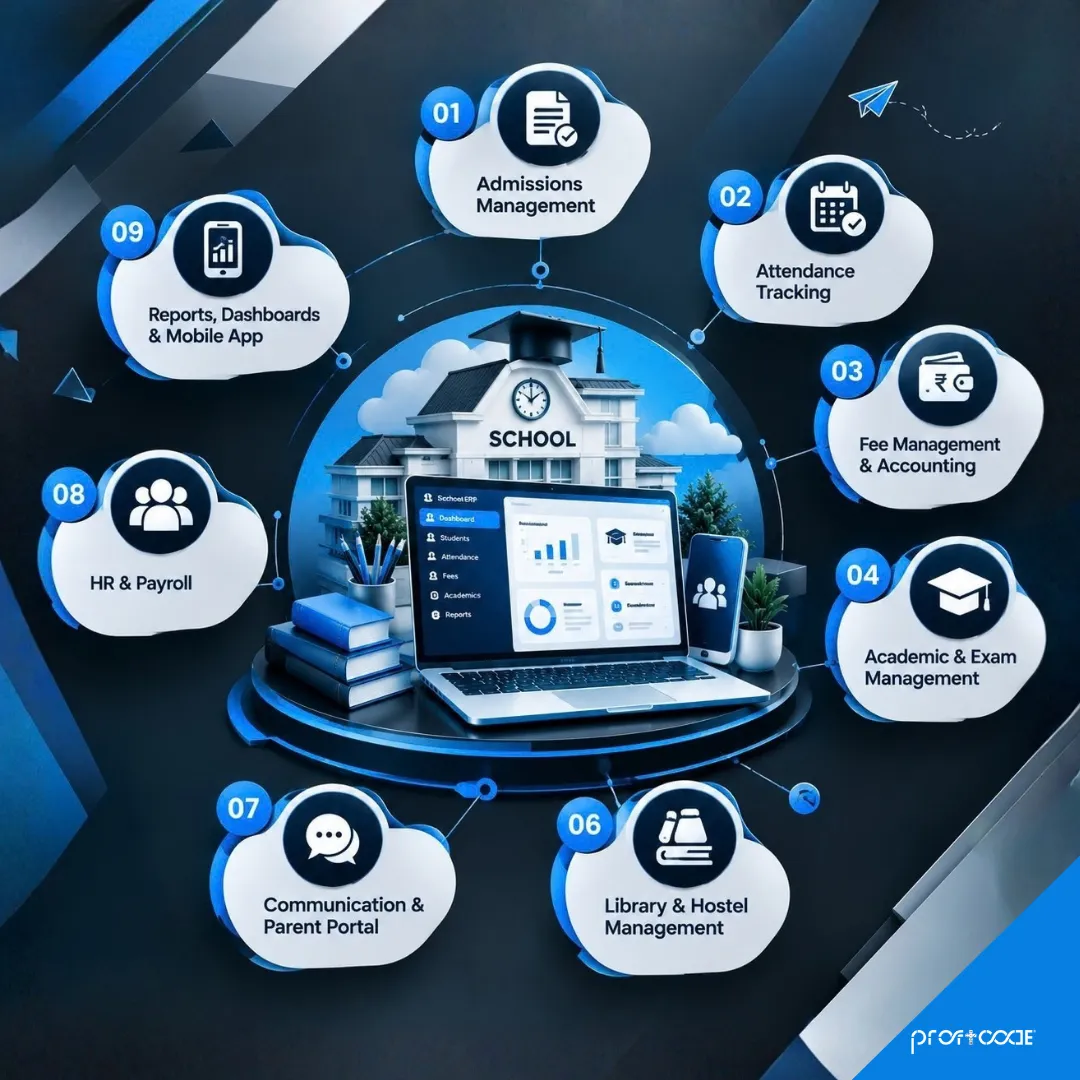
Handles the entire application process digitally, from inquiry to document verification to final seat confirmation, cutting down the seasonal paperwork rush significantly.
Attendance Tracking
Captures student and staff attendance in real time, with automatic notifications to parents when a child is marked absent.
Fee Management and Accounting Software for School
Automates fee structure assignment, receipt generation, payment reminders, and ledger entries, functioning as both a fee tracker and proper accounting software for schools in one place.
Academic and Exam Management
Manages grading, report card generation, and exam scheduling, reducing the manual compilation work teachers currently handle at term end.
Timetable and Transport Management
Organizes class schedules and transport routes, including real-time bus tracking in more advanced setups.
Library and Hostel Management
Tracks book issues and returns, along with hostel room allocation and related billing for residential schools.
Communication and Parent Portal
Gives parents direct access to attendance, grades, and fee status through a mobile app or portal, reducing dependency on phone calls to the office.
HR and Payroll
Manages staff attendance, leave tracking, and payroll processing, scaled appropriately for the school’s actual staff size.
Reports, Dashboards, and Mobile App
Gives school administrators real-time visibility into enrollment, fee collection, and academic performance from a phone, not just a desktop in the admin office. For a broader look at how these modules connect within a system, our guide on ERP software modules explains the underlying structure.
ERP Software for College: What's Different
Colleges share a lot of core needs with schools but add a few layers of their own.
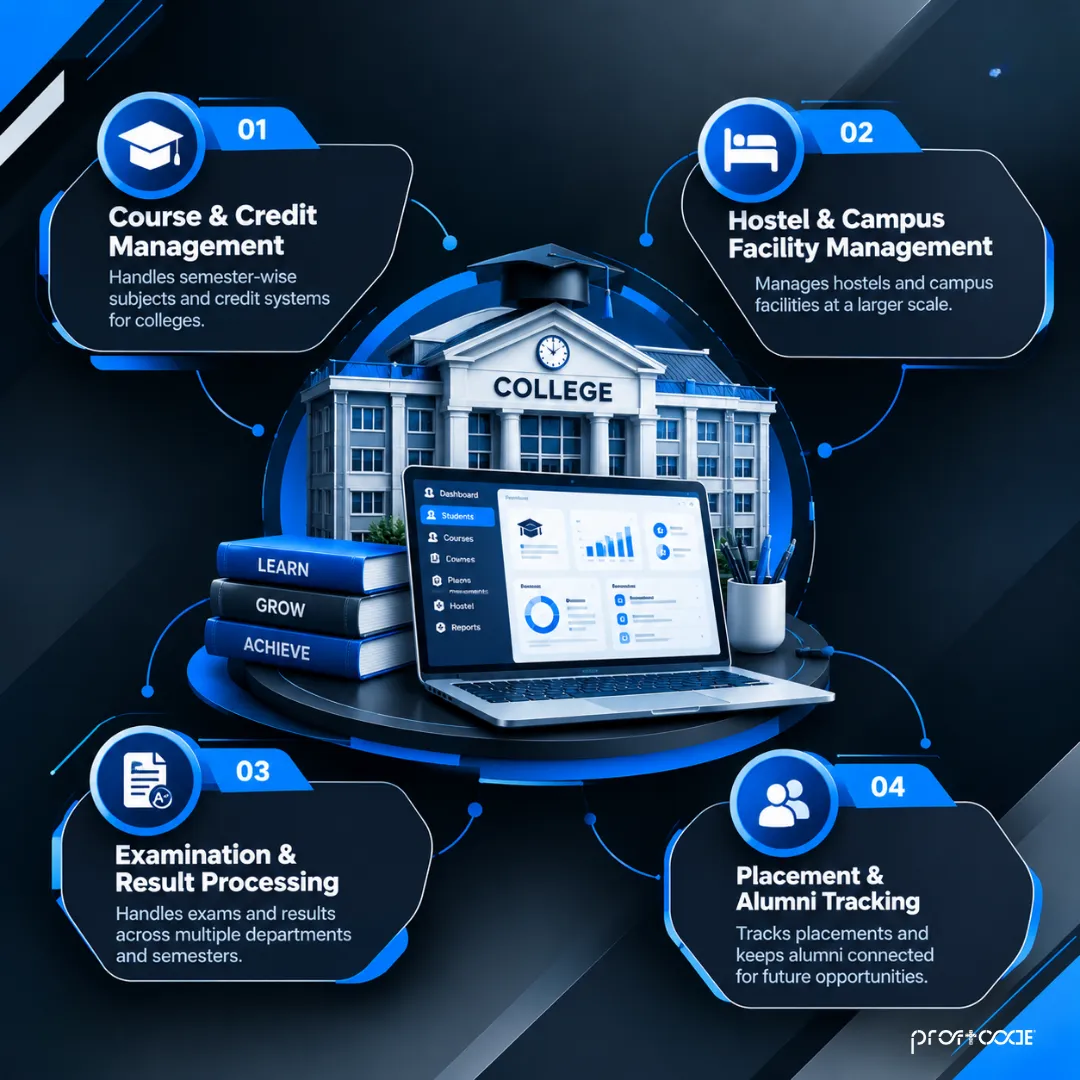
A proper ERP software for a college setup typically includes:
- Course and credit management, handling semester-wise subject allocation and credit systems that schools don’t need
- Hostel and campus facility management at a larger, often multi-building scale
- Examination and result processing across multiple departments and semesters simultaneously
- Placement and alumni tracking, which becomes genuinely important for colleges in a way it rarely is for schools
Colleges evaluating ERP should look specifically for providers with experience across both school and higher education contexts, since the two aren’t quite interchangeable despite sharing a lot of underlying structure.
Benefits of School ERP Software
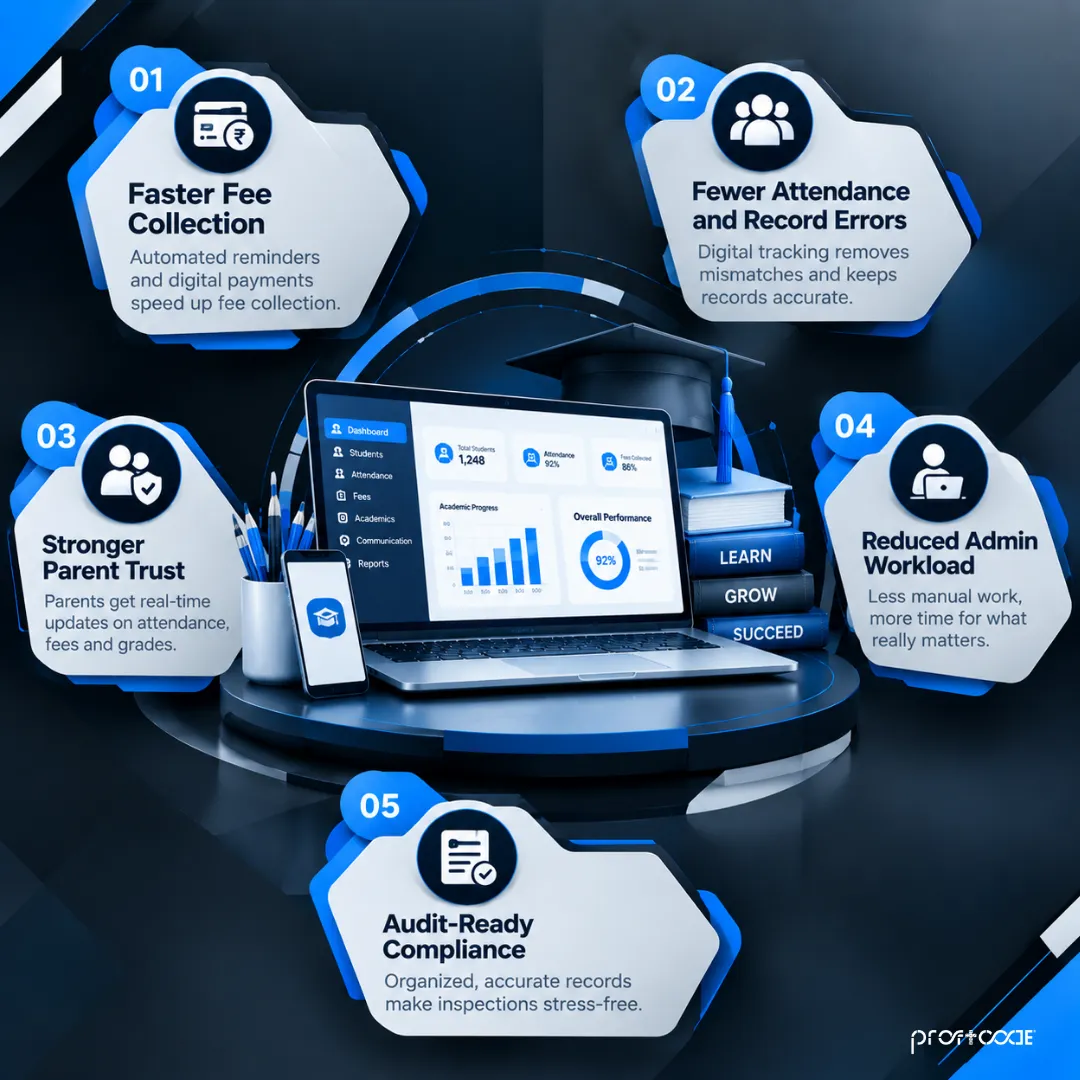
Faster Fee Collection
Automated reminders and digital payment options typically reduce the time staff spend chasing pending fees, freeing them up for more valuable administrative work.
Fewer Attendance and Record Errors
Digital attendance tracking removes the mismatches that happen when registers and spreadsheets are maintained separately by different staff members.
Stronger Parent Trust
Parents who can check attendance, fees, and grades directly through a portal tend to feel more confident in the school’s organization and transparency.
Reduced Admin Workload
Staff spend less time on repetitive manual tasks like compiling attendance or writing receipts by hand and more time on work that actually needs human judgment.
Audit-Ready Compliance
Board inspections and compliance checks become far less stressful when records are already organized and accurate within one system. Our broader piece on ERP solutions for smarter business growth covers how this kind of operational clarity benefits any growing organization, schools included.
ERP Software for School Price: What to Actually Expect
Average Cost Range in 2026
School Size | Typical Investment Range (INR) | Notes |
Small school (single campus) | 50,000 to 2 lakh | Often subscription-based, core modules only |
Mid-size school | 2 lakh to 6 lakh | Wider module coverage, some customization |
Large or multi-campus school | 6 lakh and above | Fully custom development, multiple integrations |
These figures are indicative and depend heavily on the number of students, modules required, and customization depth. Always ask for a quote based on your school’s actual requirements rather than a general figure.
Pricing Models
- One-time license. A single upfront payment, typically for on-premise deployment
- Per-student or per-user SaaS subscription. Recurring fee that scales with enrollment
- Custom development. Project-based pricing for a system built around your school’s specific processes
What Affects the Cost
- Number of students and staff accounts
- Specific modules needed, such as transport or hostel management
- Level of customization required for existing workflows
- Integrations with payment gateways or existing accounting tools
Hidden Costs to Watch Out For
- Data migration from existing registers or spreadsheets
- Staff training time, often underestimated in initial budgeting
- Annual maintenance and support contracts
- Hardware costs like biometric attendance devices or ID card printers
This is exactly the kind of gap that catches schools off guard during budgeting. Our detailed breakdown of hidden costs in off-the-shelf ERP software applies just as much to education as it does to other industries.
Cloud vs On-Premise School ERP: Which Is Better?
Factor | Cloud ERP | On-Premise ERP |
Upfront Cost | Lower | Higher |
Access | Anywhere, useful for multi-campus schools | Limited to school network |
Security | Provider-managed, generally strong | Fully in the school’s control |
Maintenance | Handled by provider | Requires in-house IT support |
Best For | Growing schools, remote access needs | Schools with strict data control requirements |
For a deeper comparison that applies across industries, our guide on cloud ERP vs traditional ERP breaks this down further, and our construction-focused piece on cloud AI ERP versus traditional ERP shows how the same trade-offs play out in a very different sector.
Custom vs Ready-Made School ERP Software
Factor | Ready-Made ERP | Custom ERP |
Fit to Process | Generic, needs adjustment | Built around your school’s exact workflow |
Upfront Cost | Lower | Higher |
Time to Launch | Faster | Longer |
Flexibility | Limited | High |
Ownership | Vendor-controlled, recurring fees | Full ownership, no per-student fee creep |
Schools with unique fee structures, specific board requirements, or multi-campus operations often find generic platforms genuinely limiting, not unlike why so many Indian manufacturers are switching to custom ERP for the same underlying reason. If you’re weighing this decision, our detailed comparison of custom ERP vs off-the-shelf ERP and our honest look at whether custom ERP is actually worth it are both worth reading before committing either way. For a growing, multi-campus institution specifically, our guide on ERP for a growing manufacturing company shows similar scaling principles that apply well beyond manufacturing alone.
At Proftcode, this is exactly where custom school ERP development fits best, for institutions whose fee structure, communication process, or reporting needs don’t map cleanly onto a generic platform built for a different kind of business.
Best ERP for Schools in India (2026)
Software | Best For | Deployment | Key Strength |
Proftcode Custom School ERP | Schools needing a fully custom workflow | Cloud or on-premises | Built entirely around the school’s specific processes |
Generic Cloud School ERP Platforms | Standard, single-campus schools | Cloud | Quick deployment, reasonable pricing |
Legacy On-Premise Systems | Established schools with existing infrastructure | On-premise | Familiar to long-term administrative staff |
SaaS Fee-Management Tools | Small schools needing basic fee tracking | Cloud | Simple, affordable entry point |
Multi-Campus ERP Suites | Large school groups across several locations | Cloud or hybrid | Centralized reporting across campuses |
For a broader view of how to evaluate any ERP vendor, our guide on choosing the right ERP software development company applies here just as much as it does for other sectors. Our dedicated piece on why ERP software matters for school management specifically goes deeper into this exact topic.
School ERP Software Company by City in India
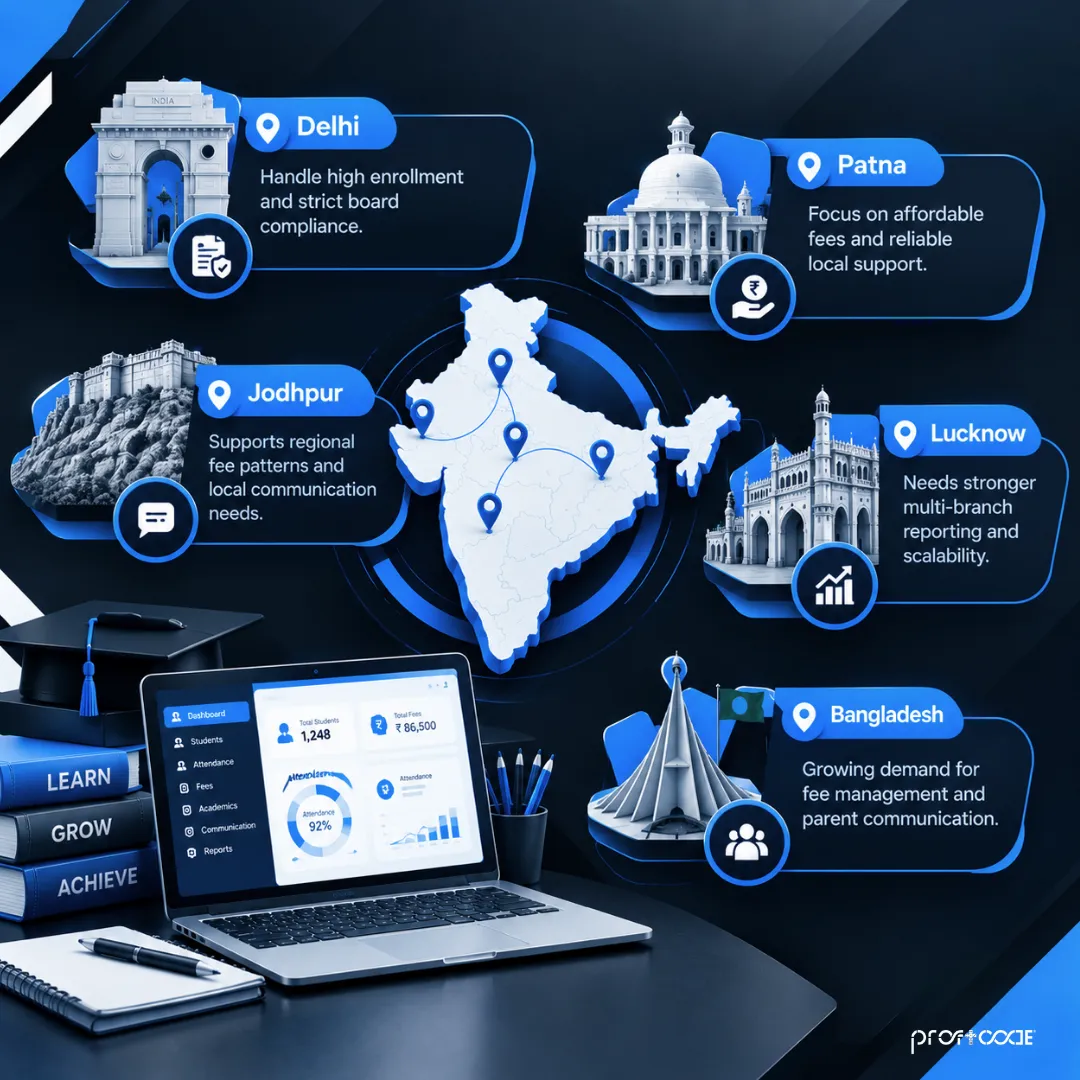
School ERP Software Company in Delhi
Delhi has a dense concentration of schools, so a school management software company in Delhi needs to handle high enrollment volumes along with strict board compliance requirements. Our dedicated guides on choosing an ERP company in Delhi and ERP software for Delhi’s small and medium businesses cover related local considerations worth reviewing.
School ERP Software Company in Patna
Schools in Patna and across Bihar are increasingly adopting digital fee management and attendance systems, often prioritizing affordability alongside reliable local support from a school ERP software development company in Patna.
School Management Software Company in Jodhpur
Jodhpur’s growing private school sector benefits from locally understood systems that account for regional fee collection patterns and communication preferences specific to the area.
School Management Software Company in Lucknow
Lucknow schools, particularly larger institutions, often need stronger multi-branch reporting as the city’s education sector continues expanding across newer localities.
School Management Software Company in Bangladesh
Demand for school management software services is growing steadily across Bangladesh as well, with schools increasingly looking for systems that handle fee management and parent communication in a way that fits local administrative practices.
School ERP Implementation Process and Timeline
Phase | Small School Timeline | Mid-Size or Multi-Campus Timeline |
Requirement Study | 1 week | 2 to 3 weeks |
Process Mapping | 1 week | 2 weeks |
Setup or Development | 3 to 5 weeks | 8 to 12 weeks |
Data Migration | 1 week | 2 weeks |
Testing | 1 week | 2 weeks |
Staff Training | 1 week | 2 weeks |
Go-Live | 1 week | 1 to 2 weeks |
Ongoing Support | Continuous | Continuous |
For a broader understanding of how this process typically unfolds, our complete guide to ERP development services and our resource on ERP development services for small businesses both cover this in more detail, including general principles that apply to school implementations too.
Common Mistakes Schools Make When Choosing ERP
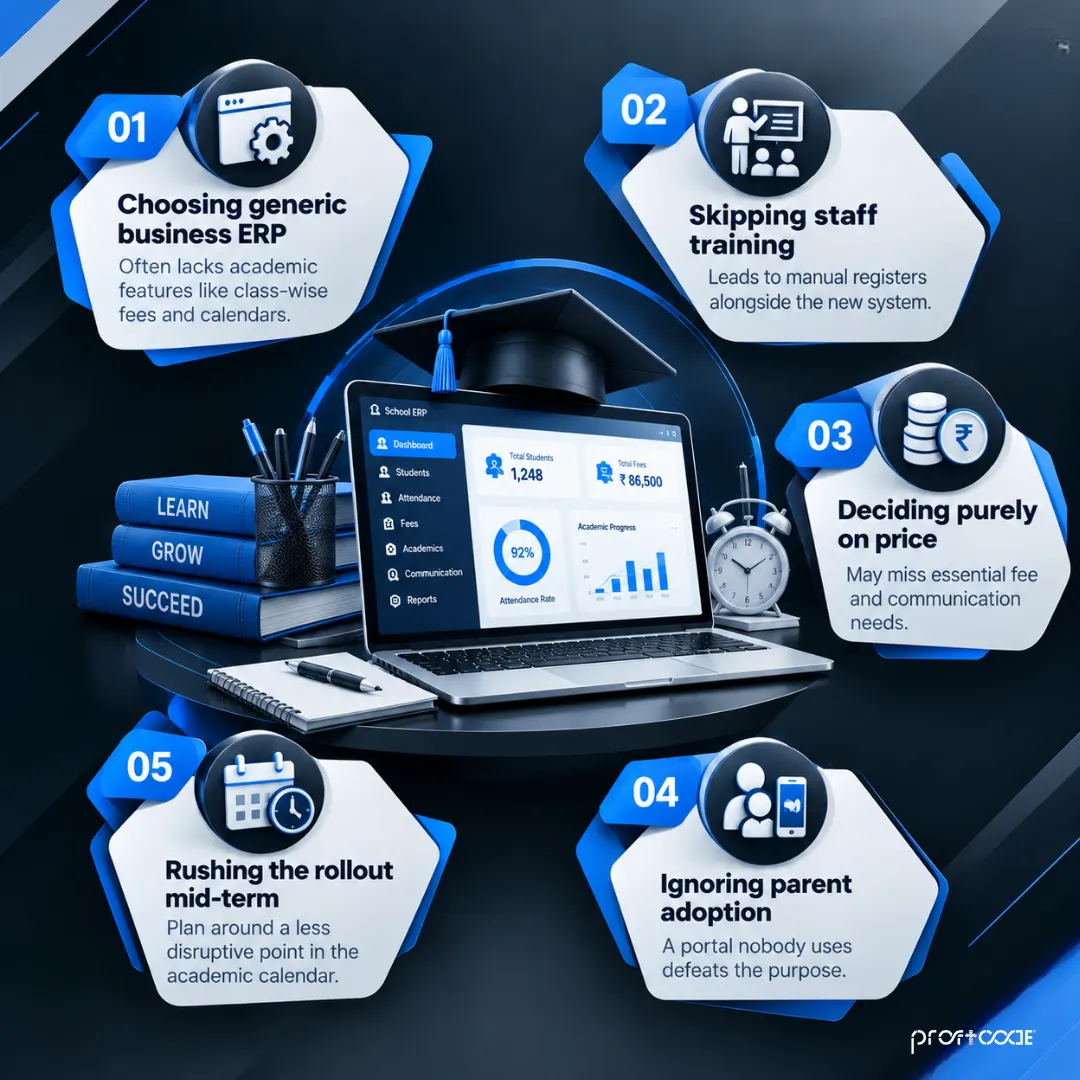
- Choosing generic business ERP that wasn’t built for academic calendars or class-wise fee structures, a pattern we cover more broadly in our piece on signs a business has outgrown generic ERP software
- Skipping proper staff training, which leaves administrative staff still relying on manual registers alongside the new system
- Deciding purely on price, without checking whether the cheaper option genuinely supports the school’s specific fee and communication needs
- Ignoring parent adoption, since a portal nobody uses defeats much of the purpose
- Rushing the rollout mid-term, rather than planning implementation around a less disruptive point in the academic calendar
If several of these mistakes sound familiar from your own evaluation process so far, our broader guide on the top signs a business needs a custom ERP system covers similar warning signs that apply just as much to growing schools as they do to businesses.
How to Choose the Right School ERP Development Company
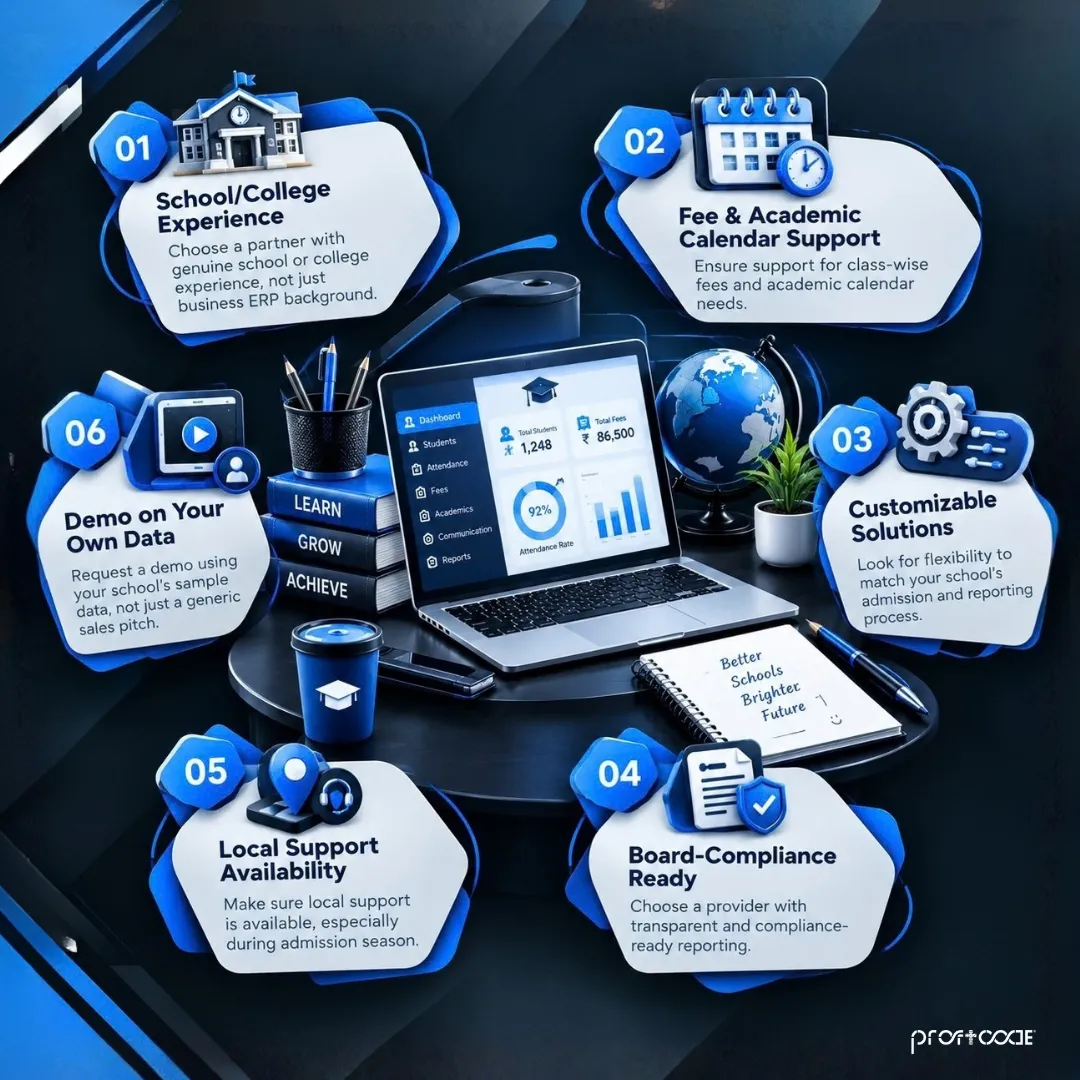
- Genuine experience with schools or colleges, not just general business ERP background
- Clear support for class-wise fee structures and academic calendar requirements
- Willingness to customize around your school’s specific admission and reporting process
- Transparent, board-compliance-ready reporting capability
- Local support availability, especially useful during admission season
- A demo run on your school’s own sample data, not just a generic sales presentation
Future Trends in School ERP for 2026
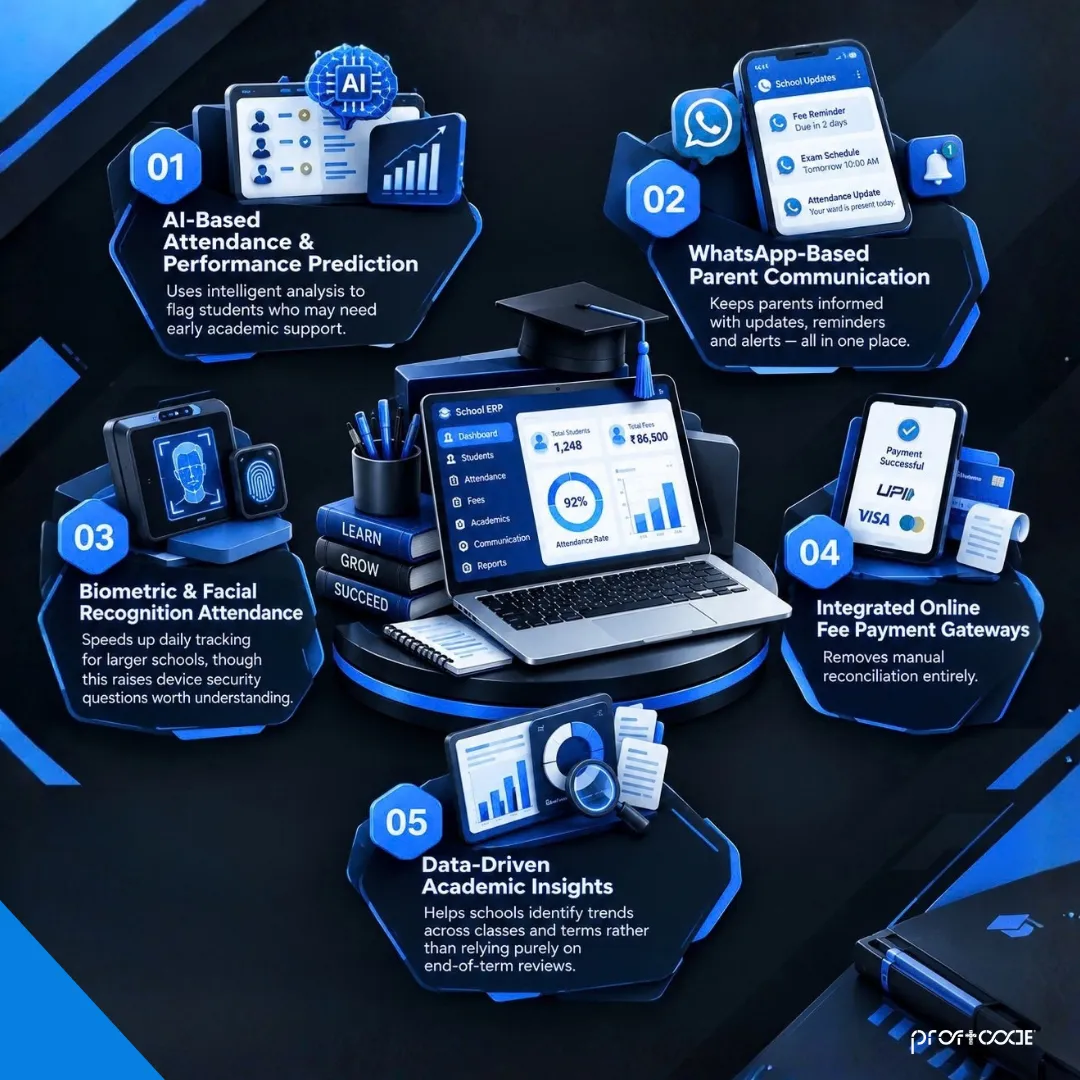
- AI-based attendance and performance prediction, flagging students who may need early academic support
- WhatsApp-based parent communication, reducing dependency on separate apps or physical notices
- Biometric and facial recognition attendance, speeding up daily tracking for larger schools, though this does raise device security questions worth understanding, covered in our piece on IoT device risks and how ERP systems address them
- Integrated online fee payment gateways, removing manual reconciliation entirely
- Data-driven academic insights, helping schools identify trends across classes and terms rather than relying purely on end-of-term reviews
Why Choose Proftcode for School ERP Development

Proftcode builds school ERP systems from the ground up, shaped around how a specific institution actually runs, whether that means a particular fee structure, a multi-campus reporting need, or board-specific compliance requirements that generic platforms weren’t built to handle. Being based in Jaipur means genuine familiarity with how schools across Rajasthan and the wider region actually operate day-to-day, not just generic assumptions applied after the fact. Support continues well past go-live, since a school ERP needs periodic adjustment as enrollment grows and academic requirements evolve. If you’re currently evaluating options, a conversation about your school’s specific administrative needs is a reasonable next step before committing to any platform.
Final Thought
Running a school well shouldn’t depend on how well staff can manually reconcile registers and spreadsheets every single term. The right erp system for school management brings admissions, fees, attendance, and communication into one organized platform, freeing administrative staff to focus on what actually matters, supporting students and teachers rather than chasing paperwork.
If you’re currently evaluating options for your institution, a free consultation with our team can help map out exactly what your school needs before you commit to any platform, custom or otherwise.
Frequently Asked Questions
It’s a connected system that manages admissions, attendance, fee collection, academics, and parent communication for a school, replacing scattered registers and spreadsheets with one organized platform.
Pricing typically ranges from around 50,000 for small schools to 6 lakh or more for large, multi-campus institutions needing fully custom development, depending on modules and customization required.
It depends on your school’s size and specific needs. Institutions with unique fee structures or multi-campus operations often benefit most from a custom-built system, while standard single-campus schools may do well with a ready-made platform.
Yes, ERP software for college setups typically includes additional modules for course and credit management, examination processing across departments, and placement tracking, beyond what standard school ERP covers.
Most school ERP systems include a built-in fee management and accounting module, handling receipts, ledgers, and financial reporting alongside academic and administrative functions.